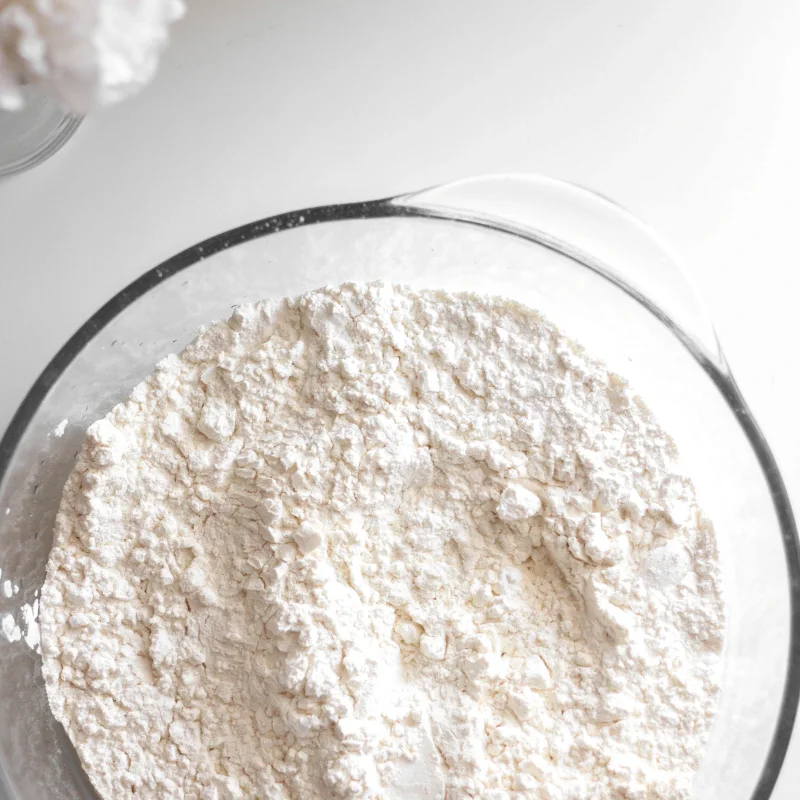
Cornstarch is purified starch extracted from maize. In creams and fruit fillings, sufficient water and heat allow it to thicken the mixture; in wheat-based doughs, replacing some flour with starch reduces the proportion of gluten-forming proteins. In gluten-free baking, it contributes to crumb structure alongside other flours, proteins and binders. Cornstarch is not the same as cornmeal, nor is it a universal substitute for every other starch.
Quick answer: what does cornstarch do?
| Use | Main effect | Most important rule |
|---|---|---|
| Pastry cream or cooked filling | Increases viscosity and helps retain free water | Mix it smooth with cold liquid first |
| Sponge cake, layer cake or biscuits | Dilutes gluten-forming proteins and may create a more tender or crumbly texture | Too much can weaken structure |
| Gluten-free baking | Helps set the crumb as the batter heats | Cannot replace the elastic gluten network on its own |
| Substituting starch | Other starches differ in viscosity, elasticity and cooled texture | Determine the starch's function; a 1:1 swap is not universal |
Four terms that appear on packaging need to be distinguished:
| Label | What it generally means | What to check |
|---|---|---|
| Cornstarch (cornflour in the UK) | Purified starch from maize | Whether the ingredient is pure maize starch or contains additives |
| Food starch | A functional category, not a guarantee of botanical origin | Whether it comes from maize, potato, wheat or another source |
| Gustin | A brand name used for a particular cornstarch product in some markets | The ingredient list; the brand name does not make all food starch maize starch |
| Cornmeal or maize flour | Milled maize containing other parts of the kernel | It behaves differently from purified starch; note that 'cornflour' is ambiguous across English-speaking regions |
Do not substitute cornmeal for cornstarch just because both come from maize. They differ not merely in grind size but also in proteins, fibre and other components of the grain.
What happens to cornstarch when heated?
Raw starch granules do not thicken a cold liquid into a stable cream. With enough water and heat, they absorb water, swell and lose their ordered internal structure. Some starch molecules move into the surrounding water, and viscosity increases. This is starch gelatinisation.
For ordinary cornstarch in laboratory systems with ample water, scientific literature often reports a range of approximately 62–72 °C. This is not a target temperature for every recipe: sugar, fat, acids, proteins and especially the amount of available water alter the onset and development of gelatinisation. A cake batter contains far less available water than a custard, so a laboratory value cannot simply be applied to both.
In practice, check whether the starch has received enough water and heat to perform its structural role, and assess the final texture after cooling. A hot starch-thickened cream can feel quite different once cold.
Where is cornstarch most useful in baking?
Pastry creams and cooked fillings
In pastry cream, cornstarch binds some of the available water and increases viscosity. That helps vanilla cream, cooked fillings and similar preparations hold their shape after cooling.
Disperse the starch evenly in a cold liquid or the cold portion of the recipe first. Adding dry starch straight to hot custard lets the outside of each clump swell before the centre is wetted, trapping dry powder inside. The result can be stubborn white lumps that ordinary whisking will not remove.
Fruit fillings
Cornstarch usually gives a firmer, more opaque filling than some other starches. That may be ideal for a pie slice that should hold together, but less suitable when a very clear fruit glaze is the goal.
Acidity and prolonged heating can change the final gel. Do not keep boiling a highly acidic filling just because it still looks slightly loose while hot. Check the texture after cooling and use a formula designed for that particular starch.
Sponge cakes, layer cakes and biscuits
Replacing part of wheat flour with cornstarch reduces the gluten-forming protein content of the dry mix. Depending on the recipe, that may make the crumb more tender, short or fragile; it does not automatically make a cake moister.
Too high a proportion can weaken the crumb, make it dry or cause the cake to crumble when cut. A short texture may be welcome in butter biscuits but undesirable in a tall sponge. Treat cornstarch as one part of the formula, not a universal improvement, especially when the flour is already soft or the batter is rich in fat and low in liquid.
Gluten-free baking
Cornstarch is one building block of a gluten-free crumb, not a stand-in for gluten. It helps set the structure when heated but cannot create the elastic gas-holding network of properly developed wheat gluten before baking.
Combine it with other gluten-free flours, proteins and suitable binders as the recipe requires. Read more about replacing wheat flour in gluten-free baking and how starch, protein, fibre and binders form gluten-free dough structure.
Cornstarch is not the same as tapioca starch
Both are purified starches, but they behave differently. Tapioca often adds more stretch and chew, while cornstarch generally produces a firmer, less extensible result. This matters especially in gluten-free doughs and chilled gels.
If the recipe depends on tapioca's characteristic elasticity, cornstarch is not a direct substitute. See tapioca starch, cassava flour and suitable replacements.
What can replace cornstarch?
First ask why the recipe includes it. Starch used for thickening custard does a different job from starch used to shorten a biscuit or form part of a gluten-free blend.
| Substitute | A reasonable starting point | What may change |
|---|---|---|
| Potato starch | Strong water binding or part of a gluten-free mix | Viscosity, mouthfeel and texture after cooling |
| Tapioca starch | When stretch or chew is wanted | A more elastic, sometimes chewier texture |
| Rice starch | Short-textured products and some gluten-free blends | May increase dryness or crumbliness |
| Arrowroot starch | Some fruit fillings where clarity matters | Different stability during long cooking and in dairy mixtures |
| Wheat flour | Some cooked creams or sauces when gluten is not a concern | More flour is typically required; the result can be cloudier and more floury |
Do not apply an automatic 1:1 substitution by weight just because two ingredients are white powders. Granule size, amylose-to-amylopectin ratio, swelling and cooling behaviour differ. Similar weights can be a starting point for a small test when starch plays a minor role. If it supports most of the structure, changing it means reformulating the recipe.
How to prevent lumps
- Whisk the cornstarch with some cold liquid from the recipe.
- Stir until completely smooth, with no dry starch at the bottom.
- While whisking, add the slurry to the warm or hot base as directed by the recipe.
- Heat sufficiently for the mixture to thicken and lose its raw, starchy taste.
- Judge the final thickness again once cooled.
If the slurry sits for several minutes, stir it again before using. Raw starch granules settle in cold water; unlike sugar, they do not dissolve.
Common mistakes when using cornstarch
The cream stays runny. There may be too little starch or insufficient water or heat; high sugar, fat or acidity may also alter thickening. Check the recipe before adjusting, and never tip additional dry starch straight into a hot cream. Make a fresh cold slurry if a correction is needed.
White lumps remain. Dry starch probably met hot liquid, or the cold slurry was not smooth. Next time, disperse the starch fully before heating.
The sponge crumbles after adding starch. The flour protein content may have become too low, or the cake may be overbaked. Check doneness first, then reduce the starch in the next controlled test.
A gluten-free crumb is gummy and sticks to the knife. There may be too much starch relative to the flours, liquid and binders, or the bake may not be fully cooled. Assess the crumb only once it has set.
Is cornstarch gluten-free?
Pure cornstarch comes from maize and naturally contains none of the gluten proteins of wheat, rye or barley. However, a packaged ingredient is not automatically suitable for someone with coeliac disease: cross-contact during manufacture and the label of the actual product matter.
For someone with coeliac disease, choose a product clearly labelled gluten-free, and check the other ingredients and work surfaces too. In the EU, a food may use the 'gluten-free' claim only when it contains no more than 20 mg/kg gluten as sold to the consumer.
PEKI recommend: choose the function before the quantity
Most cornstarch problems start with blind substitutions. In one cream, a spoonful might provide a firm slice; in another mixture it merely reduces the proportion of gluten-forming proteins. Before changing a recipe, ask: Is the starch thickening liquid, setting a baked crumb or altering shortness? How much water is available? What texture is needed after cooling?
Weigh changes in grams, vary only one ingredient at a time and assess the outcome after complete cooling. A controlled trial is more useful than assuming every starch works the same way.
Prepared by the PEK.si editorial team according to the PEKI editorial standard.
Diagnostics
Common problems and solutions
White lumps remain in cooked custard.
Cause: Dry starch was added to hot liquid or the cold slurry was not fully smooth.
Solution: Whisk starch into cold liquid first, re-stir just before adding, and pour into the warm base while mixing.
Custard remains too thin even after heating.
Cause: There may be too little starch, available water or heat; sugar, fat and acid can also change thickening.
Solution: Check the method and formula. Never add dry starch directly to hot custard; use a separate cold slurry for any adjustment.
A sponge cake crumbles after some wheat flour is replaced.
Cause: The gluten-forming protein fraction may be too low, or the cake may be overbaked.
Solution: Check doneness first; in the next test reduce the starch fraction and change only one variable.
A gluten-free crumb is gummy and sticks to the knife.
Cause: The starch proportion may be excessive relative to flour, liquid and binders, or the bake may still be warm.
Solution: Assess after complete cooling; if needed, rebalance starch, flours, liquid and binders.
Replacing starch with cornmeal produces a heavier, grainier mixture.
Cause: Cornmeal contains other parts of maize and is not purified cornstarch.
Solution: Use purified cornstarch or treat the change as a new recipe formulation with different dry ingredients and liquid.
Technical terms
Terms worth understanding
- Cornstarch
- Purified maize starch with little protein or fibre, used to thicken and as a functional baking ingredient.
- Cornmeal
- Milled maize containing more of the grain than purified cornstarch; it behaves differently.
- Food starch
- A generic food ingredient designation; the botanical source must be checked on the label.
- Gelatinisation
- A water- and heat-driven change in starch granules that increases the mixture’s viscosity.
- Starch slurry
- Raw starch evenly suspended, not dissolved, in cold liquid.
Frequently asked questions
Answers to common questions
Is Gustin the same as cornstarch?
Gustin is a brand used for a fine cornstarch product in certain markets. It does not mean that every product labelled food starch comes from maize.
Are cornstarch and cornmeal the same?
No. Cornstarch is purified starch; cornmeal includes other components of the maize kernel. Their flavour, water binding and structural effects differ.
Can I replace some wheat flour with cornstarch in sponge cake?
Sometimes, if the formula allows it. The gluten-forming protein fraction decreases, and the crumb may become more tender or crumbly; there is no universal percentage.
What can I use instead of cornstarch?
It depends on its job. Potato, tapioca, rice or arrowroot starch may suit particular tasks, but each changes texture. Similar weights are only a trial.
Is cornstarch gluten-free?
Pure maize starch naturally contains no wheat gluten. For coeliac disease, still choose suitable gluten-free-labelled products and prevent cross-contact.