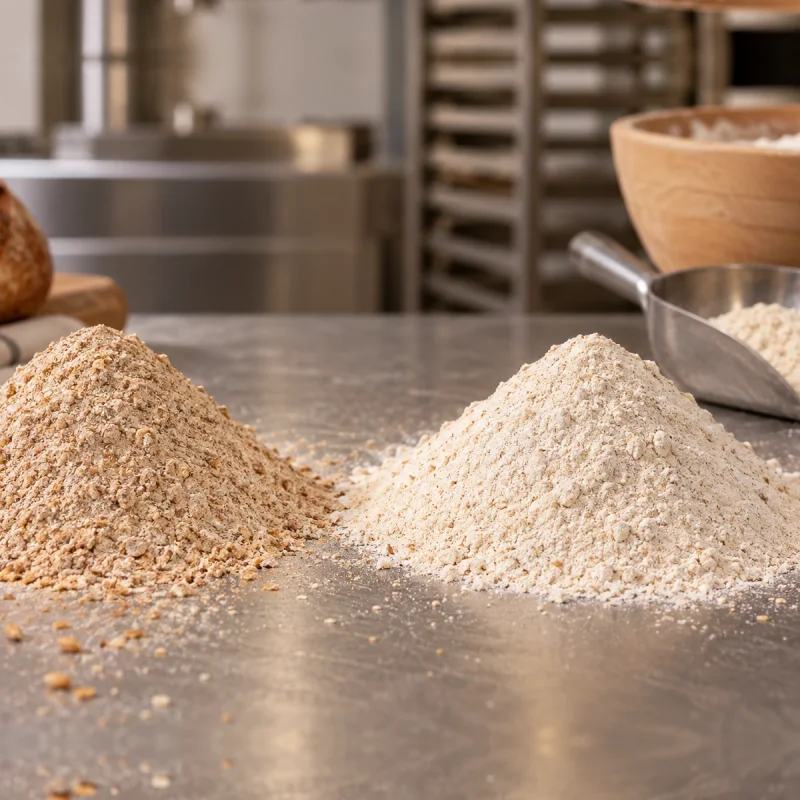
Graham flour and whole wheat flour are not two different grains
The main difference is usually the name and the way, or coarseness, of the milling
Graham flour is a whole wheat flour, or a particular style of whole wheat flour. Both contain components of the whole wheat kernel. Graham flour is usually associated with a coarser particle structure, but actual granulation varies by mill and manufacturer. For baking, do not judge the flour by the name on the bag alone.
In English, graham flour is mainly a North American term. Dictionaries and milling references generally describe it as coarse whole wheat flour or as a whole wheat flour produced so that the bran and germ remain relatively coarse. Whole wheat flour is the broader category: it tells you that the whole wheat kernel is represented, but it does not by itself tell you how fine the flour will be.
The most useful rule is simple:
Graham flour belongs to the whole wheat flour family, but not every whole wheat flour is equally coarse or technically identical to a particular graham flour.
Do not confuse this distinction with flour strength, protein level, ash content, or bread-versus-pastry flour. Those are separate variables. For the broader flour choice, see How to choose the right flour: protein, ash, strength and baking use.
What is graham flour?
The whole wheat kernel is represented, while the texture is usually more pronounced
A wheat kernel consists mainly of the starchy endosperm, bran, and germ. In refined white flour, much of the outer layers and germ are separated during milling. Whole wheat flour retains the components of the cleaned whole kernel in the finished flour.
Graham flour follows the same basic whole-grain principle. In one traditional description, the endosperm is milled more finely while the bran and germ are left coarser, then the fractions are recombined. Other products use graham flour more broadly for coarse-ground whole wheat flour.
That is why it is misleading to assume every bag of graham flour has exactly the same particle size. The manufacturer's specification and the flour you can actually see and feel are more useful for baking than the generic name.
A practical terminology warning: graham flour is not the same as gram flour. Gram flour is chickpea flour; graham flour is wheat flour.
What is whole wheat flour?
“Whole wheat” describes the grain composition, not necessarily particle size
Whole wheat flour is made from the cleaned whole wheat kernel. That means it contains not only endosperm, but also components of the outer layers and germ in proportions characteristic of the whole grain.
The important point is that whole wheat does not tell you how fine the flour feels. Whole wheat flour can be relatively finely milled or distinctly coarse. Particle-size differences can change dough feel, hydration rate, and the final texture of the baked product.
So “Is this whole wheat flour?” and “How coarsely is it milled?” are two different questions.
Graham flour vs whole wheat flour: baking comparison
| Property | Graham flour | Whole wheat flour |
|---|---|---|
| Basic material | whole wheat kernel | whole wheat kernel |
| Bran and germ | present | present |
| Particle size | often coarser and more pronounced | can be fine, medium, or coarse |
| Color and flavor | usually distinctly whole-grain | depend on wheat and milling |
| Water absorption | can be high; evaluate the actual flour | usually higher than refined flour, but not identical across products |
| Effect on gluten | depends on bran, particle size, protein, and process | likewise: “whole wheat” alone does not predict total dough behavior |
| Substitution | often reasonable as a first 1:1 test by weight | often reasonable when both are 100% whole wheat flours |
This table is a working guide, not a laboratory specification. Two whole wheat flours from one mill may behave more similarly than two graham flours from different mills.
Can I substitute whole wheat flour for graham flour 1:1?
1:1 by weight is a sensible starting test; then evaluate the dough
If a recipe calls for graham flour and you have 100% whole wheat flour, a first substitution at the same weight is reasonable for many breads, rolls, muffins, crackers, and similar baked goods. The same principle works in the opposite direction.
But 1:1 by weight does not guarantee identical behavior. Flours can differ in:
- bran particle size;
- wheat variety;
- protein quantity and quality;
- actual water absorption;
- milling method;
- flour freshness.
Do not immediately correct the water based on the first minute of mixing. For yeasted dough, let the mixed dough rest for about 20 to 30 minutes so the flour and bran can hydrate, then reassess consistency. Only then add a little water or flour if needed.
In low-moisture formulas such as some crackers or cookies, a coarser flour may show mainly as a more rustic texture. In bread, it can also affect extensibility and loaf volume.
Why particle size changes dough behavior
Bran changes water distribution as well as the gluten network
Whole wheat dough contains more parts of the kernel than dough made with refined white flour. Bran and fiber bind water, and they also interact with proteins and alter how the gluten network develops.
One important detail is often lost in simplified advice: the effect of particle size does not always move in one direction. Research on whole wheat flour shows that the particle size of bran and flour can materially change water absorption, dough stability, extensibility, and bread volume. The outcome also depends on wheat variety, bran level, and dough process.
So it is too simplistic to say “coarser flour always needs more water” or “finer whole wheat flour always makes better bread.” Watch the specific flour and the specific dough.
Which should you choose for bread?
Choose for the result you want, not just the flour name
For a distinctly rustic whole wheat loaf, graham flour can be an excellent choice, especially when its coarse particles are obvious. It gives a more pronounced whole-grain texture and flavor.
If you want a more even, somewhat finer crumb, finely milled whole wheat flour may be easier to manage. That is not a guarantee: flour strength, hydration, fermentation, and handling still determine the result.
With 100% whole wheat yeasted dough, do not judge the consistency too quickly. The dough may feel stickier immediately after mixing and become noticeably firmer after a rest. If you add a large amount of extra flour right away, the baked crumb can become dry and dense.
Which should you choose for muffins, cakes, and crackers?
Texture often matters more here than differences in rise
Graham flour works well in muffins and quick breads when you want a rustic bite and a strong whole-grain character. Finely milled whole wheat flour can produce a smoother, less grainy texture.
For crackers, a coarser flour may be desirable because the pronounced structure is part of the intended result. In a delicate sponge cake, however, coarse whole wheat flour is a major formula change rather than a simple swap for refined flour.
If the goal is a very light texture, evaluate the whole formula. Whole wheat flour changes not only flavor but also the balance among water, fat, protein, and fiber.
How to tell when the flour substitution needs adjustment
The dough tells you more than the label
The dough is still very firm and difficult to stretch after resting. Increase liquid gradually next time; do not try to force the problem away with excessive kneading.
The dough is still very soft and lacks tension after 20 to 30 minutes. Do not automatically blame the whole wheat flour. Check protein, flour strength, water level, and gluten development too.
The loaf is low and the crumb is dense. Possible causes include excess water, weak flour, poor fermentation, or the structural effect of bran. Simply changing from one whole wheat flour to another may not solve the problem.
The baked product feels unpleasantly gritty. Use a more finely milled whole wheat flour next time, or choose a formula designed for a coarser whole-grain texture.
For the underlying structure, see How the gluten network forms: dough elasticity and extensibility.
What to check on the bag before buying
With graham and whole wheat flour, the specification matters more than the marketing name
Check:
- whether the product is actually whole wheat flour;
- whether the manufacturer describes it as coarse or fine milled;
- the protein content if you plan to use it for bread;
- the manufacturer's recommended uses;
- whether the recipe needs a particular flour for texture or simply for whole-grain composition.
If one bag says graham flour and another says whole wheat flour, that does not automatically mean the flours will behave dramatically differently. They may still differ enough to require a hydration or texture adjustment.
The shortest answer
Graham flour is a type or traditional style of whole wheat flour, usually associated with a coarser grind. Whole wheat flour can be milled more finely or more coarsely. When substituting, begin 1:1 by weight, let the dough hydrate, and then adjust liquid according to the actual flour's water absorption.
Diagnostics