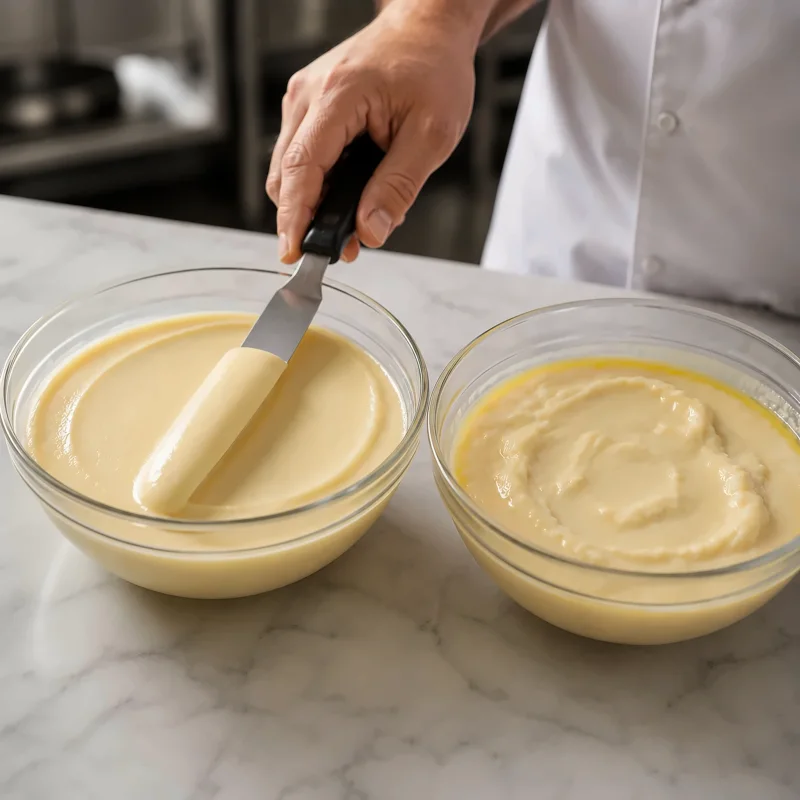
The same fat percentage can produce a different texture
Two creams can contain a similar percentage of fat and still behave completely differently. What matters is how much of the fat is solid at the working and serving temperature, how it crystallises, and whether it forms a plastic network, a liquid phase, or part of an aerated foam.
Butter, liquid oil, cocoa butter and milk fat are therefore not interchangeable versions of one ingredient.
Start with the job the fat has to do
Before swapping a fat, ask whether it needs to trap air, tenderise crumb, provide a clean slice, separate layers or melt quickly in the mouth. Plastic butter can hold tiny air cells during creaming. Liquid oil cannot reproduce that mechanism directly, although it can keep many cakes softer after chilling. Cocoa butter creates a firmer crystal network. In whipped cream, part of the milk fat must be crystallised so a load-bearing network can form around air bubbles.
Butter and oil are not a simple 1:1 swap
Butter contains water and milk solids as well as milk fat; liquid oil is almost entirely fat. Technique matters even more. If a recipe is built around creaming butter and sugar, the plastic fat phase is part of the aeration system. Replacing it with oil changes the structure, not just the flavour.
Oil can work extremely well in cakes whose volume comes mainly from egg foam or chemical leavening, and it often keeps crumb softer at lower temperatures.
Solid fat supports; liquid fat stays soft
A larger solid-fat fraction can give a filling a cleaner slice and more resistance to deformation. That is not automatically better. If too much fat is still solid at serving temperature, the texture can feel cold, hard or waxy. A very liquid fat phase can melt beautifully but may not provide enough support for piping or a tall filling.
Judge a cream at the temperature at which it will actually be eaten, not only straight from the refrigerator.
Cocoa butter builds a different crystal network
Cocoa butter has a distinct crystallisation behaviour that controls chocolate firmness, snap and melt. In creams and fillings it can increase firmness and slicing quality, but too much or serving too cold can make the mouthfeel harder. If the problem is separation between water and fat, that belongs to dessert emulsions and split ganache, not simply to the amount of cocoa butter.
Whipped cream needs partial coalescence
Before whipping, cream is an emulsion of fat globules in a water phase. During whipping, controlled partial coalescence is necessary: partly crystallised fat globules connect around air bubbles and build a foam network. If the fat is too liquid, that network is weak. If whipping continues too long, aggregation progresses and the system moves toward butter. See the guide to stabilising whipped cream for the practical control points.
Five questions before changing a fat
- Does the formula use fat for creaming and air retention?
- Should the finished product stay soft or firm after chilling?
- Is a clean slice more important than a soft crumb?
- At what temperature will the dessert be served?
- Is the fat working inside an emulsion, foam or crystal network?
If the swap changes one of those answers, you are changing the formula, not merely substituting an ingredient.
Frequently asked questions
Answers to common questions
Why does an oil-based cake often stay softer after chilling than a butter cake?
Many vegetable oils remain liquid at refrigerator temperatures while a larger fraction of milk fat becomes solid. The crumb can therefore feel softer with oil even when it does not contain more water.
Can I replace butter with oil 1:1?
Not as a general rule. Butter contains water and milk solids and is plastic within a useful temperature range; oil is almost entirely fat and liquid. The swap changes both composition and the way the batter holds air.
Why does cocoa butter firm a cream more than liquid oil?
Cocoa butter forms a substantial solid crystal phase at typical room temperatures. Liquid oil does not form the same crystal network, so it cannot provide the same firmness or clean slice.
Why should whipping cream be cold?
Cold conditions leave part of the milk fat crystallised. Those crystals help controlled partial coalescence of fat globules around air bubbles during whipping.