First identify which system is carrying the dessert
The same symptom can come from the sponge, the cream or the cake assembly
When a slice bulges at the cut, the sponge crumbles or the filling slips outward, changing the whole recipe is usually the wrong first move. Start by identifying the failed system. In a baked batter, support develops as the mixture heats and sets; in a cream it may come from a foam, emulsion, gel or fat network; in an assembled cake, the layers must also carry weight, survive slicing and tolerate temperature changes.
Structure is the dessert's internal construction. Texture is how that construction feels — light, creamy, springy, brittle, dry, rubbery or grainy. Stability tells you whether the intended structure survives chilling, slicing, transport and serving.
If the cream is runny, grainy or already slumping in the bowl, start with stable creams and mousses. If whole layers move or filling is being squeezed out, check layer-cake stability. If the sponge is dry, sticky or heavy after cooling, also look at moisture control in cakes.
That is the key diagnostic split: system first, symptom second, correction third.
Sponge cake: trapped gas must survive until the crumb sets
In foam-based sponge, volume is created before the oven but stability is built during baking
In a sponge based on egg foam, air is part of the structure. As the batter heats, gas bubbles expand while the fluid batter has to turn gradually into a strong enough porous crumb. Starch gelatinization and protein denaturation/coagulation are central to that transition, while water, sugar, fat and the rest of the formula determine when and how quickly it happens.
With proper egg whipping, do not chase volume alone. The foam must be dense and even enough to keep much of its trapped air during folding. If the batter is already thin and weak before baking, the risk of a low or flat sponge is higher.
Sugar is not only a sweetener in this system. It changes water availability and affects the temperature course of starch gelatinization and protein setting. Changing the amount of sugar can therefore change volume and texture as well. The relationship is explained in more detail in how sugar stabilizes sponge cake. A broader guide to sugar types may be available separately in PEK when the localized target is published.
If the formula uses invert sugar, do not treat its effect as extra sweetness only. The guide to invert sugar in pastry explains its role in crystallization, water binding and formula balance.
Fold flour only as much as the formula requires and avoid unnecessary mixing. Rough or prolonged folding can drive air out of the foam; too much flour changes the balance of liquid and dry matter and often produces a denser, drier crumb. If that keeps happening, check too much flour in sponge cake.
A good sponge is not necessarily the tallest one. For layer cakes, a more useful goal is an even crumb with enough support to survive cooling, slicing, soaking and the weight of the filling.
Why sponge cake can collapse after baking
Post-bake collapse is not one single problem. The centre may not have set strongly enough, but a similar result can also come from weak foam, an imbalanced formula, excessive leavening or a baking profile in which the outside sets long before the centre.
Crust colour is therefore not enough. Judge doneness from the recipe and several signals together: spring-back under gentle pressure, the state of a skewer or probe and, where the formula provides a justified target, a centre-temperature check. If the cake rises well but sinks markedly while cooling, use the dedicated guide to why sponge cake sinks after baking.
Oven conditions also affect evaporation and surface setting. Treat oven humidity and sponge structure as one part of the overall process, not as a universal trick for extra volume.
Cream: smoothness, aeration and load-bearing strength are different properties
First identify whether the structure is carried by foam, emulsion, gel or fat
A cream can be smooth and delicious yet still be unsuitable as a load-bearing cake layer. Conversely, a sufficiently stable cream can stay soft and pleasant to eat. The useful question is not “How do I make it as firm as possible?” but “What does this cream need to hold in this dessert?”
In whipped cream, air is held by a network involving air bubbles, milk proteins and partially coalesced fat globules. Temperature and cream composition strongly affect whipping, but there is no sensible single temperature for every product and mixer. For a practical method, use the dedicated guide to stabilizing whipped cream and follow the behaviour of the actual cream you are using.
More whipping does not increase stability forever. When a smooth sheen turns dull and grainy and liquid or fat starts to separate, the structure is already breaking down.
In emulsion-based creams, warning signs include a greasy film, graininess or a separated watery phase. Failure does not always have one cause: phase ratio, temperature, rate of addition and mechanical work all matter. Use the troubleshooting guide to emulsions in desserts rather than simply whipping harder.
Fat affects spreadability, melting sensation and support, but more fat does not automatically mean better texture. The relationship between solid and liquid fat phases is covered in the role of fat in dessert texture. For the link between structure and aroma release, see also how to strengthen aroma in bread and desserts.
Cake assembly: the weakest part of the cross-section determines stability
A good cream cannot compensate for the wrong load between layers
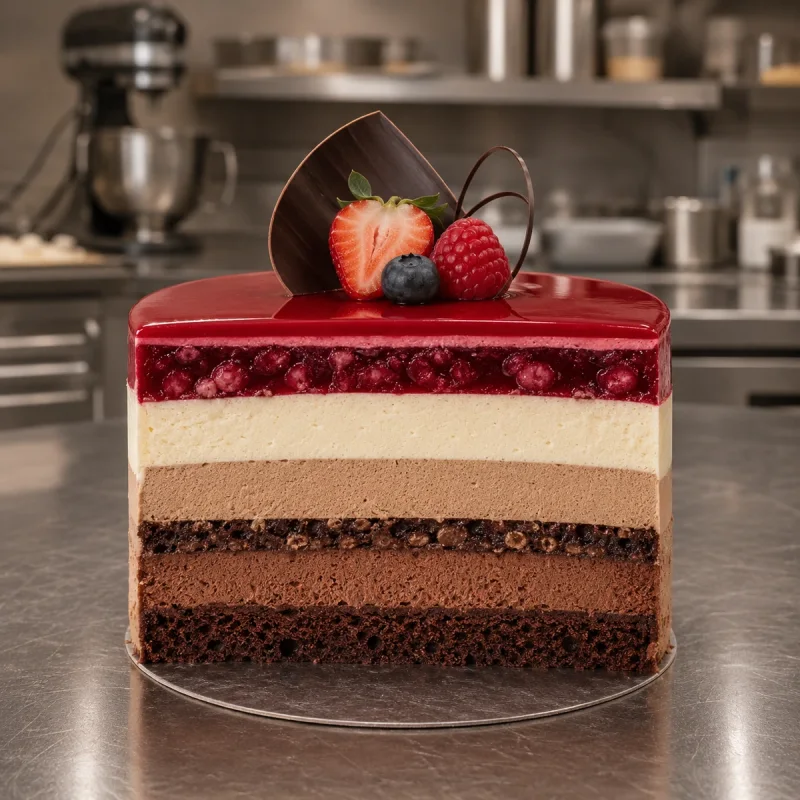
A cake can lean or bulge even when the sponge and cream are each good on their own. Once the layers are assembled, a new mechanical system is created: sponge carries part of the weight, cream connects the layers, fruit inserts add water, and chilling changes the firmness of fats, gels and other structures.
Cool the sponge fully enough before assembly. A warm layer can soften a fat-based cream and reduce its load-bearing capacity. An extremely cold, rigid cream is not automatically ideal either if spreading it tears a delicate crumb. The goal is to match the components mechanically and thermally for the actual cake.
With a looser fruit filling, limit the layer thickness and, when appropriate, contain it with a ring or dam of a stronger cream. If the edge slowly spreads after the ring is removed, a bulge forms between cake layers, or the empty space starts to close after a slice is removed, the problem lies in layer design and load-bearing capacity — not in the look of the outside coating.
A more detailed guide to thickness, support, chilling and clean slices is available in layer-cake stability when that localized target exists.
Moisture: juiciness requires water to be bound and distributed correctly
A wet centre is not the same thing as a moist sponge
Water enables dissolution, hydration and starch gelatinization and strongly affects crumb softness. But final texture depends not only on total water: it also matters how much water is bound in the structure, how much remains free and how it moves between layers during storage.
A properly moist sponge is soft and springy, not pasty-sticky. If the crumb compresses into a sticky mass after cooling, leaves a dense wet mark or develops a sunken band near the centre, first check doneness, liquid level, ingredient balance, pan size and actual oven performance. Do not automatically add more flour.
Do not taste raw or clearly underbaked batter as a diagnostic test. Raw flour and eggs can carry pathogens; use the baking process, crumb structure and other safe control signs instead.
The wider balance between water, sugar, fat, baking and later moisture migration is covered in the guide to moisture in cakes.
Quick diagnosis: let the symptom point to the right system
| What you see | Check first | First sensible action |
|---|---|---|
| Sponge is low and finely dense | amount and stability of incorporated foam, folding method | check whipping stage and batter handling before baking |
| Sponge rises, then sinks | crumb setting, formula balance and baking profile | check doneness and formula balance, not crust colour alone |
| Cream turns grainy or greasy | foam or emulsion and its temperature state | stop mechanical work and identify the type of breakdown |
| Liquid separates from the cream | which mechanism should be holding the water | correct the foam, emulsion or gel according to the actual cream |
| Cake bulges between layers | load-bearing strength, thickness and temperature of layers | reduce the load or choose a better-suited layer structure |
| Sponge is wet and sticky | doneness, liquid level, pan size and oven | check the process first; do not add flour blindly |
When troubleshooting, change one main variable at a time
If you change temperature, flour amount, whipping time, stabilizer and chilling at the same time, the next result will not tell you what actually fixed the problem. On the next attempt, choose one critical point: batter aeration, dry-to-liquid balance, final doneness, emulsion state, layer thickness or chilling.
Write down what you changed and observe the same control sign as before. That turns dessert structure into something you can diagnose and control — not something you merely hope will hold.
Diagnostics
Common problems and solutions
The sponge is low and finely dense.
Cause: Too little stable incorporated air or too much air loss while folding the flour.
Solution: Correct air development and retention first; do not add more leavening blindly.
The sponge rises in the oven and then sinks after baking.
Cause: The centre may not have set strongly enough, or the formula and baking profile may not support the expanded structure.
Solution: Assess doneness and formula balance with several control signs; crust colour alone is not enough.
The cream turns grainy or greasy, or starts releasing liquid.
Cause: The supporting foam, emulsion or another structural system is beginning to fail.
Solution: Stop mechanical processing and use the specialist troubleshooting method for that specific cream.
The cake bulges after the ring is removed or the layers begin to move.
Cause: One layer has insufficient load-bearing capacity for its thickness, free water or serving temperature.
Solution: Reduce the load or use a more suitable layer structure; an outer coating will not repair the internal failure.
After cooling, the sponge is wet and pasty-sticky.
Cause: The centre may be underbaked, the liquid balance may be too high, the pan may be mismatched or the oven may not be delivering the expected heat.
Solution: Do not automatically add more flour; first determine whether the problem is process-related or formula-related.
Technical terms
Terms worth understanding
- structure
- The internal physical construction of a dessert: how air, water, proteins, starch, fat and other components are organized and connected.
- texture
- How that structure is experienced during cutting, chewing or spreading — for example light, creamy, springy, brittle or grainy.
- stability
- The ability of a dessert to retain the intended structure and texture during chilling, storage, slicing, transport and serving.
Frequently asked questions
Answers to common questions
Does a firmer cream always make a dessert more stable?
No. Stability depends on the cream’s job and its supporting mechanism. A plated cream can intentionally be softer, while a load-bearing cake layer must carry more weight at the actual serving temperature.
Why can a sponge look nicely browned while the centre is still unstable?
Surface browning develops differently from the internal structure. The crumb must build enough starch and protein structure during baking, so crust colour should never be the only doneness signal.
How do I recognize a broken emulsion in a cream?
Common signs include a greasy film, graininess or a separated watery phase. Because the same symptom can have several causes, also check temperature, phase ratio and mixing method.
How do I distinguish a moist sponge from an underbaked one?
A moist sponge is soft and springy after cooling, not pasty-sticky. If the centre seems underbaked, check the recipe, doneness and process; do not taste raw batter as a test.
What is the best first step when a dessert loses its shape?
First identify whether the baked component, the cream or the assembled layers failed. Only then choose one main variable to change on the next attempt.