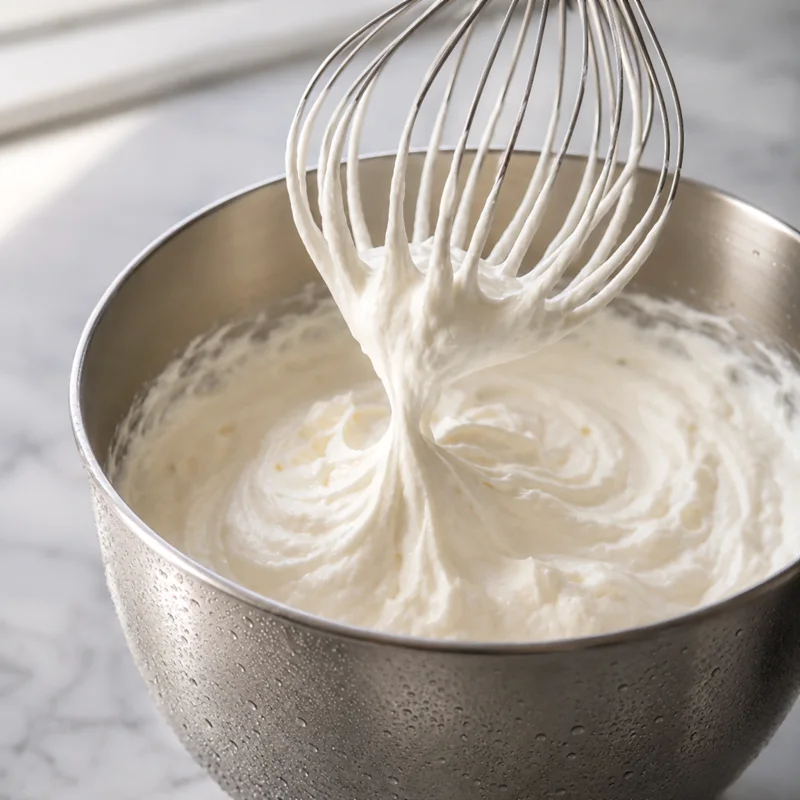
Decide what the cream has to do before you whip it
Whipped cream for a glass dessert, a layer-cake filling, and a piped rosette do not need the same firmness. Beating every batch until it is “as stiff as possible” often works against you: the cream loses its smoothness, becomes more prone to graininess, and gives you less time for clean spreading or piping.
Choose the endpoint first. Soft peaks are useful when the cream will be folded into a mousse. Medium peaks work well for fillings and coatings. For piping, the peak should hold clearly while the surface still looks smooth rather than dry or greasy. Extra stabilization becomes useful when the cream must carry weight, keep sharp definition for hours, or survive transport.
Cold fat builds the framework around air
Whipping turns cream into a foam. Air is dispersed through the liquid phase while partially coalesced milk-fat globules help form a network around the bubbles. That is why cold cream is easier to whip into a stable structure: enough of the fat remains solid enough to build that framework.
Start with cream straight from the refrigerator. In a warm kitchen, chilling the bowl and whisk can give you more working margin. There is no single magical temperature that fits every product, but the cream should stay cold while you work and the texture should guide the decision.
Cream around 30% fat can whip, but it gives you less margin for tall fillings and piping. Around 35% fat or higher is usually more forgiving and produces a fuller, more stable foam. Higher fat is not a guarantee, though: warm or overwhipped cream can still fail.
Stop by texture, not by the clock
At soft peaks, the tip bends over quickly and the cream remains flexible enough to fold. At medium peaks, whisk trails stay visible while the cream still spreads smoothly under a spatula. At stiff peaks, a piped shape should hold without the surface looking dry, curdled, or oily.
Once the cream turns grainy, dull, or develops a greasy film on the side of the bowl, you are not gaining useful stability anymore. The fat is aggregating too far toward butter. If the change is only slight, a small amount of cold liquid cream can sometimes be folded or whisked in gently to smooth it. Once fat and liquid have clearly separated, reliable recovery to smooth whipped cream is unlikely.
Choose a stabilizer for the mechanism you need
Plain whipped cream is enough for many desserts served soon after preparation. A stabilizer becomes useful when you need longer holding time, cleaner slices, taller layers, or decorations that must stay defined during storage or transport.
Gelatin creates an additional gel network in the water phase. The amount is not universal because Bloom strength, gelatin format, other ingredients, and desired firmness all change the result. For 500 g of cream, roughly 2–4 g can be a practical starting range for light to medium stabilization, but it is not a fixed formula. For hydration, melting, and temperature-shock problems, see the PEK guide to using gelatin in mousse and desserts.
Bloom the gelatin correctly and melt it gently. Then temper it with a small portion of softly whipped cream before combining it with the main batch. Pouring hot gelatin straight into very cold cream can create strings or small gelled particles.
Mascarpone works differently. It adds fat, milk proteins, and body, making the cream denser and richer rather than creating the same gel network. It is therefore not a one-for-one substitute for gelatin. Commercial stabilizers based on starches or other hydrocolloids should be used according to their own formulation and instructions.
Filling, frosting, and piping need different endpoints
Cream served in a glass can stay softer because the container supports it. A layer-cake filling needs enough body that it is not squeezed out by the cake above it, but it should not become rubbery when sliced. Piped decoration should keep its ridges and peak without cracking or crumbling.
Fruit purée, syrup, and other water-rich additions change the balance of water and solids. Do not assume that the same stabilizer dose will behave identically in plain whipped cream and in a fruit or cheese-based cream.
Chilling should set the structure, not hide a mistake
After assembling the dessert, refrigerate it until the cream is cold and stable through the full thickness of the layer. A universal rule of four or six hours does not fit every dessert. A thin coating without gelatin behaves very differently from a thick stabilized layer in a tall cake.
With gelatin, the network needs time to set. With correctly whipped cream alone, the main job is to keep the fat structure cold until serving. At slicing, look for a clean cut and a filling that stays inside the layer instead of being pushed out.
PEKI recommend this order: purpose → enough fat → cold preparation → correct whipping stage → stabilizer only if needed. That gives you the lightest structure that still does its job, instead of relying on unnecessary amounts of binder.
Frequently asked questions
Answers to common questions
Why does whipped cream collapse or start weeping?
Common causes include cream that is too warm, insufficient fat for the required use, under- or overwhipping, and too little structural support for the holding time or load.
How much fat should cream have for a cake?
Cream around 30% fat may whip, but it is less forgiving for tall fillings and piping. Around 35% or more usually gives a more reliable fat network when the cream is cold and whipped correctly.
How much gelatin should I use for 500 g of cream?
There is no single correct amount. Roughly 2–4 g per 500 g cream can be a useful starting range for light to medium stabilization, but adjust for Bloom strength, other ingredients, and the required firmness.
Can overwhipped cream be fixed?
If it is only slightly grainy and has not separated, a small amount of cold liquid cream can sometimes be worked in gently. Once fat and liquid clearly separate, reliable recovery to smooth whipped cream is unlikely.
Does a whipped-cream cake always need four or six hours of chilling?
No. The cream must be cold and stable through the full thickness of the layer; the required time depends on layer thickness, recipe, stabilizer, and starting temperature.