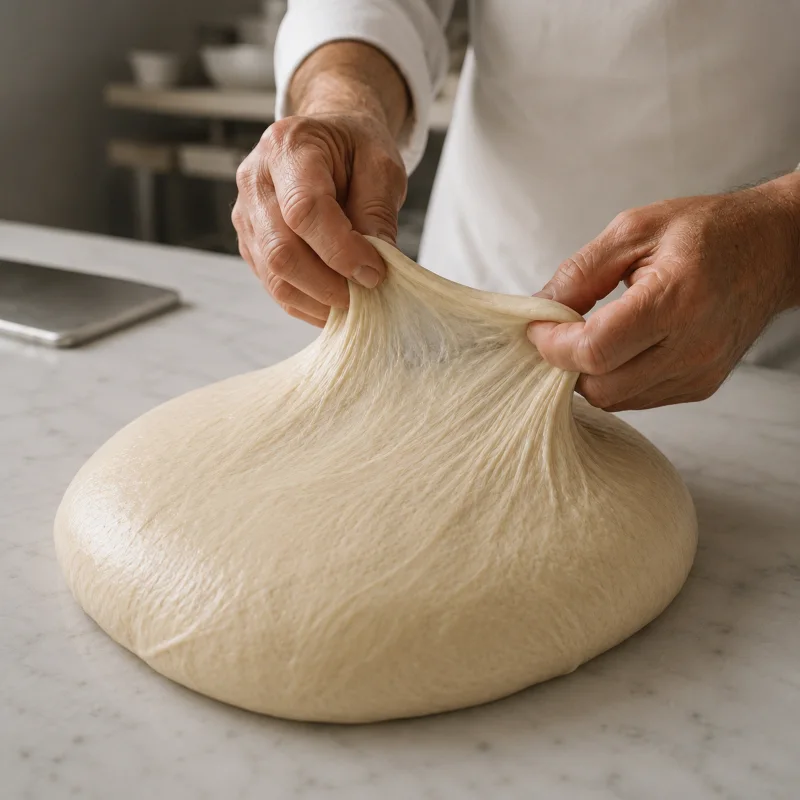
When dough feels greasy under your fingers, the structure is already out of balance
Why fat and liquid are not simple substitutes for each other
When dough no longer feels resilient but slides softly across the work surface, the problem is usually not simply “too much liquid”. It is often the balance between water, fat and flour: water lets proteins and starch hydrate, while fat partly slows that contact, coats flour particles and tenderises the bite. The foundation for understanding this is dough structure, flour, hydration and gluten development, because a good crumb is created by the interaction of ingredients rather than by one ingredient alone. Proper dough resists the hand and then yields; the surface is smooth rather than oily, and the baked crumb is even without a heavy compact band at the bottom.
Fat in dough is not just flavour. It is a brake, a tenderiser and a barrier.
If there is too much fat for the available liquid and structure, dough becomes shorter, more crumbly and less able to retain gas. If there is too much liquid for the flour’s capacity, the dough loses support, sticks and can bake into a dense or gummy crumb. Blindly adding flour is not the right answer because it changes the whole formula. First decide whether the dough is too fatty, too wet, or simply has not rested long enough.
Water builds the network; fat softens it
What happens in flour when liquid is added
When flour meets water, proteins begin to hydrate and form the basis of a gluten network. Starch absorbs water at the same time, so the mixture often moves from rough to more cohesive. In doughs with more fat this process is slower because fat coats part of the flour and reduces direct contact with water.
That is why the order of addition in enriched doughs such as brioche, sweet yeast breads or milk dough is structural, not cosmetic.
For yeasted dough, first combine the liquid with the flour and allow an initial hydration period of 15–25 minutes. Add most of the soft fat afterwards. This gives the flour time to bind water before fat coats it. If a large amount of fat goes in too early, the dough can stay smeary for longer, develop elasticity more slowly and rise less efficiently.
It also helps to understand how flour absorbs water, because different flours do not accept the same amount of liquid. Strong bread flour can usually carry more water than weaker cake flour. Whole-grain flour may feel dry at first and then absorb more water during rest because of bran and fibre.
When there is too much fat in the dough
A greasy surface does not automatically mean a properly enriched dough
If the dough shines like an oiled surface and leaves a film on your hands, the fat is either not well incorporated or there is more than the current structure can support. Such dough often breaks in short, soft tears instead of stretching. In the oven the edges may colour quickly while the crumb remains heavy because a weakened network retains less steam and fermentation gas.
Well-incorporated fat should not appear as an oily layer. The dough feels soft but still has tension; when pulled, it stretches into a thinner sheet before giving way. The surface is smooth, not slippery.
With enriched yeast dough, stop adding flour first. Rest the dough for 10–20 minutes so liquid can redistribute and the flour can continue binding it. If the dough is still greasy and refuses to come together after the rest, add flour in small steps of 2–3% of the flour weight in the formula. With 500 g flour, that is 10–15 g flour at a time. After each addition, mix only until the dough reconnects.
Do not use the same correction for shortcrust pastry. There, fat intentionally creates shortness, so excess flour can quickly make the texture hard and dry. If shortcrust pastry becomes too greasy, chill it for 20–30 minutes first, then work on a cool surface.
Do not skip this check. A fatty dough defect may only become obvious after proofing, when the dough spreads, the surface softens and the crumb loses height.
When there is too much liquid in the dough
Sticky dough is not necessarily wrong dough
High-hydration dough can be sticky and still be completely correct. The difference is resistance. A well-hydrated dough may stick, but it pulls back and remains coherent when stretched. Dough with more liquid than its structure can carry flows, tears without useful tension and smears under a dough scraper like thick cream.
Crust colour can mislead you.
A dough may brown attractively outside while remaining wet and compressed inside if the flour cannot bind the added water or the gluten network is underdeveloped. For bread and yeasted dough, use rest first, then kneading or a controlled series of stretch-and-folds. In soft cake batters, reduce the liquid in the next batch by 5–8%, not by a third; an aggressive correction creates a dry, brittle product that stales quickly.
If dough seems suspiciously soft just after mixing, do not immediately throw in a large amount of flour. Leave it for 15 minutes. If it noticeably firms during that time, delayed hydration was part of the issue rather than a faulty formula. This is exactly why resting dough is one of the cheapest and most precise diagnostic steps for this kind of problem.
The balance changes with the type of dough
Yeast dough, shortcrust and cake batter cannot use the same logic
In yeast dough, liquid supports extensibility while steam and fermentation gases contribute to lift. Fat tenderises the crumb but, at high levels, can slow network development. The goal is a supple dough that releases from the bowl yet remains soft to the touch. If the dough overheats during mixing, butter begins to melt and lubricate the structure; for enriched yeast dough, a working dough temperature around 24–26 °C is generally a useful target.
Shortcrust uses the opposite logic. Fat deliberately limits gluten development to create a tender, crumbly texture. There should be only enough liquid for the crumbs to press together into a mass. Too much water makes the pastry shrink and become hard after baking; too little makes it fall apart during rolling.
In sponge and mixed cake batters, fat affects tenderness and perceived moistness, while liquid influences water content and starch gelatinisation. Too much fat can weaken a foam; too much liquid can lengthen baking and leave a wet band near the base. Do not try to rescue these batters with aggressive mixing. Mix only until combined, because overmixing develops structure where tenderness is the goal.
How to correct a formula without destroying texture
Small changes in dough are stronger than they look
Dough problems are rarely solved by large corrections. If you add 50 g flour to bread dough only because it sticks, you may turn a supple crumb into a dry, heavy loaf. If you remove too much liquid from cake batter, the slice may look neat but taste lean and dry.
Change one thing at a time.
For bread and yeasted dough, adjust liquid by 3–5% relative to flour weight. With 500 g flour, 5% liquid is 25 g, already enough to feel clearly different by hand. In enriched dough, do not reduce fat blindly; first control dough temperature, rest and the order in which ingredients are added. Only if the dough still looks greasy, spreads and rises poorly after those checks should you reduce fat in the next batch by about 5%.
Shortcrust needs a different correction: add liquid in 5 g increments, and do not reduce fat just because the dough feels soft. Chill it first. For sponge and mixed batters, do not rescue the mixture with extra flour at the last minute because tenderness is easily lost. More accurate liquid weighing, shorter mixing and correct ingredient temperature are better corrections.
PEKI recommend recording flour, liquid and fat weights, dough temperature and rest time whenever you make a correction. Without those values the same fault easily returns, because the process may appear identical while three variables have actually changed.
If you need to improve texture without a major formula change, first fix rest, temperature and order of addition. Change quantities only afterwards. A good dough is often decided by the difference between 20 g water and 10 minutes of rest.
Practical signs of correct balance
The dough should tell you what it needs
Balanced dough does not have to be dry, firm or completely non-sticky. Bread and pizza dough may feel slightly tacky, but the mass should hold tension when stretched. A chilled shortcrust dough should keep its shape without crumbling into dry sand under pressure. A cake batter should fall in a ribbon rather than in lumps or like water.
The balance between fat and liquid is first visible in movement: water gives stretch, fat gives tenderness and flour gives resistance. When one part dominates, the fault often appears before baking as an oily film, spreading, tearing or dry crumbling.
Flour is not merely the background of the recipe. It determines how much liquid the dough can carry before spreading and how much fat it can tolerate before losing grip. Bread, pizza and enriched yeast dough need flour that can hold more water and withstand mixing; sponge cakes and shortcrust need a more delicate structure. The guide to choosing the right flour is useful here because the wrong flour changes dough behaviour before the first process mistake is made.
Next time dough feels wrong, do not look only at whether it sticks. Watch how it moves. If it stretches and springs back, it needs time or structural development; if it flows, the liquid exceeds what the chosen flour can support; if it leaves an oily film, the fat is no longer in balance.
Frequently asked questions
Answers to common questions
Can I always fix overly wet dough by adding flour?
No. Rest it first because flour often needs time to absorb and redistribute water. Add flour only if the dough still spreads and has no useful tension after 15–20 minutes.
Why is butter added gradually to enriched yeast dough?
Gradual addition lets the flour hydrate and begin building structure first. If a large amount of fat is added too early, gluten develops more slowly and the dough can remain greasy and smeary.
How do I know when the dough is properly balanced?
It may be slightly tacky, but it stretches with resistance, does not leave an oily film and does not tear immediately. After baking, the crumb should be even rather than heavy and damp at the base.
Do eggs count as liquid or fat?
They contribute both: egg white contains a great deal of water, while the yolk supplies fat and emulsifiers. When adjusting a formula precisely, treat eggs as an ingredient that affects hydration, tenderness and structural stability.