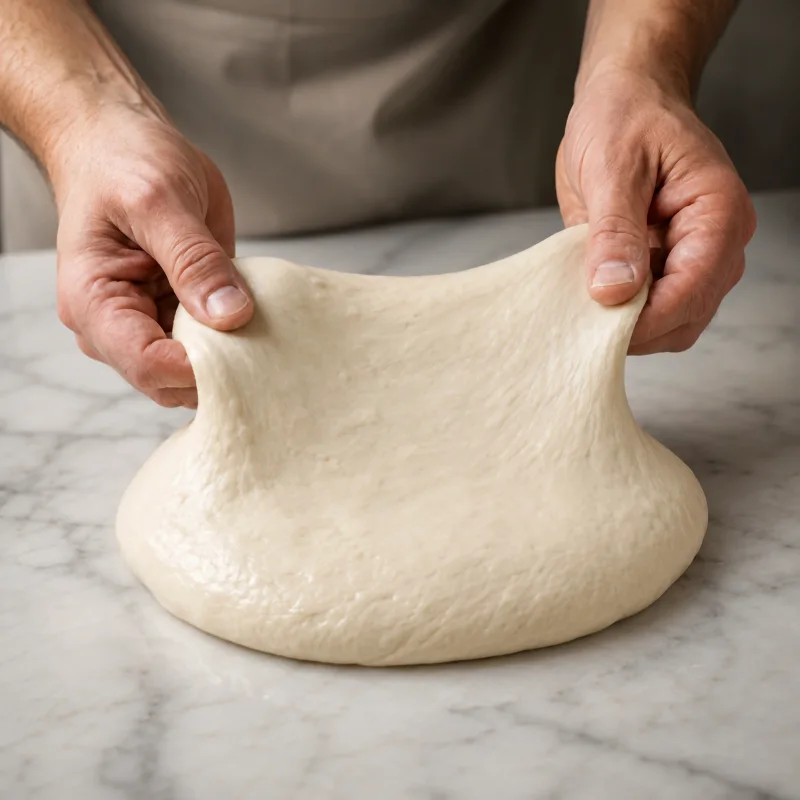
When dough springs back under the rolling pin, it does not automatically need more strength
Let tension relax before you force the shape
Dough that keeps shrinking back, tears at the edge or feels rubbery does not automatically need more flour. It often needs time. The key is understanding dough structure, hydration and gluten development, because the problem starts before rolling: water is still distributing through the dough and mixing has left mechanical tension in the gluten network. The useful signal is not simply “softer.” It is movement. Rested dough stretches farther, the surface looks calmer, edges fray less and the mass does not snap sharply back toward its original shape.
This is where many corrections do more harm than good. More flour is added, pressure increases or mixing continues. The dough may feel less sticky on the bench, but the baked result can become firmer, denser and less supple.
A rest is not dead time. It gives moisture time to even out and lets some internal tension relax. For many basic wheat doughs, 20–30 minutes covered after the first mix is a useful comparison point. Shortcrust needs a cold rest, while strudel-style dough benefits from a protected room-temperature rest so it can stretch thinly without tearing.
The dough is not resting because you stopped working. It is resting because its structure needs time to settle.
Why freshly mixed dough can feel deceptively sticky
Adding flour too early changes the formula before the dough has finished hydrating
When flour is mixed with water, milk, eggs or another liquid, hydration does not become perfectly uniform at once. That is why a dough may feel wetter during its first minutes than it does 15–20 minutes later. Adding flour immediately does not simply “fix” the dough; it changes the ingredient ratio before you have seen the rested consistency.
For bread, pizza, enriched yeast dough and strudel-style dough, cover the mixture after the ingredients first come together. Then reassess whether it needs a few folds, a little more development or a genuine small liquid adjustment. If the same percentage of water behaves differently with two flours, the explanation starts with how flour absorbs water.
Keep dough covered during a rest. A dry skin is difficult to reincorporate cleanly and can split during rolling or shaping.
More pressure does not solve surface drying. Protection from air does.
Why rested dough springs back less
Useful dough is extensible as well as elastic
Mixing and kneading can leave dough under strong elastic tension. Roll it and it pulls inward; stretch it and the edge tears. Rest does not destroy the gluten structure. It reduces mechanical tension enough for the dough to accept a new shape more readily.
Pizza makes this obvious. A tight dough ball retreats toward the center under your fingers; a better-rested ball opens outward with less resistance. Enriched dough rolls into a calmer sheet, and bread dough accepts folds more cleanly. For the bigger picture, see how the gluten network forms and why elasticity differs from extensibility.
If the dough still behaves like a stretched rubber band after the planned rest, give it another 10–15 minutes. Do not automatically dust in more flour and do not fight it with the rolling pin.
How long different doughs need to rest
Bread, pizza, shortcrust and strudel do not run on the same clock
For a basic yeasted wheat dough, start with 20–30 minutes covered after the first mix. It should then look more cohesive, less rough and easier to handle. If it still tears, a few controlled folds may be more useful than a large flour addition.
For pizza, rest can be decisive for stretching. If the dough ball keeps pulling back, cover it and wait another 15 minutes. Good pizza shaping comes from relaxed dough, not brute force.
Shortcrust follows a different rule. A 30–60 minute rest at 4–6 °C lets the fat firm again while moisture redistributes. If the dough is too hard after chilling and breaks in sharp cracks, leave it at room temperature for 5–8 minutes before rolling.
For strudel-style dough, the goal is a long, soft stretch. Cover it, lightly oil the surface and rest it for 30–45 minutes at room temperature. When ready, the edge does not tear immediately and the center thins more evenly.
When to wait and when to actually adjust the dough
Before adding flour, check surface, resistance and stretch
The worst correction is one made too early. Stickiness immediately after mixing does not prove the recipe is wrong. Spring-back immediately after working does not prove the dough is too dry. Give it time first.
After the rest, check three signals. The surface should be calmer and free of a dry skin. The dough should stretch farther before tearing. Resistance should ease instead of bouncing back like a tight elastic band. If it still pulls back strongly, cover it again and wait 10–15 minutes.
Extra flour makes sense only when the dough is still excessively wet, shapeless and unable to release from hands or bowl after resting. With bread dough, a short series of folds is often a better first move than dry dusting. With high-hydration dough, use wet hands. With shortcrust, if it smears, check temperature before adding flour.
The most reliable rule is simple: rest first, decide second. Keep the dough covered, measure the pause and continue when the surface settles, resistance falls and the dough moves under your hands without needless tearing.
Frequently asked questions
Answers to common questions
Does every dough need to rest?
Not for the same length of time, but many doughs become easier to handle after a short rest. Rest is especially useful for bread, pizza, enriched yeast doughs, shortcrust and strudel-style doughs.
Why is dough often less sticky after resting?
Because moisture has more time to distribute through the mass. The surface feels less wet, the dough becomes more cohesive and shaping is easier.
Can dough rest for too long?
Yes. Yeasted dough can lose useful tension and hold its shape less well if it goes too far. Shortcrust can become too firm in the refrigerator; let it sit for 5–8 minutes at room temperature before rolling.
How long should dough rest if it springs back when rolled?
Cover it and give it another 10–15 minutes. Continue only when it no longer snaps strongly toward its original shape under the rolling pin.