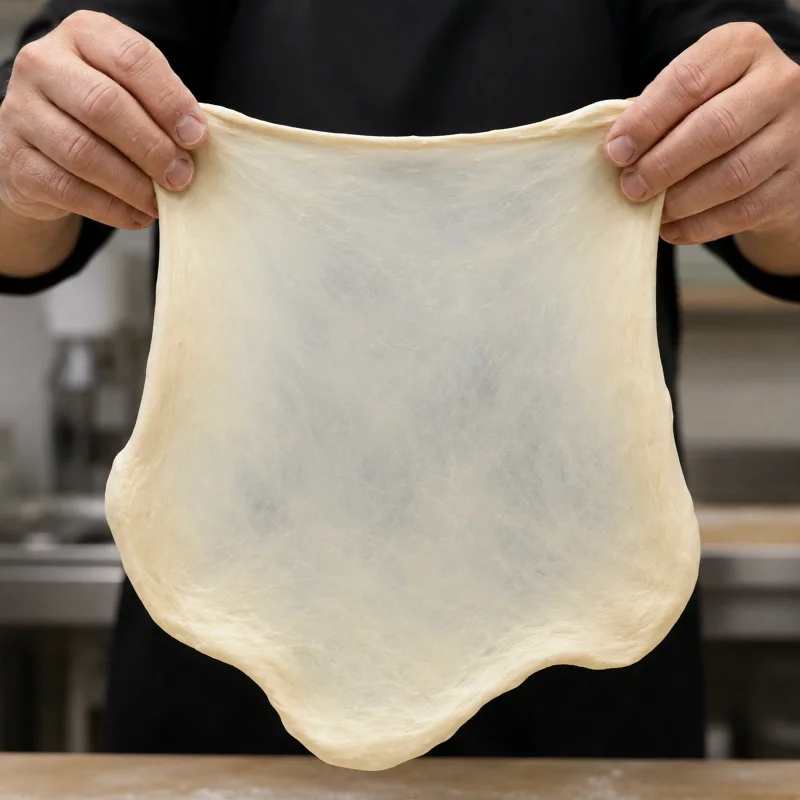
Dough structure forms when flour, water and processing are in balance
Wheat dough is a viscoelastic system. Flour provides the raw capacity, water hydrates starch and proteins, and time plus mechanical work allow a continuous gluten network to develop. A useful dough must be elastic enough to hold gas yet extensible enough to expand without tearing. More water or more kneading is therefore not automatically better.
Hydration is not just a recipe number
Hydration is water weight divided by flour weight × 100. With 1,000 g flour and 650 g water, hydration is 65%. Preferments contribute both their flour and water. Eggs, milk, butter and purées contain water but also solids, fat and protein, so their full weight should not automatically be counted as water. The same nominal hydration can feel very different with different flours. See also dough hydration.
| Hydration | Practical behaviour |
|---|---|
| 55–62 % | firm, easy to shape |
| 63–70 % | balanced and manageable |
| 71–80 % | softer, stickier, more extensible |
| >80 % | strongly flour- and technique-dependent |
Flour sets structural potential, not protein percentage alone
Protein percentage is useful but does not fully describe flour strength. Gluten quality, milling, bran and damaged starch also affect absorption and dough behaviour. Whole-grain flour usually binds more water while bran interrupts the continuity of the gluten network. Give it time to hydrate and judge the dough by behaviour rather than by a perfect windowpane. choosing flour for dough structure.
How hydrated proteins develop into a gluten network
When wheat proteins hydrate, glutenin and gliadin can connect into a viscoelastic network. Mixing, folds and time reorganize that network. Elasticity helps dough recover and hold shape; extensibility lets it stretch. A dough that snaps back strongly needs a different correction from one that spreads with almost no resistance. how the gluten network forms.
Kneading is not the goal; adequate development is
Mechanical work helps distribute water and develop structure, but excessive mixing can heat and weaken dough. Use visible and tactile signals: a smoother surface, longer stretch before tearing, useful elastic return and the ability to retain tension. The windowpane test is a control sign, not a universal pass/fail rule. controlled kneading.
Rest changes dough without extra mechanical energy
A covered rest lets water redistribute and mechanical tension relax. For lean wheat dough, 20–30 minutes can be a useful comparison test. If a rough dough becomes smoother and more extensible after resting, slow hydration or tension was part of the problem. Rest cannot repair unsuitable flour, extreme hydration or a structure already degraded by fermentation.
Salt, sugar and fat change the same system in different ways
Salt often makes dough feel tighter and also slows fermentation. Sugar competes for available water and, at higher levels, increases osmotic stress on yeast. Fat changes lubrication and protein interactions; in enriched dough it is often easier to develop a coherent base dough before adding soft fat gradually.
Read the dough response: symptom, test, then correction
Diagnose before correcting. Dry cracking edges suggest insufficient available water or incomplete hydration. Sticky dough that tears may be underdeveloped or too wet for the flour. Smooth dough that contracts strongly usually needs relaxation. Dough that was strong after mixing but later spreads points toward fermentation time, temperature, hydration or flour capacity. Change one main variable at a time.
| Signal | First check |
|---|---|
| dry, cracking edges | covered rest, then water availability |
| sticky and tearing | rest plus one control fold |
| smooth but strongly retracting | 10–20 min relaxation |
| spreads only after fermentation | time, temperature and flour capacity |
Fermentation reveals whether the structure can carry the load
Fermentation continuously loads the network as gas expands it. If dough is sound after mixing but becomes slack only later, do not blame kneading alone. Check time, dough temperature, yeast or starter level, hydration and flour capacity. During baking, starch gelatinization and protein setting eventually stabilize the crumb.
A reliable method for adapting to a new flour
With an unfamiliar flour, keep the formula and process as comparable as possible. Hold back roughly 5–10% of the planned water, mix, allow a short rest, then add water in small increments only if the dough can carry it. One percentage point of water equals 10 g per 1,000 g flour. Record the result and alter only one major variable in the next batch.
Diagnostics
Common problems and solutions
Dough is firm, rough and tears at the edges during shaping.
Cause: Too little available water, or the water has not yet distributed evenly.
Solution: Rest the covered dough for 15–20 minutes. If it softens only slightly and remains dry, add about 1% water relative to flour weight; if rest alone improves it markedly, slow hydration was the main issue.
Dough is very sticky and tears quickly when lifted.
Cause: The gluten network is not developed enough, or hydration exceeds the flour’s current carrying capacity.
Solution: Give it a short rest and one controlled fold. If tension improves, continue development; if not, test slightly lower hydration in the next batch instead of randomly adding dry flour.
Dough is smooth and strong but snaps back quickly after stretching.
Cause: High elasticity with too little time for internal tension to relax.
Solution: Cover and rest for 10–20 minutes. If it then stretches with less recoil, more kneading was not the right solution.
Dough was firm after mixing but becomes slack and spreads during fermentation.
Cause: Fermentation is too long or too warm, hydration is too high for the flour, or the flour has limited carrying capacity.
Solution: Compare the dough immediately after mixing and before shaping. On the next batch change one variable: shorten fermentation, lower process temperature, or reduce hydration slightly.
Enriched dough becomes greasy, split and fails to come together after butter is added.
Cause: The base network was not developed enough before adding fat, or the dough overheated during mixing.
Solution: Next time, first develop a cohesive base dough, then add soft fat gradually while monitoring dough temperature.
Technical terms
Terms worth understanding
- Baker’s percentage
- A formula system in which total flour weight is 100% and all other ingredients are expressed relative to it.
- Hydration
- The ratio of water weight to flour weight; it strongly affects dough firmness, stickiness and extensibility.
- Gluten network
- The connected structure of hydrated wheat proteins that lets dough stretch and retain fermentation gases.
- Elasticity
- The ability of dough to partly return to its original shape after stretching.
- Extensibility
- The ability of dough to stretch without tearing.
- Bassinage
- A technique in which part of the water is held back and added gradually after initial dough development.
Frequently asked questions
Answers to common questions
Does higher-protein flour always make stronger dough?
No. Protein quantity is only one signal. Gluten protein composition, damaged starch, milling level, bran and hydration method also matter, so two flours with the same protein percentage can behave very differently.
How do I calculate hydration when using sourdough starter or a preferment?
Add the flour in the preferment to the main dough flour, and its water to the main dough water. Hydration is total water divided by total flour, multiplied by 100.
Does sticky dough always mean too much water?
No. Stickiness can come from uneven hydration, insufficient network development, higher temperature or loss of strength during overlong fermentation. First compare the response after a short rest and fold.
Must every properly developed dough pass the windowpane test?
No. It is most useful for white wheat dough. Whole-grain, rye and heavily enriched doughs can reach suitable structure without a very thin translucent membrane.
What should I change first when testing a new flour?
Keep the recipe and process as comparable as possible, hold back a small amount of water and add it in roughly 1% steps relative to flour weight. This isolates the flour response instead of changing several variables at once.