Flour names are not the same as flour performance
Start by separating protein, ash, milling and strength
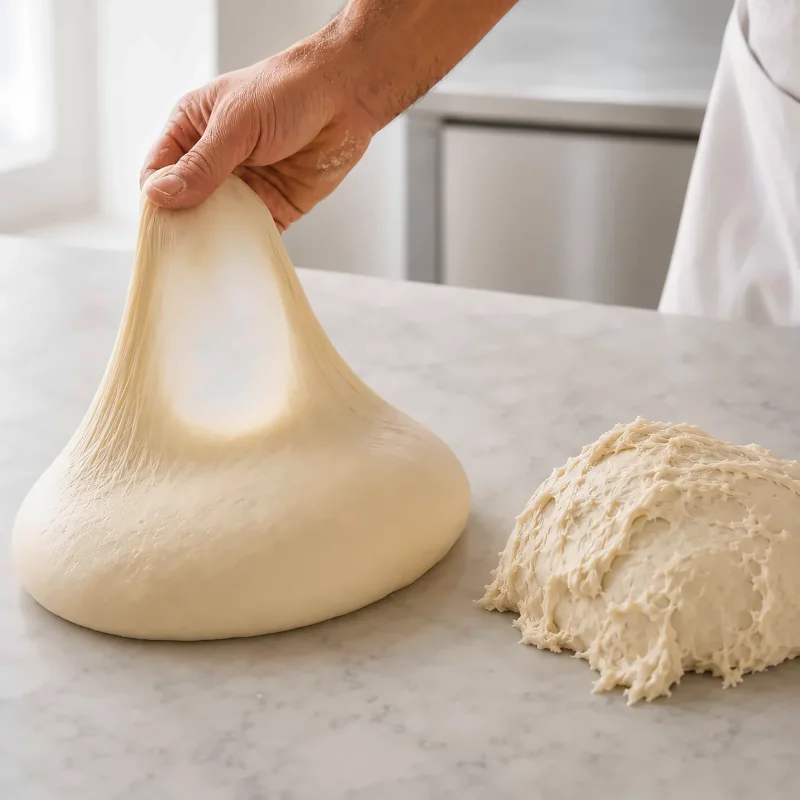
A flour label can describe several different properties. Protein percentage is a useful guide to gluten-forming potential. Ash content reflects mineral content and extraction. Milling affects particle size and how flour disperses. Flour strength is the technological result: how well a dough can stretch, hold gas and tolerate water and fermentation.
These are related, but they are not interchangeable.
That is why a fine flour is not automatically weak, and a high-protein flour is not automatically the best choice for every bake. Cake, short pastry, bread and pizza need different structural targets.
The simplest rule is:
choose the structure first, then choose the flour.
Cake flour, all-purpose flour and bread flour
Protein is one of the most useful first clues
Cake flour is formulated for lower gluten-forming potential and a tender crumb. All-purpose flour sits in the middle and is designed to work across many everyday bakes. Bread flour has more protein and can form a stronger gluten network.
That extra strength is valuable when a dough has to hold fermentation gases and a relatively high amount of water. It is much less useful when your goal is a delicate cake or a short, crumbly pastry.
If you want a deeper explanation of why mixing flour and water creates an elastic network, read How the gluten network forms: dough elasticity and extensibility.
Fine flour is not automatically weak flour
Particle size and protein are separate variables. Italian 00 flour is a good example: “00” is a milling/classification term, not a guarantee of low strength. Some 00 flours are designed for pizza and can be quite strong.
The same logic applies to ash. Ash tells you about mineral content and extraction, not directly how much gluten structure the dough will build.
Professional flour specifications often list protein and ash separately for exactly this reason.
For cakes, tenderness matters more than maximum strength
When flour is added to cake batter, the goal is usually enough structure to support the cake without creating a chewy network. Lower-protein flour can help, but mixing technique matters too.
Once the flour goes in, mix only until the batter is uniform. Continued mixing encourages gluten development. If your sponge cakes turn dense or rubbery, the flour may be too strong, the batter may be overmixed, or both. See Fluffy sponge cake: how to get a light, stable crumb.
Shortcrust pastry has a similar structural goal: enough binding to hold together, but not the elastic network you want in bread. The contrast is explained in Shortcrust pastry vs strudel dough: gluten, texture and technique.
For bread and pizza, judge flour by the dough it can support
Bread and pizza dough must absorb water, survive mixing and fermentation, trap gas and still be stretchable enough to shape.
Protein percentage is a useful screening tool. Higher protein often means more gluten-forming potential and greater water absorption. But protein quantity is not the whole story: gluten quality, wheat variety, milling and bran all affect the final dough.
Whole-wheat flour illustrates the limitation. It can have plenty of protein, yet bran can interfere with the gluten network. More protein therefore does not always translate into the same dough strength as a white bread flour.
A practical flour guide
| What you are making | Check first | Practical direction |
|---|---|---|
| Tender cake or sponge | protein and mixing | lower gluten potential; mix minimally after flour is added |
| Cookies and short pastry | low elasticity | pastry/cake-style flour can help keep the texture short |
| Pancakes and batters | smooth dispersion | all-purpose flour is usually straightforward |
| Everyday bread | protein, strength and absorption | use bread flour or a suitable all-purpose flour |
| High-hydration bread or long pizza fermentation | strong gluten potential | choose flour designed to hold more water and time |
| Whole-grain bread | water absorption and bran | expect more water, but do not assume stronger gluten |
Three common mistakes
1. “Higher protein is always better”
It is not. High protein is useful when the bake needs strong gluten. For tender cake or short pastry, too much strength can work against the desired texture.
2. “00 flour is weak flour”
Not necessarily. 00 describes classification and refinement, not strength. Check protein, W value when supplied, and intended use.
3. “Sticky dough needs more flour immediately”
Freshly mixed flour may not be fully hydrated. Give the dough time before correcting it. Adding too much flour too early often turns an open, moist crumb into a dry, tight one.
How to choose flour in under a minute
Read the bag in this order:
- intended use — cake, pastry, bread, pizza, all-purpose;
- protein percentage — a practical clue to gluten potential;
- ash or type information, when relevant to the market;
- miller guidance and, for specialist flour, strength data such as W.
Then watch the first dough you make with it. Bread dough should hold tension after resting; cake batter should stay light after flour is incorporated; short pastry should bind without becoming springy.
The right flour is not the flour with the biggest number. It is the flour whose protein, extraction, milling and strength match the structure you are trying to bake.
Diagnostics
Common problems and solutions
Problem
Cause: The recipe was developed for a higher gluten-forming potential and possibly higher water absorption.
Problem
Cause: The flour may not have enough strength for the hydration or fermentation schedule.
Problem
Cause: The flour is too strong for the target texture or the batter was mixed too long after flour was added.
Technical terms
Terms worth understanding
- protein percentage
- A practical indicator of how much gluten-forming protein is available in wheat flour; higher protein often supports stronger dough.
- ash content
- The mineral residue measured after flour is incinerated; it is used as an indicator of extraction and mineral content.
- flour strength
- The technological ability of flour to form a dough that balances elasticity, extensibility and gas retention.
Frequently asked questions
Answers to common questions
What is the main difference between cake flour and bread flour?
Cake flour has lower protein and therefore lower gluten-forming potential, helping create a tender crumb. Bread flour has more protein and can form a stronger dough that holds gas and water more effectively.
Does higher protein always mean better flour?
No. Higher protein is useful when you need strong gluten, but cakes and short pastry often benefit from lower protein. Protein quality and the recipe still matter.
What does ash content in flour mean?
Ash is the mineral residue left after a flour sample is burned under controlled conditions. It reflects mineral content and, broadly, how much of the grain is represented after milling.
Is 00 flour the same as weak flour?
No. 00 describes an Italian refinement/classification, not strength. A 00 flour can be weak or strong, so check protein or W value and intended use.
Which flour is best for bread and pizza?
Choose a flour that matches your hydration and fermentation. Protein percentage is a useful first clue, but dough strength, extensibility and actual water absorption are the final test.