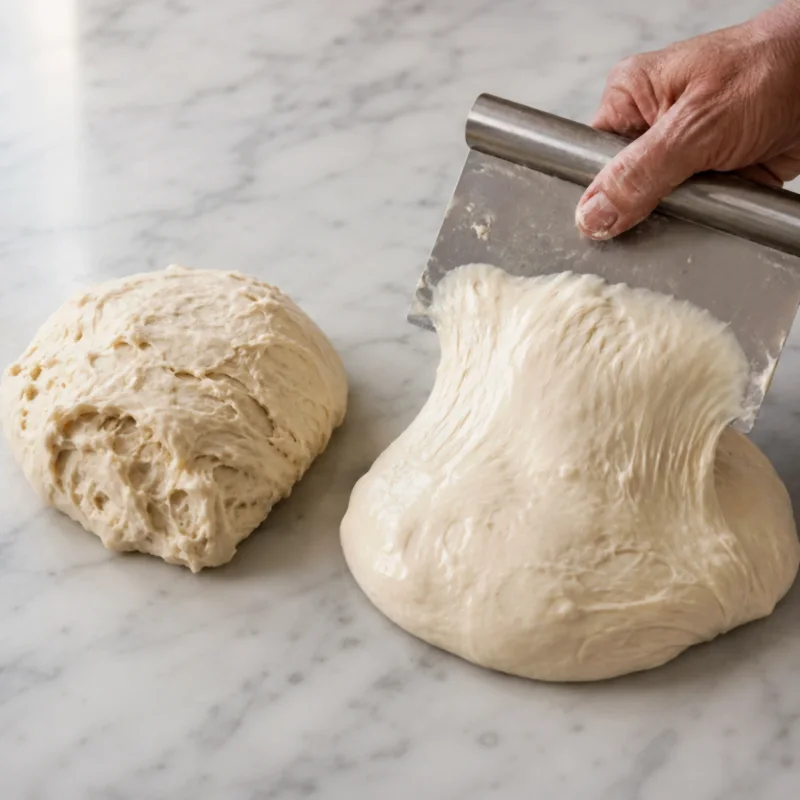
The same hydration percentage does not mean the same dough
Protein, damaged starch, arabinoxylans, fibre, bran, and initial flour moisture all affect water binding. Two flours can therefore feel very different at the same water-to-flour ratio.
Let the water distribute before judging
Mix until no dry flour remains, cover, and give the dough a short rest. Then judge extensibility, tension, and its ability to hold shape.
PEK method: reserve some water
With a new flour, hold back part of the recipe water and add it gradually only after the first assessment. For the mathematics, use dough hydration calculation.
Whole-grain flour has no universal water increase
Bran and fibre often raise water demand, but milling, variety, particle size, and damaged starch differ. Do not apply one fixed percentage to every whole-grain flour.
Diagnostics
Common problems and solutions
The dough remains dry after resting and breaks when squeezed.
Cause: There may be too little water, or the water may not yet be evenly distributed.
Solution: Add a small amount of reserved water, incorporate it fully, and reassess.
The dough is sticky but gathers after folds.
Cause: Structure is still developing; stickiness alone does not prove excess water.
Solution: Do not add flour only because the dough is sticky; continue appropriate development.
The dough still spreads without tension after resting and folding.
Cause: Water may be too high for this flour, or the gluten network may be too weak.
Solution: Check total hydration, flour type, and gluten development; reserve more water next time.
Whole-grain dough becomes noticeably firmer during the rest.
Cause: Bran and fibre have taken up more water during the rest.
Solution: Add water gradually according to the flour’s response; do not use a fixed universal increase.
Technical terms
Terms worth understanding
- dough hydration
- Water mass expressed relative to flour mass as a baker’s percentage.
- flour water absorption
- The ability of a particular flour to take up and retain water at a given dough consistency and process.
- damaged starch
- Starch granules mechanically damaged during milling; they interact with water differently from intact starch.
- arabinoxylans
- Grain-cell-wall polysaccharides that can strongly affect water retention and viscosity.
- autolyse
- A rest of mainly flour and water before further mixing, used to hydrate flour and support extensibility.
Frequently asked questions
Answers to common questions
Why do two flours behave differently at the same hydration, and how can you tell after mixing and resting whether a particular flour needs more water?
The same hydration does not always produce the same dough because different flours absorb and retain water differently. Protein, damaged starch, fibre, arabinoxylans, bran, and initial moisture all matter. Mix until no dry flour remains, rest the dough covered, then judge extensibility, tension, and firmness before adding reserved water.
Should I add flour immediately when the dough is sticky?
Not necessarily. Rest it covered first and check whether folding builds tension; stickiness alone does not prove excess water.
Does whole-grain flour always need a fixed percentage more water?
No. It often absorbs more, but bran, particle size, milling, damaged starch, and protein composition vary too much for one safe universal increase.
How should I adjust water with a new flour?
If the recipe allows it, reserve some water, mix until no dry flour remains, rest briefly, then add the remaining water gradually according to firmness, extensibility, and tension.