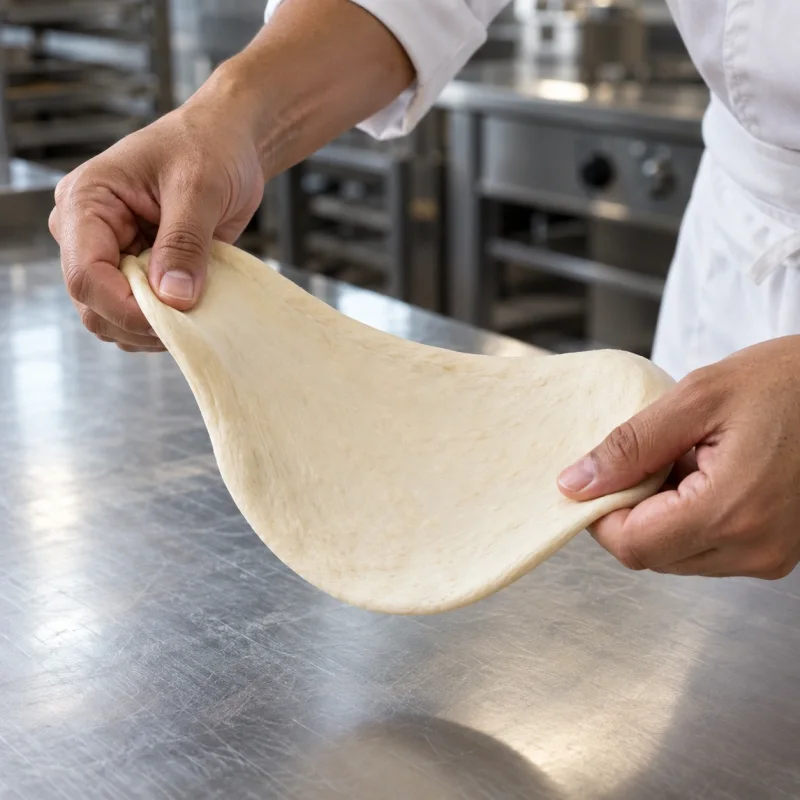
Flour tortilla dough: a reliable formula for soft, flexible tortillas
Soft homemade tortillas need more than thin rolling. The key is a soft, well-hydrated dough, enough resting time and a short cook in a properly heated dry skillet. If the dough keeps springing back, it has not relaxed enough. If a tortilla stays pale for too long and dries out, the skillet is usually too cool. If a cooked tortilla is left uncovered, it can lose flexibility within minutes.
For about 8 tortillas around 20 cm / 8 in wide, use this practical starting formula:
- 300 g all-purpose wheat flour
- 1 teaspoon baking powder
- 1/2 teaspoon fine salt
- 50 g neutral vegetable oil
- 200 g warm water, then add only as needed up to about 225 g
Water is not a universal number because different flours absorb differently. Start with the lower amount and add just enough to get a smooth, soft, slightly tacky dough that is not crumbly and does not need to be rescued with a large amount of extra flour.
Step-by-step method
1. Mix and knead the dough
Whisk together the flour, baking powder and salt. Add the oil and most of the warm water. Mix and knead until the ingredients form a cohesive dough. If dry particles remain and the dough cracks while kneading, add a little more water gradually.
Knead only until the dough becomes smooth and cohesive. The goal is not a stiff dough; it should form a smooth ball without dry cracks.
2. Divide and rest
Divide the dough into 8 similar pieces, shape them into balls and keep them covered so the surface does not dry. Rest for about 30 minutes.
This rest does two useful things: flour has more time to absorb water, and the gluten network loses some of the tension created during mixing. The dough therefore rolls more easily and springs back less. For the deeper mechanism, see why resting dough matters.
3. Heat a dry skillet
Use a heavy skillet or cast-iron griddle without oil. Heat it over medium-high heat. The first tortilla is a calibration piece: within roughly half a minute, bubbles should begin to form and light brown spots should appear underneath.
If the surface darkens in a few seconds, reduce the heat. If the tortilla stays pale for a long time and starts drying out, increase it.
4. Roll thin without forcing the dough
Roll each dough ball to about 20 cm / 8 in. Keep the remaining balls covered.
Use only enough flour to prevent sticking. A thick layer of dusting flour dries the surface and works against a soft result. If the round keeps shrinking and pulling back, do not fight it. Cover it and wait another 5–10 minutes. If sticking or tearing is the problem, use the techniques in how to roll dough without sticking, tearing or shrinking.
5. Cook briefly
Put the rolled tortilla into the hot dry skillet. When bubbles and the first light brown spots appear, flip it; with a properly heated skillet this is often around 30 seconds. Cook the second side for about the same time, or only until the dough is cooked while still soft.
Treat the clock as guidance, not law. Thickness, pan material and burner power change the exact timing. Three signals are more useful: bubbles, brown spots and a surface that is still flexible.
6. Stack and cover immediately
Stack each cooked tortilla on the previous one and wrap the pile in a clean towel or keep it covered in a container. Heat and moisture remain around the tortillas, helping them stay foldable and rollable.
This step is part of the process, not just serving. Even a correctly cooked thin tortilla can become stiff if it sits uncovered.
Four control points that decide the result
After kneading: the dough should be soft, smooth and moist enough that the edges do not crack.
After resting: it should stretch with less resistance. Strong spring-back means it needs a little more time.
In the skillet: correct heat creates bubbles and scattered brown spots quickly instead of slowly drying the tortilla.
After cooking: the tortilla should bend without cracking. Stacking and covering preserve that state.
Troubleshooting dry, tough or shrinking tortillas
The dough springs back
The gluten network is still too tense.
Fix: cover the dough and rest it another 5–10 minutes. Do not add flour simply because the dough resists the rolling pin.
The edges crack while rolling
This usually indicates dough that is too dry or too much flour on the work surface.
Fix: keep all dough balls covered and reduce dusting flour. In the next batch, adjust water inside the stated range. For a broader framework, see how to improve dough texture with small adjustments.
The tortilla becomes hard but is not burned
A common pattern is long cooking on a skillet that is not hot enough: the tortilla slowly colours while losing moisture.
Fix: heat the skillet more and shorten the cooking time. Stack and cover each tortilla immediately.
The tortilla darkens too quickly
The skillet is too hot.
Fix: lower the heat and allow the skillet to settle briefly before cooking the next piece.
Oil, butter or lard?
Neutral vegetable oil is a simple everyday choice. Butter or lard can also work, but they change flavour and dough behaviour. Do not assume that a direct fat swap gives exactly the same texture.
For the broader effects of changing fats in doughs and batters, see butter versus oil in baking.
Storage and reheating
If you are not serving the tortillas immediately, let them cool fully while protected from drying, then store them tightly sealed. Refrigerated tortillas can be reheated briefly in a dry skillet only until flexible again.
Do not aim for extra browning during reheating. The goal is to restore warmth and pliability, not to dry them a second time.
The rule worth remembering
Soft flour tortillas come from a sequence, not one trick:
soft dough → covered rest → thin rolling with little extra flour → short cooking on a hot skillet → immediate covering
When one batch differs from the previous one, identify which control changed before adding random extra flour, water or fat.
Diagnostics
Common problems and solutions
The dough springs back while rolling.
Cause: The dough is still too tense after kneading or has not rested long enough.
Solution: Cover it and rest another 5–10 minutes, then continue without additional kneading.
The edges crack while rolling.
Cause: The dough is too dry or there is too much extra flour on the work surface.
Solution: Keep the dough balls covered, use less dusting flour and, in the next batch, adjust water within the stated range.
The tortilla is hard after cooking even though it is not deeply browned.
Cause: It cooked too long on a skillet that was not hot enough, or it was left uncovered after cooking.
Solution: Heat the skillet a little more, shorten the cook and stack and cover each tortilla immediately.
The tortilla browns heavily before it puffs evenly.
Cause: The skillet is too hot.
Solution: Lower the heat and let the skillet settle briefly before cooking the next tortilla.
Technical terms
Terms worth understanding
- dough rest
- The time after kneading when flour continues to absorb water and dough tension falls, making rolling easier.
- pliability
- The ability of a cooked tortilla to fold or roll without cracking.
Frequently asked questions
Answers to common questions
Why does tortilla dough spring back when I roll it?
It usually needs more rest. Cover the dough ball for another 5–10 minutes, then roll again without intensive re-kneading.
Why are homemade tortillas dry after cooking?
Common causes are cooking too long on a skillet that is not hot enough or leaving cooked tortillas uncovered. Aim for quick bubbles and spots, then stack and cover.
How do I know the skillet is hot enough?
The first tortilla should begin to bubble and develop light brown spots in roughly half a minute. Raise the heat if it stays pale; lower it if it darkens within seconds.
Can I use butter instead of oil?
Yes, but changing the fat changes flavour and dough behaviour. For repeatable results, follow one formula first and change only one variable at a time.
Can I make the dough ahead?
Yes. Keep the dough or shaped balls tightly covered so they do not dry out. If chilled, allow enough time before rolling for the dough to become flexible again.