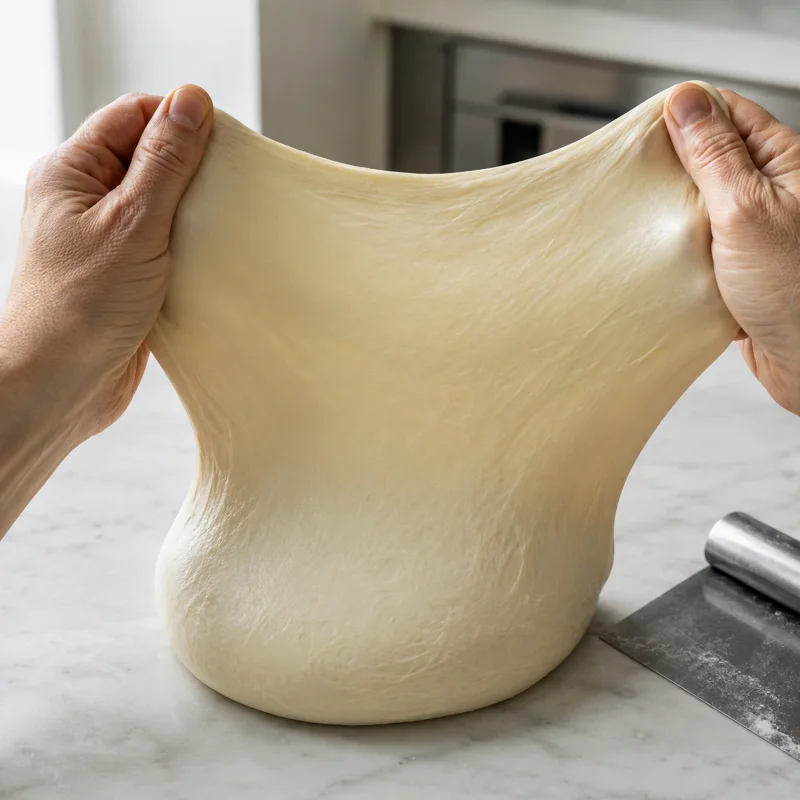
When the dough is not wrong, just slightly out of balance
The first clue is resistance under your fingers, not a number in the formula
Dough usually reveals the problem in your hands first: it snaps back, cracks around the edge, or spreads before you can shape it cleanly. That does not automatically mean the recipe is bad. More often, the balance between flour, liquid, fat, rest and mixing is only slightly off. The key is dough structure, because it determines whether dough feels elastic, extensible, crumbly, tough or heavy. Start with the smallest useful adjustment: 1–2% more liquid, 10–20 minutes of rest, or shorter, more controlled mixing. A useful sign is dough that indents under pressure and slowly rebounds without tearing.
A small correction should leave a clear trace in the texture.
If the dough is dry, do not pour in a large amount of water. Add 5–10 g of liquid per 500 g flour, mix until incorporated, then wait 5 minutes before judging again. Flour does not bind all available water immediately; starch and proteins need time. A dough can therefore feel much firmer in the first minute than it does after a short rest. Understanding how flour absorbs water matters because the same liquid percentage does not produce the same feel with every flour.
Hydration can fix dryness, but it can also weaken shape very quickly
Add liquid by weight, not by instinct
In bread dough, yeasted dough and other soft doughs, texture may improve with only a 1–3 percentage-point increase in hydration. With 500 g flour, that is roughly 5–15 g additional water or milk. It is a small amount, but enough to improve extensibility and reduce an unnecessarily dry crumb.
Too much liquid creates a different problem. Dough clings to your fingers, smears around the bowl, fails to build surface tension and becomes difficult to shape. Do not immediately solve that with heavy dusting flour, because this changes the ratio mainly in the outer layer. Give the dough a 10-minute rest, then fold or knead it briefly. If it still smears and has no useful tension, add flour only in 5 g steps.
Enriched doughs are more sensitive still. Butter, oil, eggs and milk do not soften dough in the same way. Fat changes lubrication and protein interactions and can delay water uptake, so the relationship between fat and liquid needs to be understood before changing the flour. The guide to balancing fat and liquid in dough helps explain why a dough can feel soft because it is too wet, too fatty, or simply not yet organized.
The bowl wall should not make the diagnosis for the center of the dough.
A successful hydration correction shows up as a smoother surface, less cracking during stretching and slower drying during fermentation. The dough may still feel lively and slightly tacky, but it should not flow without control.
Resting dough is the cleanest texture correction
Give gluten time and the dough stops fighting back
If dough shrinks while rolling, it usually needs less internal tension, not more force. The gluten network may be too tight, hydration may still be uneven, or the dough may have been shaped immediately after mixing. Adding flour at this point often does little more than create a drier surface.
Cover the dough and rest it for 15–30 minutes at room temperature. For short, buttery or otherwise delicate doughs, use the refrigerator once the mixture is cohesive and flattened into a disk. Rest allows moisture to redistribute and tension to relax, which makes the dough easier to extend without tearing. That is why resting dough is one of the most effective corrections when you want a better texture without changing the formula.
Do not skip this step just because the dough looks workable on the bench. The fault often appears later during shaping, baking or slicing. Dough rolled too soon can contract in the oven, thicken around the edges or bake with uneven internal tension.
In yeasted dough, rest is not simply idle time. Water continues to distribute, gluten organizes and fermentation begins to load the network. If the dough looks rough after the first mix, leave it for 10 minutes, then give it a short fold. The surface will often look smoother and the mass will feel more coherent.
Kneading should build structure, not harden the bite
Too little development weakens crumb; too much can overheat and tighten the dough
Kneading improves texture only while it is building enough structure to support gas, moisture and shape. Underdeveloped dough tears easily, holds gas poorly and can bake into a dense, uneven crumb. Excessive or very aggressive mixing can raise dough temperature; the mass may then become tight, smeary or harder to control.
For basic bread and soft yeasted dough, a finished dough temperature around 24–26°C is a useful target. Rich doughs with more butter, eggs or sugar are often easier to control around 22–24°C, because warmer fat softens faster and can reduce surface tension. If you knead by hand, do not rely only on minutes. Watch the surface: it should become more uniform, the edges less ragged, and a piece of dough should stretch farther before tearing.
For an open, airy crumb, the network must be strong enough to retain gas without being exhausted before fermentation. The article on kneading dough and gluten development explains this in more detail. Good texture does not come from kneading as long as possible; it comes from developing enough strength while keeping extensibility.
A stretch test gives a practical signal. Gently pull a small piece between your fingers. Wheat bread dough should thin before it breaks. Doughs with less gluten or more fat will not form a perfect membrane, but they should still stretch more calmly and farther than they did at the start.
When small adjustments are no longer enough
If the dough keeps tearing, evaluate the flour instead of adding more tricks
Sometimes the dough does not need another technique. It needs a more suitable foundation. If it repeatedly tears even after rest, a small liquid correction and controlled kneading, the flour may be too weak for the structure you want or too strong for a tender product. That is the limit of micro-adjustments, not the first reaction.
If the same fault repeats from batch to batch, check how to choose the right flour before changing the formula further. Higher-protein flours can often build a stronger network and hold more water, while weaker flours can give a more tender bite but may not tolerate long fermentation or high hydration.
The clearest way to identify the cause is to change only one variable at a time: rest first, then liquid, then kneading, and flour last. If everything changes at once, you lose the evidence. PEKI recommend stopping the correction as soon as the surface becomes smoother, the edge no longer tears sharply during stretching, and the dough holds light, controlled tension under your hand.
Frequently asked questions
Answers to common questions
Can I improve dough texture without changing the recipe?
Yes. Rest the dough first; texture often improves without adding flour, water or fat.
How much water should I add if the dough is too dry?
Add 5–10 g liquid per 500 g flour, then wait a few minutes. A large addition at once can quickly turn a dry dough sticky.
Why does dough feel softer after resting?
During rest the flour continues to absorb water and tension in the gluten network relaxes, so the dough stretches and shapes more easily.
Is it better to add flour or let the dough rest?
Rest it first. Add flour only if the dough still spreads, lacks useful tension and cannot hold shape after the rest.