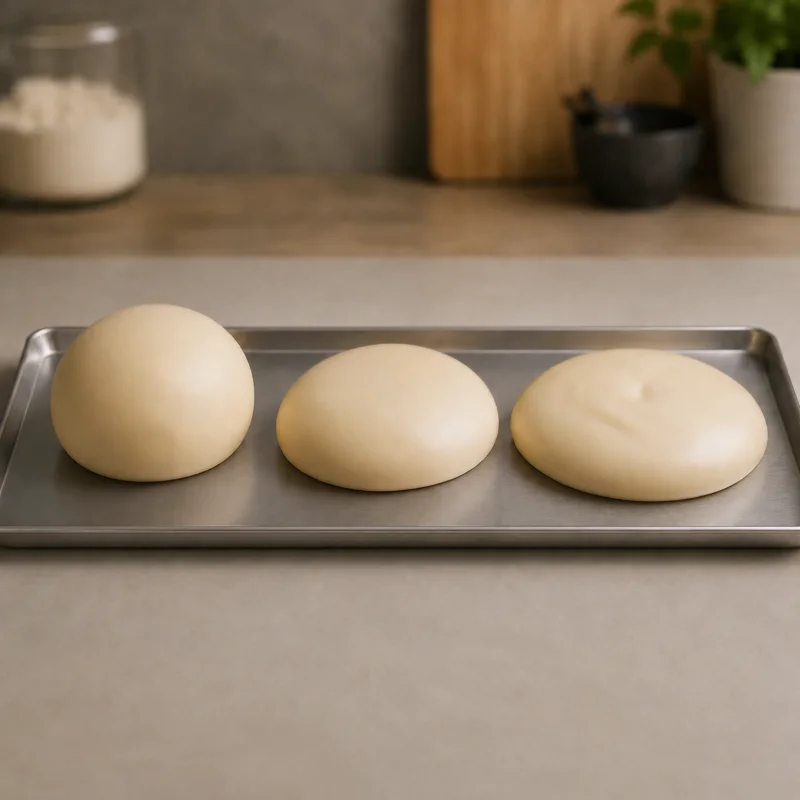
Why higher hydration changes dough behaviour
As water increases, dough usually moves from firm and resistant to more extensible, sticky and prone to spreading. The percentage itself does not create structure: flour quality, gluten development, temperature and fermentation determine whether the extra water can be supported.
Too little water leaves proteins, starch and fibre incompletely hydrated. The dough feels tight, tears sooner when stretched and often bakes with a denser crumb. More water can increase extensibility and allow gas cells to expand, but only if the gluten network is strong enough. If the structure is weak, wetter dough simply spreads.
How to calculate dough hydration
In baker's percentages, total flour is always 100%.
hydration (%) = total water ÷ total flour × 100
With 500 g flour and 325 g water:
325 ÷ 500 × 100 = 65%
For 70% hydration with 500 g flour:
500 × 0.70 = 350 g water
At 500 g flour, every percentage point equals 5 g water. A change from 65% to 70% is therefore only 25 g water, yet the handling difference can be obvious.
Include all flour and water from a preferment. If a poolish contains 100 g flour and 100 g water, both amounts belong in the total formula.
Enriched doughs and “hidden” water
Milk, eggs and butter contain water, but enriched doughs should not be treated as if every gram of that internal water behaved like plain water. Milk solids, egg proteins, sugar and fat all change water availability and dough structure.
Use the mathematical water contribution when you need a precise formulation, but judge the dough by behaviour as well. Fat itself does not count as hydration. It changes handling because it coats flour particles and interferes with direct contact between proteins and water.
What different hydration ranges usually feel like
For wheat-based fermented doughs, these are useful starting zones rather than quality scores:
| Hydration | Typical handling | Common result |
|---|---|---|
| 50–55% | very firm, strong resistance | tight, even crumb and strong shape |
| 56–62% | firm and easy to shape | fine to moderately open crumb |
| 63–68% | supple and balanced | moist, moderately airy crumb |
| 69–75% | sticky and extensible | more open crumb if structure is developed |
| 76–85% | very soft, difficult to shape conventionally | large irregular cells, moist crumb |
A bagel dough and a ciabatta do not need the same hydration. More water is not automatically better.
Why the same percentage behaves differently with different flours
Water is bound not only by gluten-forming proteins but also by damaged starch, fibre, pentosans and bran. That is why two flours at 70% hydration can feel completely different.
Whole-grain flour often needs more water but can still feel firmer because bran and fibre absorb it. Stronger bread flour can support more water than a weak flour before losing shape. Choose flour according to the intended dough structure, not by hydration number alone. See PEK's guide to choosing flour for strength and baking use.
How to raise hydration without losing structure
For soft dough, do not necessarily add all the water at the start. Hold back 5–10% of the planned water and add it after the dough has begun to develop strength. This late addition is often called bassinage.
For 500 g flour and 375 g total water, begin with roughly 337–356 g, then add the remaining 19–38 g in small additions. Add the next portion only after the dough becomes cohesive again.
After machine mixing, many lean wheat doughs are easiest to manage around 24–26°C, although the correct target depends on yeast level, fermentation time and room temperature. Overmixing can warm and soften dough, which may look like “too much water” even when the formula is correct. Good kneading and gluten development matter more than blindly adding dry flour.
Rest before deciding the dough is too wet
After the initial mix, rest wheat dough for 20–40 minutes. During this time, flour absorbs free water and the dough often becomes less sticky without any extra flour.
Whole-grain or coarser flour may benefit from 40–60 minutes before final judgement. The rest does not lower hydration; it redistributes water.
If the dough is still weak after resting, change one variable at a time: hydration, flour, mixing or fermentation. Adding 30–50 g flour during kneading changes the entire formula, including the relative percentages of salt, yeast, sugar and fat.
Choosing a starting hydration
For a dough that a beginner needs to shape reliably by hand, 60–65% is a practical starting point with ordinary white bread flour.
For a more open loaf or pizza crumb, 68–72% can work well when flour strength and fermentation are controlled. The dough should still retain a rounded edge after folding rather than immediately flowing flat.
Focaccia and ciabatta are often comfortable in the 75–85% range, but these doughs are handled with folds rather than treated like firm balls.
The right result is not defined only by hole size. A well-managed crumb has elastic cell walls and does not leave a wet, gummy streak when compressed.
A repeatable way to test a new flour
Keep flour weight constant and change hydration in steps of only 2–3 percentage points. At 500 g flour, that means 10–15 g water per test.
Record:
- flour weight and type;
- total water, including preferment water;
- dough temperature after mixing;
- rest time and mixing method;
- spreading after folds;
- surface tension and extensibility during shaping.
Hydration becomes useful when it is treated as a measured process variable. The number tells you where you started; the dough tells you whether the formula is balanced.
Frequently asked questions
Answers to common questions
Do oil and butter increase dough hydration?
Pure fat does not count as water. Butter contains some water, typically around 15–18%, but enriched doughs should not be treated as if that water behaved exactly like plain water.
How much water do I add to increase hydration by 5 percentage points?
Multiply the flour weight by 0.05. For 500 g flour add 25 g water; for 1,000 g flour add 50 g.
Why can whole-wheat dough still feel stiff at 75% hydration?
Bran and fibre bind more water than white flour. Judge the dough after a longer rest, often 40–60 minutes, when water has redistributed more evenly.
Does higher hydration always create bigger holes?
No. An open crumb also needs sufficient gluten strength, appropriate fermentation and gentle shaping. Too much water without support makes dough spread rather than creating an open crumb.