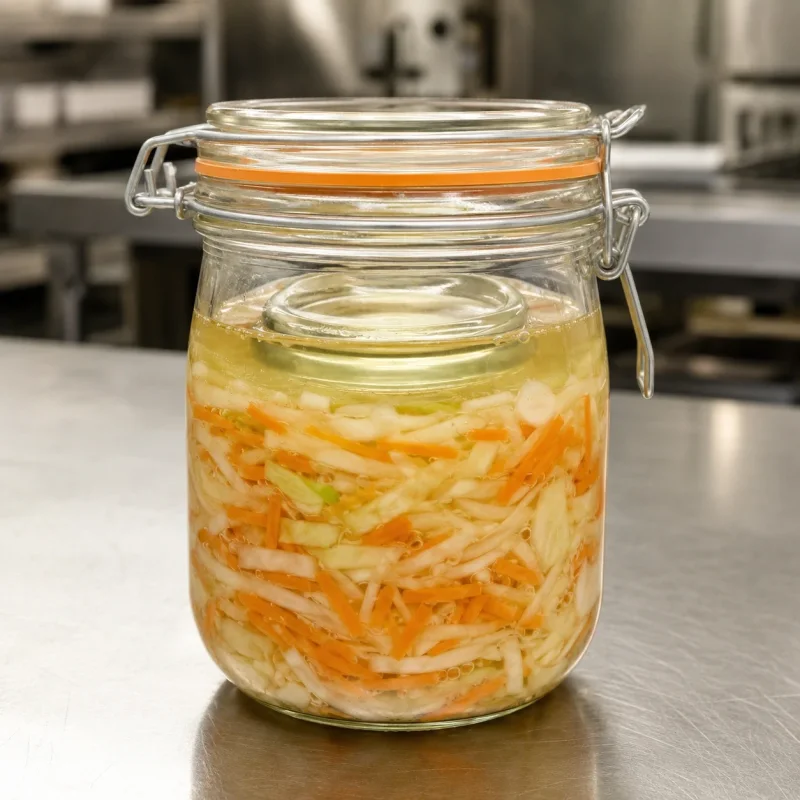
Food fermentation is not the same as vinegar pickling
Food fermentation is a controlled microbial process: microorganisms grow and use their enzymes to transform components of the food. Organic acids, alcohol, gases, and aroma compounds may be produced, changing flavour, texture, aroma, and keeping quality.
That distinction matters. In fermentation, microorganisms drive the transformation. In vinegar pickling, acid is added at the start, so pickling with vinegar is not automatically fermentation.
Brine by itself does not prove that fermentation is taking place either. Salt can be part of a fermentation system, but it is also used in other preservation methods.
Fermentation is not always an oxygen-free process
The idea that every fermentation must happen without oxygen is too simple.
In lactic-acid vegetable fermentation, the food is usually kept below the brine because this limits surface exposure to air and reduces the chance of unwanted surface growth. In other fermentations, oxygen has a different role. Acetic-acid bacteria, for example, require oxygen when vinegar is produced.
So rules for sauerkraut should not automatically be transferred to vinegar, kombucha, miso, yoghurt, bread, or other fermented foods. First establish what is being fermented and which microorganisms or process should dominate.
Fermenting vegetables safely starts with a tested method
One of the biggest mistakes in home vegetable fermentation is treating a recipe as only a rough suggestion.
The proportions of vegetables, salt, liquid, and any added acid serve technological functions. The National Center for Home Food Preservation specifically warns against reducing the salt required in tested recipes for fermented sauerkraut and brined pickles. Salt affects more than flavour: it helps favour the desired microorganisms and influences texture and process safety.
This does not mean that every fermented food needs the same percentage of salt. It means the opposite: use a tested method for the specific food and preserve its required proportions.
Another old internet rule also needs correction: iodised salt is not automatically unsafe. Fermented and non-fermented pickles may be made safely with either iodised or non-iodised table salt; anti-caking materials can mainly make the brine cloudy. In a tested recipe, correct quantity and an appropriate salt are more important than the blanket rule “always use non-iodised salt”.
Four control points determine how fermentation develops
Instead of relying on one universal formula, assess four separate control points.
Tested recipe. Check whether the proportions of food, salt, water, and any added acid are defined for that specific process. A bad shortcut is: “I will reduce the salt because I prefer the taste.”
Temperature. Check which temperature range belongs to the specific food and method. A bad shortcut is: “18–22 °C is ideal for every fermentation.”
Air exposure. In brine fermentation, check that the food is submerged and protected in the way the method requires. A bad shortcut is: “If I see bubbles, everything is fine.”
Time and product condition. Use the method’s endpoint criteria, not just a number of days. A bad shortcut is: “Fermentation is always finished after three days.”
1. Do not change critical ratios by guesswork
For fermented sauerkraut and brined pickles, do not reduce the salt required by a tested recipe. In products that use added vinegar, do not change the vinegar-to-water-to-food ratio without a validated method.
Acidity in food preservation is not only about flavour. In some processes it is part of the safety barrier, so a preservation recipe should not be adjusted with the assumption that “milder will still be safe enough”.
2. Temperature belongs to the method, not to a universal rule
Different fermentations have different temperature ranges. One number cannot be the correct rule for sauerkraut, yoghurt, kombucha, and bread dough at the same time.
As a concrete example, the tested NCHFP sauerkraut method recommends roughly 21–24 °C / 70–75 °F. In that range, fermentation may take about 3–4 weeks. Lower temperatures slow the process, while temperatures that are too high can reduce quality and texture.
That is a sauerkraut example, not a universal food-fermentation rule.
3. Keep vegetables submerged when the method requires brine
For classic fermented pickles and sauerkraut, the food should generally remain below the brine or its own juices when the tested process requires it. A fermentation weight helps prevent pieces from floating to the surface and staying exposed to air.
4. Read time together with the food and the method
Fermentation does not have one universal number of days.
Temperature, food type, salt level, piece size, starting microbiota, and other conditions all affect the rate of fermentation. An instruction such as “ferment for three days” is not precise enough without context.
With a tested recipe, follow the stated time or endpoint criteria. Bubbles can be a useful sign of microbial activity, but they are not independent proof that the food is safe.
Bubbles and a pleasant smell do not prove safety
This is one of the most important limits in home fermentation.
Visible bubbles can indicate gas production. A sour aroma may be expected. Changes in colour or texture may be part of the process. But no single sensory sign can confirm microbiological safety.
The CDC warns that botulinum toxin cannot reliably be seen, smelled, or tasted. A small “test bite” is therefore not a safe way to check suspicious preserved or fermented food.
If you do not know whether a safe process was followed, or the food has obvious signs of spoilage, do not taste it simply to see whether it is “still good”. When in doubt, discard it.
That is why the rule “if it smells fine, the fermentation worked” is not good enough for a professional safety-focused guide.
Fermented food is not automatically probiotic
Fermentation and probiotics are not synonyms.
The ISAPP scientific consensus defines fermented foods as foods made through desired microbial growth and enzymatic conversions of food components. The finished food may contain live microorganisms, but it does not have to.
Bread is a clear example: the dough ferments, but baking kills most of the fermentation microorganisms. Other fermented foods may also be heated, pasteurised, or filtered after fermentation.
The word probiotic requires more. Live microorganisms need to be sufficiently characterised and shown, in an appropriate amount, to confer a health benefit. Traditional sauerkraut, kombucha, or another fermented food cannot therefore be labelled probiotic automatically just because it was fermented.
Health benefits should not become a marketing shortcut
Fermentation can change nutrient composition, digestibility, aroma, and other properties of food. That does not mean every fermented food has the same effect on digestion, immunity, inflammation, or the gut microbiome.
The effect depends on the specific food, microorganisms, production method, further processing, and amount consumed. Broad claims such as “fermented food boosts immunity”, “heals the gut”, or “restores the microbiome after antibiotics” are not appropriate unless there is relevant evidence for the specific food and context.
For home practice, a more useful question is: what is changing during the process, and which conditions need to be controlled?
Food fermentation and bread-dough fermentation are different problems
With fermented vegetables, the main concerns are microbial succession, acidification, ingredient ratios, texture, preservation, and process safety.
With bread dough, the goal is different. The baker tracks gas production and whether the developed dough structure can retain that gas until the next stage of preparation.
Bread-dough fermentation is therefore judged using yeast or sourdough activity, temperature, time, volume, and the mechanical strength and extensibility of the dough. Signals from vegetable fermentation should not be transferred directly to baking fermentation.
The PEK control model before you start fermenting
Before placing food in a fermentation vessel, answer six questions:
- What exactly am I fermenting? Vegetables in brine, a dairy product, a drink, dough, or something else?
- Am I using a tested method? Preservation and acidification ratios should not be improvised.
- Which ratios matter for safety? Salt, water, vinegar, and other ingredients serve different functions in different processes.
- Which temperature applies to this product? Do not apply one universal temperature to every fermentation.
- How should air exposure be managed? With brined vegetables, submersion may be critical; in other fermentations oxygen is not necessarily the enemy.
- What tells me the process is finished — and when should I discard the food? The answer should come from a tested method, not only from bubbles, smell, or the calendar.
If you cannot answer one of those questions, find a tested process for the specific food before you begin. That is far more reliable than trying to correct the method halfway through fermentation.