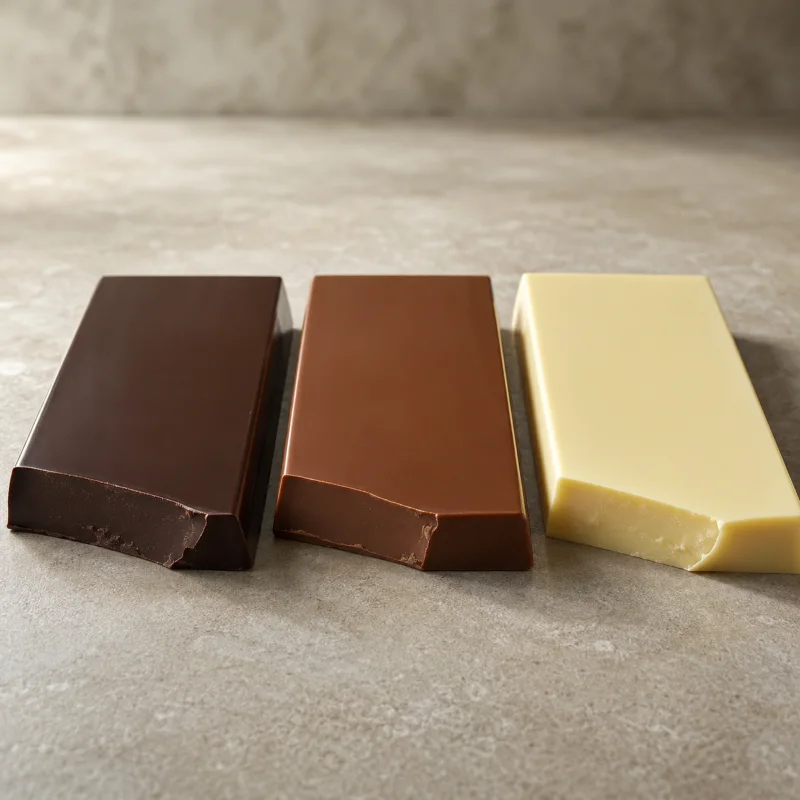
What determines how chocolate behaves in pastry work?
Dark, milk, white and ruby chocolate do not behave identically. Their proportions of cocoa mass, cocoa butter, sugar and milk ingredients, together with fluidity and working temperature, determine whether the melted chocolate flows in a thin ribbon or forms a thick coating. A higher cocoa percentage does not automatically make a chocolate better for every dessert; one temperature cannot suit every formulation.
Choose by the result you need. Properly tempered chocolate starts to set evenly, develops a firm snap and shows no grey streaks. A freshly emulsified ganache needs a different test: it should be smooth, homogeneous and free from a separate ring of fat. Gloss may indicate a good emulsion while mixing, but it is not a universal measure of how every ganache should look once set.
The composition of chocolate matters more than the name on its wrapper.
For lumpy, streaky or split coatings, see how to rescue a chocolate glaze. For a smooth, glossy chocolate glaze or a dull coating, use the dedicated troubleshooting guides. When you need crisp shells made from real couverture, follow the home chocolate-tempering method.
A thin praline shell, a brownie and a sliceable ganache call for different fluidity and different balances of fat, liquid and solids. Decide on the finished texture before choosing the chocolate.
What is chocolate actually made of?
Chocolate is a dispersion of tiny solid particles in a continuous fat phase, mainly cocoa butter. The solids include cocoa particles, sugar and, in milk or white chocolate, milk ingredients. Pure chocolate contains very little water: its sugar remains as fine particles surrounded by fat rather than dissolving.
This explains why steam or a few drops of water can suddenly turn melted chocolate into a thick, grainy mass.
Cocoa mass contributes flavour, colour and bitterness
Cocoa mass is made by grinding roasted cocoa nibs. It contains both cocoa butter and non-fat cocoa solids, which provide colour, acidity, bitterness and roasted and fruity notes. More cocoa mass often gives stronger flavour but also more particles; a chocolate with the same cocoa percentage and more added cocoa butter may therefore flow much more easily.
Cocoa butter governs melting and fluidity
Cocoa butter gives chocolate its characteristic melting behaviour. When crystallised correctly it contributes sheen, a clean snap, contraction during cooling and a pleasant melt in the mouth. At the appropriate temperature, a chocolate richer in cocoa butter generally flows more freely, allowing couverture to form thinner moulded shells than thicker baking chocolate.
Sugar affects more than sweetness
The quantity and particle size of sugar affect texture and viscosity. Sugar does not dissolve in cocoa butter. When a little water reaches the particles, their surfaces become wet and stick together, causing the chocolate to seize. Such chocolate cannot be tempered as it stands, but sufficient additional liquid can turn it into a sauce or ganache.
Milk ingredients change the structure
Milk and white chocolate contain milk proteins, lactose and often milk fat. They soften the bite and round out the flavour. Their melting and working temperatures are usually lower than those of dark chocolate. Excessive heat can thicken white chocolate, spoil its clean flavour and give it a yellowish cast, depending on the formulation.
What does the cocoa percentage tell you?
A label stating 70% cocoa does not mean 70% cocoa powder. It usually describes the combined proportion of cocoa-derived ingredients, including cocoa mass and cocoa butter. Two 70% chocolates can differ substantially: one may be rich in cocoa solids and comparatively thick, while the other contains more cocoa butter and pours easily.
The percentage on its own cannot tell you how much cocoa butter is present, how fluid or bitter the chocolate will be, whether it will produce a clean snap, whether it suits shells, ganache or cakes, or whether its flavour leans towards fruit, roast or milk.
A higher percentage is not a guarantee of higher quality. For moulded pralines prioritise fluidity and snap; for ganache consider flavour, the concentration of solids and the firmness you need.
How do dark, milk, white and ruby chocolate differ?
Dark chocolate
Dark chocolate contains cocoa mass, cocoa butter and sugar. It can work in glazes, ganache, mousse, pralines, brownies, cakes and decorations, but a single dark chocolate will rarely be best for every use. Choose fluid couverture for thin shells. A cocoa-rich chocolate may give a more intense ganache, but its extra solids usually require an adjusted liquid ratio.
More bitterness does not necessarily mean more flavour complexity. Origin, fermentation and roasting influence acidity, fruitiness and roasted notes. See the guide to developing deeper chocolate flavour without extra sugar.
Milk chocolate
Milk chocolate typically has fewer non-fat cocoa solids, more sugar and added milk ingredients. It tastes gentler, sets with a softer bite and uses a lower working temperature. Replacing dark chocolate with the same weight of milk chocolate in a ganache will not yield the same firmness. A higher chocolate-to-liquid ratio is often needed, but the actual formula and serving temperature determine the result.
White chocolate
White chocolate contains cocoa butter, sugar and milk ingredients but no brown non-fat cocoa solids. It is especially sensitive to overheating. Melt it gently, taking the bowl off the heat while a few pieces are still visible, then stir until the residual heat finishes the job. For colouring, choose fat-soluble colours: water-based colouring may make it seize.
Ruby chocolate
Ruby chocolate has a naturally pink appearance and a fruity, slightly acidic flavour; it is not merely white chocolate with pink dye. It pairs well with fruit, pistachio, almond and vanilla. Prolonged heating or strongly alkaline ingredients can dull its colour. Consult the specific manufacturer's processing curve.
Couverture, baking chocolate or compound coating: which is which?
Couverture is formulated with sufficient cocoa butter to flow well for dipping, moulding and thin praline shells. Its technical value lies in predictable fluidity, not just flavour. Check the maker's intended uses and fluidity specification: an ingredient list alone may not tell you whether it will coat a mould thinly.
Baking chocolate can be thicker or designed to retain chips during baking, or to provide a particular mix of fat, sugar and cocoa solids to a batter. It can be excellent in biscuits while being unsuitable for thin moulded shells.
Compound coating replaces some cocoa butter with other vegetable fats. Many products set quickly without classic cocoa-butter tempering, but their flavour, melting and snap differ from real chocolate. Do not mix compound coating with couverture unless the fat systems are known to be compatible: you may end up with a greasy, soft or unstable finish.
| Application | Preferred choice | Decisive property |
|---|---|---|
| Thin praline shells | Fluid couverture | Thin coating and controlled contraction |
| Chocolate bars | Couverture or suitable bar chocolate | Sheen and clean snap |
| Ganache | Chocolate with known composition | Predictable liquid balance |
| Brownies and sponge cakes | Chocolate suited to the recipe | Ratio of fat, sugar and cocoa |
| Chocolate chips in cookies | Baking chocolate or bake-stable chips | Controlled melting in the oven |
| Crisp coating | Tempered couverture | Thin, firm shell |
| Soft glaze | Ganache or soft chocolate glaze | Slices without sharp cracking |
| Quick coating without tempering | Compound coating | Fat system not requiring classic tempering |
Start with the finished dessert rather than the percentage on the front of the package.
Why are melting and tempering different?
Melting liquefies cocoa butter; tempering controls the formation and retention of stable cocoa-butter crystals as the chocolate is shaped and cooled. Chocolate can be completely melted yet not be tempered. For many pastry applications, the desirable crystal structure is commonly referred to as form V, which gives sheen, contraction and a firm, clean break.
Typical reference ranges for classic couvertures are:
| Chocolate | Fully melt | Cool to | Working temperature |
|---|---|---|---|
| Dark | 50–55 °C | 28–29 °C | 31–32 °C |
| Milk | 45–50 °C | 27–28 °C | 29–30 °C |
| White | 45–50 °C | 26–27 °C | 28–29 °C |
These are common professional reference curves, not rules for every product. Ruby and other special chocolates can require different treatment; one Callebaut ruby couverture, for example, is specified at approximately 45 °C for melting, 27 °C for cooling and 28.5–29.5 °C for working. Always follow the maker's product-specific instructions over a general table.
Too much heat can melt the stable seed crystals. Too little heat may allow excess crystallisation, thickening the chocolate and producing an overly heavy coat. For a complete seeded method, follow how to temper chocolate at home.
How can you recognise a good temper?
Spread a thin smear on baking parchment, a palette knife or the cool edge of a metal bowl. At ordinary room temperature it should start to set evenly within a few minutes, with no wet streaks or grey patches. When fully set, it should feel firm and smooth. The time is only a guide; judge the surface and firmness together.
How should chocolate be used in ganache, glazes, creams and pralines?
Ganache needs an emulsion, not tempered chocolate
Ganache combines chocolate with cream, milk, fruit purée or another liquid. Fat and water must form a fine, stable emulsion. Fresh ganache should be smooth and homogeneous, with no separate oily rim or dark watery streaks under the spatula. Dark, milk and white chocolates do not use interchangeable ratios; milk and white usually require more chocolate per unit of liquid to obtain comparable firmness. Exact ratios depend on the chosen product and use.
For the mixing technique, consult the guide to smooth, stable chocolate ganache.
Not every chocolate glaze is the same mixture
A 'chocolate glaze' might be tempered pure chocolate, ganache, chocolate diluted with cocoa butter or a softer coating made with a different fat. Tempered couverture makes a crisp shell; ganache stays softer and slices without a sharp crack. Fat-adjusted glazes can be more flexible but do not have the same snap.
Match the temperature and fluidity of the glaze to the dessert. An overly thick glaze sets before it levels on a very cold cake; on a cake that is too warm it can run off or fail to form the intended structure. For separated coatings see glaze troubleshooting, for the finish see glossy chocolate glazing, and for grey or dull results see why glaze turns matte.
Mixing temperature matters in chocolate mousse
The chocolate base must not be so hot that it melts whipped cream, nor so cold that it hardens into grains on contact with the cooler foam. Whip cream to soft peaks. First mix in a small portion more firmly to reduce the density difference, then fold in the remainder gently. The balance of fat, air and liquid is explained further in stable cake creams and mousses.
Pralines depend on fluidity and a clean snap
Use adequately fluid couverture for moulded shells. Chocolate that is too thick leaves walls heavy, reduces space for filling and gives a hard bite. Keep moulds completely clean, dry and free of greasy film. Chocolate reproduces the mould's finish: a glossy mould gives a glossy shell; scratches or dullness transfer to the surface.
Allow room for a closing layer above ganache filling. The filling's surface must be stable and free of condensation, otherwise the bottom layer will not seal properly.
How can you prevent bloom, seizing and loss of shine?
Grey or whitish chocolate is not necessarily mould. The two common forms of bloom have different causes. Fat bloom can follow poor cocoa-butter crystallisation, temperature swings or fat migration from a filling. The surface may be smooth, patchy and slightly greasy. Sugar bloom follows moisture: condensation dissolves surface sugar and leaves coarse, dry crystals as it evaporates.
Store chocolate dry, protected from light and strong odours, at a reasonably cool and stable temperature; follow the manufacturer's storage requirements. Refrigerate only when the finished product calls for it. Before moving cold chocolate into a warm room, seal it airtight and leave it wrapped until its temperature has equalised, to minimise condensation.
Before your next recipe, ask whether you need a crisp tempered shell, a soft emulsion or a chocolate ingredient that will bake into the batter. That decision determines the right chocolate, its fluidity and the correct method.
Diagnostics
Common problems and solutions
Chocolate is too thick for a thin moulded shell
Cause: The couverture has insufficient fluidity for that use.
Solution: Check the product data sheet and choose a more fluid couverture instead of simply raising the temperature.
Ganache shows a ring of free oil
Cause: The fat–water emulsion has broken.
Solution: Check mixing temperature and homogenise again using the dedicated ganache and glaze troubleshooting guides.
Frequently asked questions
Answers to common questions
Can I gently reheat chocolate that has cooled while working?
Yes, but only within its recommended working temperature. If you melt the stable seed crystals, temper the chocolate again.
Why does tempered chocolate become thicker without water entering?
More cocoa-butter crystals develop during work, increasing viscosity. Warm gently towards the top of the recommended working range.
What if the maker does not specify fluidity?
Test a small amount in a mould at the correct working temperature. If it leaves thick walls, it is not fluid enough for thin shells.
Is refrigeration always wrong for setting chocolate?
No. Short, controlled cooling can help, but long refrigeration and immediate transfer into a warm, humid room increase condensation and sugar-bloom risk.
Can ordinary chocolate be used for pralines?
Only if it can be tempered correctly and flows thinly enough at working temperature. Thick baking chocolate gives heavy moulded walls.