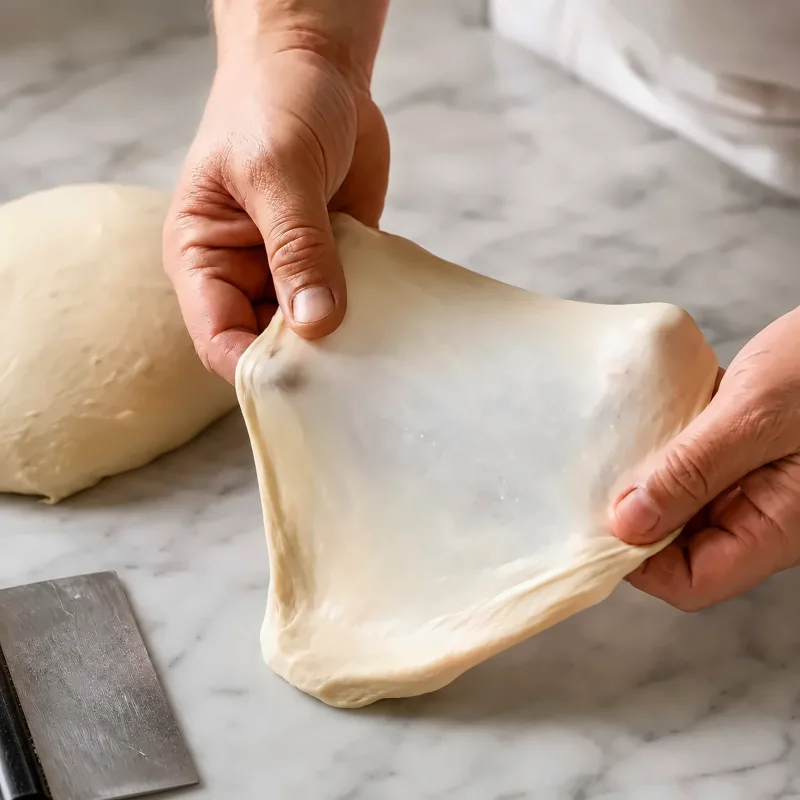
The gluten network forms when wheat proteins hydrate and connect into a viscoelastic structure. Mixing, stretching and time then reorganise that structure. For reliable dough, do not chase “maximum strength”. You need a workable balance: enough elasticity to hold shape and gas, and enough extensibility to expand without tearing.
That distinction matters because three common symptoms are not the same problem: dough that tears immediately, dough that snaps back like a rubber band, and dough that spreads with little support.
What is the gluten network?
Gluten is a connected structure, not a single strand
Two important groups of wheat gluten proteins are glutenins and gliadins. As a useful simplification, glutenin polymers contribute strongly to strength and elastic response, while gliadins contribute more to flow and extensibility. The final behaviour, however, belongs to the whole dough system: flour characteristics, water, mixing, time, salt, fat, sugar and fermentation all change what you feel in your hands.
Water allows the proteins to hydrate and become mobile. Mechanical work then aligns, stretches and reconnects the developing protein structure. The network surrounds starch granules and helps the dough retain gas later in fermentation.
Elasticity and extensibility are not the same
Elasticity is the tendency of dough to return partly toward its previous shape after deformation. Extensibility is the ability to lengthen before tearing.
Bread and pizza dough usually need both. A very elastic but poorly extensible dough fights shaping and shrinks back. A very extensible dough with too little structural support can spread and lose form. That is why “more elastic” does not automatically mean “better”.
If dough keeps snapping back, more kneading is often not the first useful move. A covered rest can reduce mechanical tension and improve handling. If the dough spreads without resistance, look instead at development, hydration, fermentation and possible structural weakening.
Water enables development; mixing directs it
Dry flour cannot form a useful gluten network without hydration. Too little water leaves the mass stiff and makes continuous development difficult. More water can improve mobility and extensibility, but the dough also becomes softer and harder to control. The practical question is not “is higher hydration better?” but “can this flour and this process still support this amount of water?”
Mixing adds mechanical energy and develops the network, but more is not endlessly better. Powerful mixers can pass the optimum development point. Judge changes in consistency and stretch, not only the clock.
Why resting changes dough behaviour
After the first mix, flour continues to absorb water and mechanical tension in the dough can relax. This is why dough often stretches more easily after a rest even without extra kneading.
Not every rest is an autolyse. In classic baking usage, autolyse is a specific pre-mix rest built around flour and water before the process continues. A general dough rest is a broader concept. For troubleshooting, the important point is simple: if cohesive dough keeps shrinking back during rolling or shaping, rest can be more useful than force.
How to recognise a sufficiently developed network
The windowpane test can help: stretch a small piece slowly and see whether it can thin into a membrane before tearing. But do not use it as a universal pass/fail test.
Read it together with other signs:
- the dough is more cohesive and smoother than after the initial mix;
- the stretched edge does not immediately tear into coarse jagged pieces;
- folding or shaping creates some surface tension;
- the dough can lengthen without instantly snapping back;
- during fermentation it can retain gas without the structure collapsing immediately.
Whole-grain bran can interrupt network continuity, so a perfectly transparent window is not always a sensible target. Rye and gluten-free doughs use different structural systems, making the test even less transferable.
Five symptoms, five different decisions
1. The dough tears immediately
If it is dry, rough or unevenly hydrated, first allow time for hydration and then reassess. Immediate extra kneading is not always the right answer.
2. The dough stretches but snaps back strongly
This points mainly to elastic tension. Cover the dough and let it relax. Adding flour can make the handling problem worse.
3. The dough spreads with almost no recoil
Do not label this automatically as “not enough gluten”. Possible causes include underdevelopment, excessive hydration for the flour, advanced fermentation or structural weakening.
4. Machine-mixed dough becomes shiny, soft and suddenly loses tension
A powerful mixer can develop the network and then, with enough continued energy, begin to weaken it. Stop mixing and assess the structure rather than trying to rescue it with flour.
5. Whole-grain dough does not form a perfect windowpane
That alone is not proof of failure. Bran interferes with network continuity. Judge shape retention and gas holding as well as membrane transparency.
Formula ingredients change the network
Sugar competes for available water. Fat changes lubrication and interactions in the dough and can slow protein hydration depending on timing and formula. Bran can interrupt continuity. Salt, acidity and enzymes also affect dough behaviour.
So do not judge brioche, pizza and lean bread with one identical standard. The useful endpoint is the structure required by that product.
Gluten helps retain gas, but it does not create open crumb by itself
A developed network is important for gas retention, yet crumb structure also depends on fermentation, shaping, gas-cell distribution and baking. Large holes are not automatic proof of “good gluten”, and a tight crumb is not automatic proof of under-kneading.
When troubleshooting, change one major variable at a time. If the dough tears, separate hydration from development. If it shrinks back, test rest and relaxation. If it spreads, check development, hydration and fermentation before changing the formula.
PEKI recommend: assess three properties together — how far the dough stretches, how strongly it returns, and whether it still holds shape after handling. That combination is more useful than blindly counting kneading minutes or chasing one perfect windowpane.
Diagnostics
Common problems and solutions
The dough tears immediately into rough edges during a gentle stretch.
Cause: The proteins may be insufficiently hydrated, the network may be underdeveloped, or the chosen hydration may not suit the flour.
Solution: Allow a rest first and reassess the stretch; only then decide whether more mixing or a water adjustment is needed.
The dough stretches but snaps back strongly during shaping.
Cause: The network has a strong elastic response and is mechanically tense.
Solution: Cover the dough and let it relax, then shape again with less force.
The dough spreads and barely holds shape after folding.
Cause: Possible causes include insufficient development, too much water for the flour, advanced fermentation or structural weakening.
Solution: Review the dough history—hydration, development before fermentation and current fermentation state—rather than automatically adding flour.
After long machine mixing the dough becomes very shiny, soft and suddenly loses tension.
Cause: Mechanical work may have passed the optimum development point and the network can begin to break down; heating changes the behaviour further.
Solution: Stop mixing and assess the structure without adding more flour; reduce energy input in the next batch.
Whole-grain dough does not form a perfectly transparent windowpane but still holds shape and fermentation gas.
Cause: Bran particles interrupt network continuity, so a perfect membrane is less likely.
Solution: Also judge structural support, stretch and gas retention; do not overmix solely to chase a transparent membrane.
Technical terms
Terms worth understanding
- Gluten network
- The viscoelastic protein structure that develops in wheat dough after gluten proteins hydrate and organise.
- Elasticity
- The tendency of dough to return partly toward its previous shape after deformation.
- Extensibility
- The ability of dough to lengthen before it tears.
- Glutenin
- A group of gluten proteins whose polymers contribute strongly to dough strength and elastic response.
- Gliadin
- A group of gluten proteins that generally contributes more to flow and extensibility.
- Windowpane test
- A practical check in which a small piece of dough is stretched into a thin film; the result must be interpreted in the context of flour and dough type.
Frequently asked questions
Answers to common questions
How do I know the gluten network is developed enough?
The dough becomes more cohesive and smooth, does not tear immediately when stretched and keeps some tension after shaping. The windowpane test is useful as an additional signal, not as the only criterion.
Why does my dough keep shrinking back?
Strong snap-back indicates elastic tension. If the dough is otherwise cohesive, it often needs rest and gentler handling rather than more kneading.
Does more kneading always strengthen gluten?
No. Mixing develops the network toward an optimum, but sufficiently intense continued mixing can weaken its structural support, especially in a powerful mixer.
Is the windowpane test required for every dough?
No. It is less informative for whole-grain, rye, very enriched and differently structured doughs. Always combine it with stretch, support and shaping behaviour.