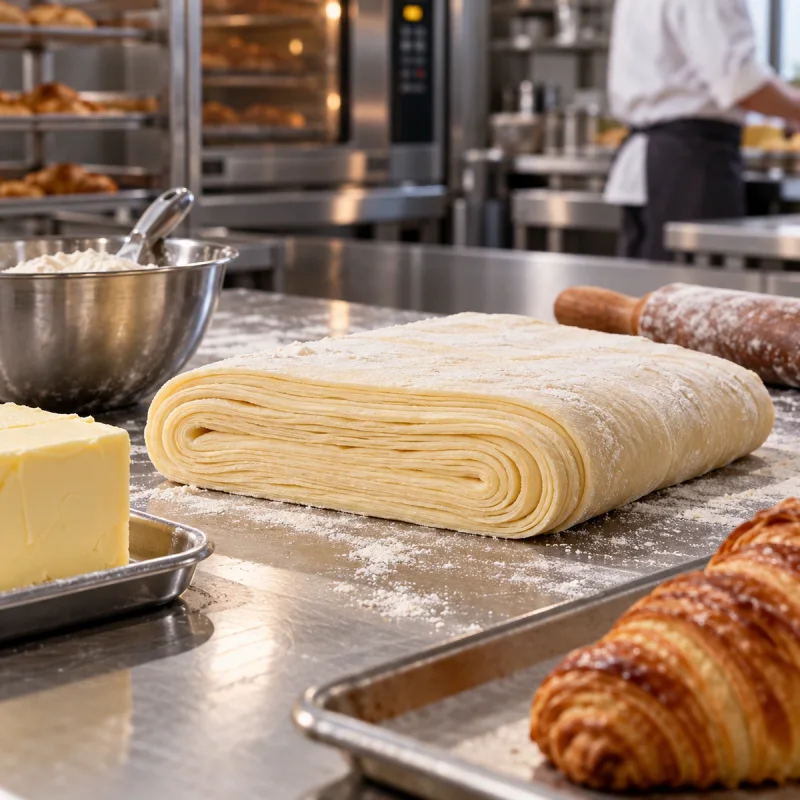
Puff pastry is made by lamination: a sheet of butter is enclosed in a base dough, the packet is rolled and folded several times, and it is chilled between turns until the butter is firm but still pliable. Many failures are caused less by the exact number of folds than by a mismatch between the plasticity of the dough and the butter. Butter that is too hard fractures into plates; butter that is too soft becomes shiny, smears into the dough, and glues the layers together.
What actually creates the layers in homemade puff pastry
Classic puff pastry needs neither yeast nor baking powder. During baking, water in the dough and butter turns to steam. If the fat layers remain sufficiently continuous between sheets of dough, steam pushes those sheets apart until heat sets the structure.
The goal during lamination is therefore not simply to keep everything as cold as possible. Dough and butter need to deform together under the rolling pin. The butter must be firm enough to remain a distinct layer and pliable enough to stretch without breaking.
If the dough snaps back strongly after every pass of the rolling pin, the gluten network is under tension and needs rest. For a wider comparison of pastry structures, see shortcrust pastry vs strudel dough.
What “without added industrial trans fats” means
Unsalted butter is the simplest choice for homemade puff pastry. That is not the same as a laboratory-confirmed claim of 0 g trans fat, because dairy fat naturally contains small amounts of naturally occurring trans fatty acids.
A more accurate statement is no added partially hydrogenated fat, meaning no intentionally added source of industrially produced trans fat.
Margarine by itself does not prove that a product contains an excessive amount of trans fat. For plant-based laminating fat, check both the ingredient list and whether the product is designed for lamination. If partially hydrogenated fat or oil is listed, choose another product for this purpose.
In the EU, trans fat other than trans fat naturally occurring in fat of animal origin is limited to a maximum of 2 g per 100 g of fat in foods intended for the final consumer. That limit does not mean every product contains 0 g.
A practical formula for homemade butter puff pastry
A useful home starting point is:
- 500 g plain or all-purpose wheat flour;
- 250 g cold water;
- 10 g salt;
- 40 g melted and cooled butter in the base dough;
- 350 g unsalted butter for lamination.
Water is about 50% of the flour weight and laminating butter about 70%. This is a working formula, not a universal standard. Different flours absorb different amounts of water, so the finished base dough should be cohesive and extensible, not so dry that the edges crack and not so soft that it cannot hold its shape without excessive flour.
Butter around 82% milk fat is a practical choice. Professional dry or laminating butter can make the process easier but is not essential at home. Fat percentage alone does not tell you how the butter will behave at your actual working temperature.
Mix the base dough only until it is cohesive
Mix the flour and salt, then add the water and 40 g melted but cooled butter. Mix until dry patches of flour disappear and the dough comes together evenly. Classic puff pastry does not require the degree of gluten development you would seek in a strong bread dough.
Shape the dough into a flat square, wrap tightly, and chill for about 30 to 45 minutes. A flat shape cools more evenly than a thick ball, while wrapping prevents a dry skin.
If the dough springs back after each pass, do not fight it with more force. Resting is part of the method.
Prepare the butter for plasticity, not just a target temperature
Shape 350 g butter between two sheets of baking paper into an even square or rectangle. Pay particular attention to the edges: thin or broken edges create uneven lamination later.
Do not rely on one universal butter temperature. Different butters have different ratios of solid and liquid fat. Use a simple physical test: under gentle pressure, the butter should bend without cracking and should not look greasy or shiny.
Roll the base dough so the butter block can be enclosed completely. Seal the seams without creating a thick lump of dough in the centre.
Similar plasticity matters more than matching one exact temperature.
If the butter is much harder than the dough, it fractures into plates on the first passes. If it is too soft, it squeezes toward the edges or smears into the dough. Both destroy the continuous layers needed for even lift.
Fold systematically and chill according to the dough’s condition
First lengthen the sealed packet with several gentle taps, then roll it into a long rectangle. Brush away excess flour before folding.
For a single turn, fold the bottom third toward the centre and the top third over it like a business letter. Rotate the packet 90° and chill when needed.
For home baking, four single turns are a useful starting system, not the only correct one. Professional formulas use different combinations of single and double turns. More folds are not automatically better.
Between cycles, chill for about 20 to 30 minutes or until the packet is evenly firm again. In a cool kitchen you may sometimes complete two turns in succession; in a warm room the dough may need a rest after every turn.
If the surface starts to shine, butter pushes out at the edge, or the dough becomes suddenly sticky, stop rolling and chill immediately. For sticking, tearing, or persistent shrinkage, see how to roll out dough without sticking, tearing, or shrinking.
Rest after the final turn before finishing
After the final turn, wrap well and chill for at least about one hour. A longer cold rest often makes final rolling easier because tension in the dough has more time to relax.
For many small pastries, a final thickness around 3 to 4 mm is a useful starting point. Mille-feuille, turnovers, vol-au-vent, and filled pastries may require different thicknesses and baking profiles.
Cut with a sharp straight blade. A blunt blade or twisting a cutter can compress the edge layers. Keep egg wash on the top surface; if it runs down a cut edge it can glue layers together and reduce lift. Chill shaped pieces again before baking if the butter softened during shaping.
Baking must create lift first, then dry the centre
Puff pastry needs a well-preheated oven. For unfilled pieces about 3 to 4 mm thick, roughly 200 to 220°C is often a useful starting range, but the correct setting depends on size, filling, tray, heating mode, and the oven’s actual temperature.
Avoid opening the oven unnecessarily during the early stage. Once the pastry has lifted, it still needs enough time for the inner layers to dry. A golden exterior alone does not guarantee a properly baked centre.
Well-baked puff pastry has clearly separated layers and a dry, crisp centre without a heavy gummy band.
Diagnose the type of failure before changing the method
Large cavities next to thick compact areas often indicate butter that was too hard and fractured. A greasy surface or butter leaking at the edge points to a packet that became too warm. Persistent shrinkage calls for more resting time. Low edges with a partly raised centre suggest checking the blade and egg wash. If the outside is dark but the centre remains soft and gummy, the baking profile did not dry the pastry adequately for its thickness.
A plant-based version still needs a laminating fat
For dairy-free puff pastry, use a plant fat that is sufficiently plastic at working temperature and is specified as suitable for lamination. Liquid oil cannot directly replace a butter block in classic puff pastry because it cannot form a stable separating layer.
Very soft table margarine is not automatically suitable either. Before making a large batch, perform one test fold. If the fat remains evenly distributed, does not crack, and does not leave greasy patches, its working range is probably suitable.
Diagnostics
Common problems and solutions
The baked pastry has large cavities separated by thick compact layers.
Cause: The butter was too hard during rolling and fractured into separate plates.
Solution: Before the next turn, wait until the butter bends under gentle pressure without cracking, then resume rolling.
The dough surface becomes greasy while rolling or butter leaks from the edges.
Cause: The butter is too soft relative to the base dough or the packet stayed warm for too long.
Solution: Wrap and chill immediately until the surface is dry and the packet is evenly firm again.
The dough shrinks strongly after each pass of the rolling pin.
Cause: The gluten network is under tension and did not have enough relaxation time between turns.
Solution: Stop rolling and rest the dough in the refrigerator for at least about 30 minutes.
The edges stay low even though the centre rises partly.
Cause: The blade or cutter compressed the layers, or egg wash ran over the edge and glued them together.
Solution: Cut with a sharp straight blade and keep egg wash only on the top surface.
The pastry is golden outside but soft and gummy in the centre.
Cause: The structure lifted, but the centre did not receive enough time or an appropriate heat profile to dry.
Solution: Adjust time and, if needed, temperature after initial lift; do not judge doneness by surface colour alone.
Technical terms
Terms worth understanding
- Lamination
- Repeated rolling and folding of dough with separate fat layers that create the flaky structure during baking.
- Base dough
- The mixture of flour, water, salt and a smaller amount of fat that encloses the butter block.
- Fat plasticity
- The ability of butter or another fat to extend under pressure without cracking, leaking or blending into the dough.
- Single turn
- Folding a rolled rectangle into thirds like a business letter.
- Partially hydrogenated fat
- Fat whose unsaturated bonds have been only partly hydrogenated industrially, a process that can form trans fatty acids.
Frequently asked questions
Answers to common questions
Can I use ordinary table margarine for puff pastry?
Only if it is firm enough for lamination and the ingredient list does not contain partially hydrogenated fat. Very soft table margarine often smears into the dough during rolling.
Can I freeze prepared puff pastry?
Yes. After the final rest, roll it into a slab, protect it tightly from drying, and freeze. Thaw in the refrigerator so the butter does not soften before the base dough.
Why does puff pastry not need baking powder?
Steam from water in the dough and butter creates the lift. Fat layers temporarily trap steam between sheets of dough, pushing them apart during baking.