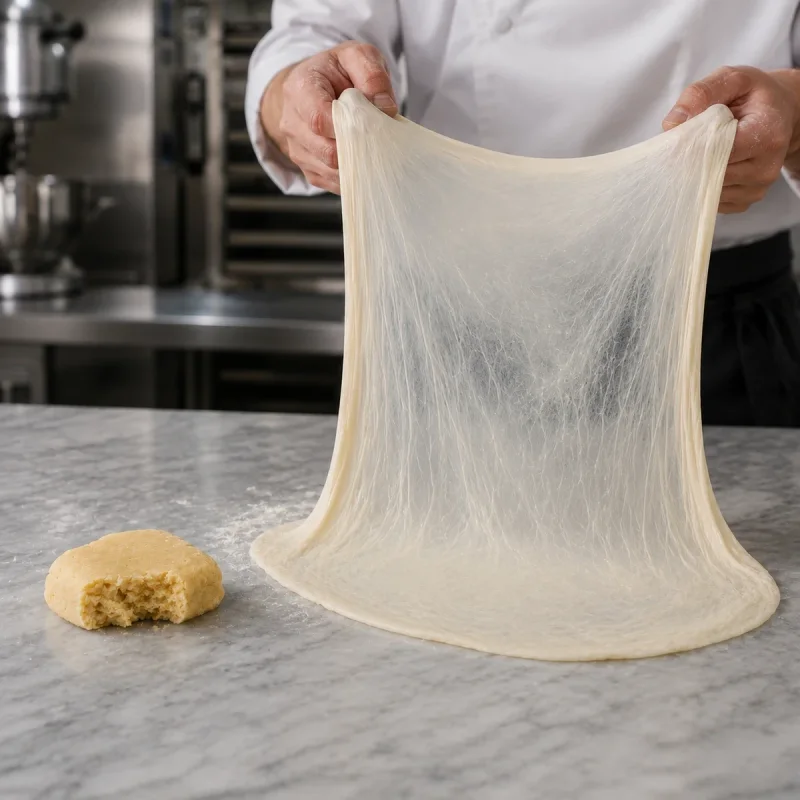
Shortcrust pastry should break cleanly; strudel dough must stretch
A rolling pin quickly reveals the difference between these two doughs. Well-made shortcrust rolls into a compact, pliable sheet, but its baked texture should be short and crumbly rather than elastic. Strudel dough has the opposite task: after kneading and resting, it should stretch into a thin, almost translucent membrane without tearing across the surface.
Gluten is the key variable. In shortcrust pastry, fat, limited liquid and brief handling restrict its development. In hand-stretched strudel dough, hydration and kneading build a strong network; resting then reduces the tension that would make the sheet spring back. Kneading shortcrust like bread makes it tough; under-kneading strudel dough leaves it prone to tearing.
Ingredient ratios are a starting point, not a fixed formula
For a basic shortcrust, roughly 50–60 g of fat per 100 g of flour is a useful starting range. Add the liquid gradually, stopping as soon as the crumbs hold together when squeezed. The precise amount depends on flour absorption, the fat used, and whether the formula contains eggs or sugar. More fat generally makes the pastry more tender but less robust; excess water makes gluten formation and subsequent shrinkage more likely. Sugar also affects tenderness, browning and moisture retention, so a sweet tart dough cannot be treated exactly like a savoury one.
For strudel dough, begin by considering roughly 55–60 g of water per 100 g of flour, with salt and a little oil, then adjust to the actual flour. This is an orientation, not a universal hydration requirement. A flour with greater absorption may need more water, while a softer flour may become sticky at the same percentage. The protein figure on a bag does not guarantee stretchability: judge the kneaded dough by whether it can be pulled slowly into a thin film before breaking.
Building a tender yet workable shortcrust
With the rubbing-in method, work cold fat into the flour before adding water. Some flour particles become coated with fat, limiting protein hydration. A coarse, uneven crumb produces a slightly more irregular, flaky bite; a finer crumb gives a more uniform, sandy break. Add the liquid last and mix only until the dough comes together when pressed. A smooth, springy dough is usually a sign that shortcrust has been worked too much.
Press the dough into a flat disc or rectangle, wrap it well and chill for 30–60 minutes. This evens out moisture, firms the fat and relaxes some gluten tension. A flat piece chills more evenly than a thick ball. Roll it when cool but still pliable: deep cracks at the rim usually mean it is too cold or insufficiently hydrated. If its surface becomes shiny and sticky, chill it for another 10–15 minutes instead of adding increasing amounts of flour.
For large pastry sheets, see how to roll dough without sticking or tearing; a consistently thick sheet is essential when lifting it into a tin.
Thickness, lining and resting prevent shrinkage
For many pies and tarts, 3–4 mm is a practical starting thickness. A thinner base can crumble under a heavy filling; an overly thick one may bake slowly and remain pale. Lay the pastry over the tin, lift the outer edge and ease it into the corners. Do not pull it tight against the sides: stretched pastry tends to contract in the oven.
Chill the lined shell for at least 20–30 minutes before baking. Small tartlet moulds are especially unforgiving of uneven thickness; mini tart shells without cracks need even support, careful handling and sufficient chilling.
Blind baking helps when a filling is wet, bakes more quickly than the crust or is added after the crust is cooked. Line the pastry with baking paper and enough weights to support the sides, not just the centre. For a 24–26 cm shell about 3–4 mm thick, around 180°C in a conventional oven is a starting point. Bake with weights until the rim is set and lightly coloured, then remove them and continue until the base no longer looks raw or greasy. The tin, sugar content and thickness all affect the time.
A wet filling can ruin a well-made pastry shell
Water from an excessively wet filling migrates into a raw or partly baked base. The starch can gelatinise without the pastry drying sufficiently, leaving a soft underside. Drain or bind free moisture and cool the filling before assembly; a hot filling can melt the fat in a cold pastry case even before baking starts. For savoury pies, the timing of assembly matters as much as the formula. The guide to shortcrust for savoury tarts without a soggy base explains when to blind bake and how to limit moisture transfer.
Strudel dough needs a strong gluten network that can relax
Hydration allows wheat proteins to connect, and kneading develops a flexible sheet able to hold together at very low thickness. Mix the ingredients into a rough dough, then knead until the mass is smooth, cohesive and visibly extensible. Do not rely solely on minutes: the useful test is a slow stretch that produces a thin membrane before the dough tears. A ragged surface and abrupt breaks suggest insufficient kneading or too little water.
Shape the dough into a smooth ball, coat it lightly with oil and cover it against drying. For dough used the same day, allow around one hour of rest. This redistributes moisture and relieves gluten tension; it cannot repair an inadequately developed network. Refrigerated dough should warm evenly while covered before stretching. Even a thin dry skin can initiate a tear when the interior begins to extend.
Stretch from the centre towards the edges
Roll the rested dough into a thin round or rectangle, then lift it over the backs of your hands or gently over your knuckles. Let gravity help while you apply broad, even pressure, not concentrated pressure from your fingertips. Work from the thicker centre outwards and finish on a lightly floured cloth. Stretch or trim the thick rim so that the sheet is uniformly almost transparent rather than heavy through its middle.
If it keeps retracting, cover the dough and wait another 10–15 minutes. Pulling harder only increases tearing. An isolated hole near the edge may be trimmed or covered when rolling; repeated tears across the sheet suggest a dry surface, weak flour, insufficient kneading, inadequate hydration or too little rest. Flour with about 10–12% protein can be a starting point for troubleshooting, but the dough's actual behaviour is the deciding factor.
Keep fillings cool and free of excess liquid
A thin strudel sheet has little mass and a large surface area: it browns quickly but absorbs released liquid just as readily. Cool the filling before spreading it. With juicy fruit, use a measured amount of breadcrumbs, finely ground nuts or suitable starch to absorb some of the juice; a thick dry layer makes the filling unpleasantly powdery.
Brush the stretched pastry with a thin layer of fat to help keep the rolled layers distinct. Too much fat can pool underneath. Roll without pressing the filling into a hard cylinder, and position the seam underneath. For many strudels, 190–210°C in a conventional oven is a useful initial range, but the finished underside must be well baked and the top evenly brown and dry; timing depends on size and filling.
Shortcrust, strudel and puff pastry are not interchangeable
Shortcrust limits gluten development; strudel dough deliberately develops it and is stretched by hand. Puff pastry is a different system: separate layers of dough and plastic fat are built by repeated folding and rolling, and steam lifts those layers during baking. Strudel's thin layers result from stretching and rolling around filling, not lamination. If you want airy, visibly risen layers, follow the technique for homemade butter puff pastry and its folds, keeping dough and butter at compatible working temperatures.
Choose the pastry by the result you want
| Feature | Shortcrust pastry | Hand-stretched strudel dough |
|---|---|---|
| Main aim | Tender, short break | Thin, extensible membrane |
| Gluten | Deliberately limited | Developed, then relaxed |
| Technique | Brief mixing and chilling | Kneading, resting and stretching |
| Typical thickness | About 3–4 mm for a pie base | Almost translucent |
| Main failures | Toughness, shrinkage, sogginess | Tearing, spring-back, gummy layers |
| Best uses | Pies, tarts, tartlets, biscuits | Strudels and other hand-stretched sheets |
For a tart that must carry a fruit or cream filling, choose shortcrust. For a roll wrapped in a thin sheet, choose strudel dough. For tall, separated layers, choose laminated puff pastry. Set the mechanical goal before mixing: should gluten be restricted so the baked pastry breaks cleanly, or developed so the raw dough stretches without tearing?
Diagnostics
Common problems and solutions
The shortcrust pastry is hard and chewy after baking instead of breaking cleanly when cut.
Cause: Too much liquid was added or the dough was worked for too long, allowing an overly strong gluten network to develop.
Solution: Add liquid gradually and stop mixing as soon as the crumbs hold together when pressed. Do not knead shortcrust into a smooth, elastic dough.
Deep cracks form around the edge of the shortcrust as it is rolled out.
Cause: The dough is too cold, insufficiently hydrated, or the moisture has not yet distributed evenly after mixing.
Solution: Leave the dough at room temperature for 5–10 minutes and gently press the cracks together. If the whole batch still crumbles, work in a few grams of cold water, a drop at a time, using gentle presses rather than more kneading or fat.
The shortcrust shrinks or slips down the sides of its tin while baking.
Cause: It was stretched when lining the tin, rested insufficiently, or went into the oven too warm.
Solution: Ease the dough into the corners without stretching and chill the lined case for at least 20–30 minutes. Leave the rim slightly proud and trim once it has set.
Strudel dough repeatedly springs back and contracts during stretching.
Cause: The gluten network is still under tension after kneading, or the dough is too cold.
Solution: Cover the dough and rest it for another 10–15 minutes. If refrigerated, let it come evenly to room temperature while covered before stretching.
The strudel dough tears in many places and will not stretch into a thin sheet.
Cause: It may be underhydrated, insufficiently kneaded, dried out on the surface, or made with flour that cannot form a strong enough network.
Solution: Flour containing roughly 10–12% protein is a starting point, not a guarantee. Check that the kneaded dough slowly stretches into a thin membrane before tearing. Lightly oil it and keep it fully covered while resting.
The bottom of the tart or strudel is soft and wet after baking.
Cause: The filling contained too much free liquid, was added while hot, or the pastry did not bake through.
Solution: Cool and drain the filling, thickening it if needed. Blind-bake a shortcrust case where appropriate and ensure adequate heat reaches the underside of the strudel.
Technical terms
Terms worth understanding
- Gluten network
- The connected network of wheat proteins that gives dough elasticity, extensibility and structural strength.
- Hydration
- The amount of water compared with flour weight: 60% hydration means 60 g of water for every 100 g of flour.
- Rubbing-in method
- A shortcrust method in which fat is rubbed into flour before liquid is added, limiting the hydration of flour proteins.
- Blind baking
- Baking an empty pastry shell, usually with weights, before adding a wet or already-prepared filling.
- Dough relaxation
- The easing of gluten tension during rest, helping dough roll or stretch with less spring-back.
- Lamination
- Repeatedly folding and rolling dough around separate fat layers to create puff pastry.
Frequently asked questions
Answers to common questions
Can I make shortcrust pastry the day before?
Yes. Keep the dough tightly covered in the refrigerator. Before rolling, allow it to become pliable but still cool; rock-hard pastry tends to crack.
Can strudel dough rest for too long?
A little extra rest can help stretching if the surface stays protected. Refrigerate for longer storage and allow the covered dough to temper gradually before use.
When should I choose ready-made strudel dough?
Choose it when speed and uniformly thin sheets are the priority. Homemade dough is useful when you need to control sheet thickness, size and the balance between pastry and filling.