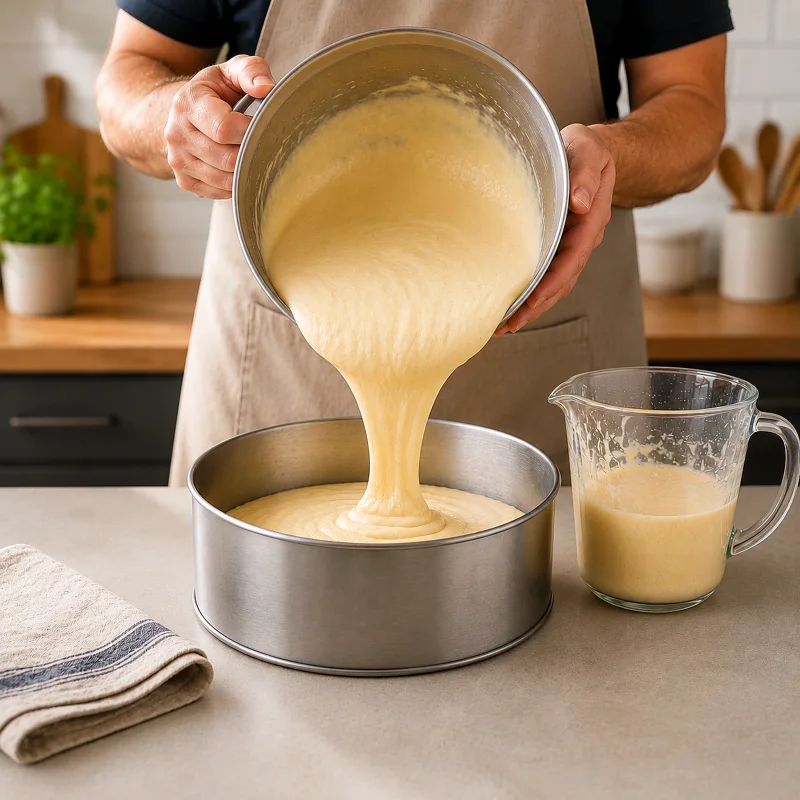
Batter quantity starts with pan area and desired layer depth
If you want the same recipe to bake to roughly the same height in another round pan, do not scale by the centimetre difference. Compare the base areas. For round pans at equal batter depth: factor = new diameter² ÷ old diameter².
Moving from 20 cm to 24 cm gives 1.44, so you need about 44% more of the whole recipe. From 18 cm to 24 cm the factor is about 1.78. For the broader method, see how to scale a cake recipe to another pan size.
If layer depth changes, include the depth ratio
For an intentionally taller or thinner layer, use new diameter² × new depth ÷ (old diameter² × old depth). This is a geometric approximation for the same recipe with comparable batter density. When moving between round and square pans, compare actual base areas; see round-to-square pan conversion.
A universal grams-per-pan chart is not reliable
Foam cakes, butter cakes and dense chocolate batters do not have the same density or expansion. The same weight can therefore sit at different depths in the same pan. Weight is excellent for repeating one recipe, but it is not a universal conversion between different batters.
Do not fill every pan to a universal percentage
Rules such as “always half full” or “always two-thirds full” are too broad. When scaling the same tested recipe, comparable raw batter depth and the headroom required by that recipe are better controls. If the same amount spreads into a much shallower layer in a larger pan, the baked cake will also be shorter; see why a cake is shorter in a larger pan.
Do not change oven temperature automatically after scaling
If batter depth remains similar, start with the proven temperature from the original recipe. A larger diameter alone is not a reason for a fixed temperature reduction. An intentionally thinner layer may finish sooner, while a deeper layer may need a different baking strategy. Actual depth, formula, pan and oven determine the adjustment.
Scale cream and filling separately
For the same filling thickness between layers, the same area factor is a useful starting point. If filling thickness or the number of layers changes, include those changes too. The most reliable workflow is to measure internal diameter, calculate the factor, scale the whole recipe, then check raw batter depth before baking.
Diagnostics
Common problems and solutions
Problem
Problem
Technical terms
Terms worth understanding
- Area factor
- Ratio of target-pan area to original-pan area; for round pans at equal depth it equals the ratio of squared diameters.
- Batter depth
- Height of raw batter in the pan before baking.
- Volume factor
- A ratio that includes both pan area and desired layer depth.
- Batter density
- Mass per unit volume; different batters can occupy different volumes at the same weight.
Frequently asked questions
Answers to common questions
How do I calculate batter for a larger round pan?
For a similar layer height, multiply the entire recipe by new diameter² ÷ old diameter².
How much more batter do I need from 20 cm to 24 cm?
At the same depth the factor is 1.44, so you need about 44% more of the same recipe.
Is there a reliable grams chart for every pan diameter?
Not a universal one. Batters differ in density and rise, so scale the same recipe and compare raw batter depth.
Should every cake pan be filled halfway or two-thirds full?
No. Required headroom depends on the recipe; when scaling the same recipe, comparable raw batter depth is the better reference.
Should I automatically lower the temperature in a larger pan?
No. With comparable batter depth, start with the tested recipe temperature and judge doneness at the centre.