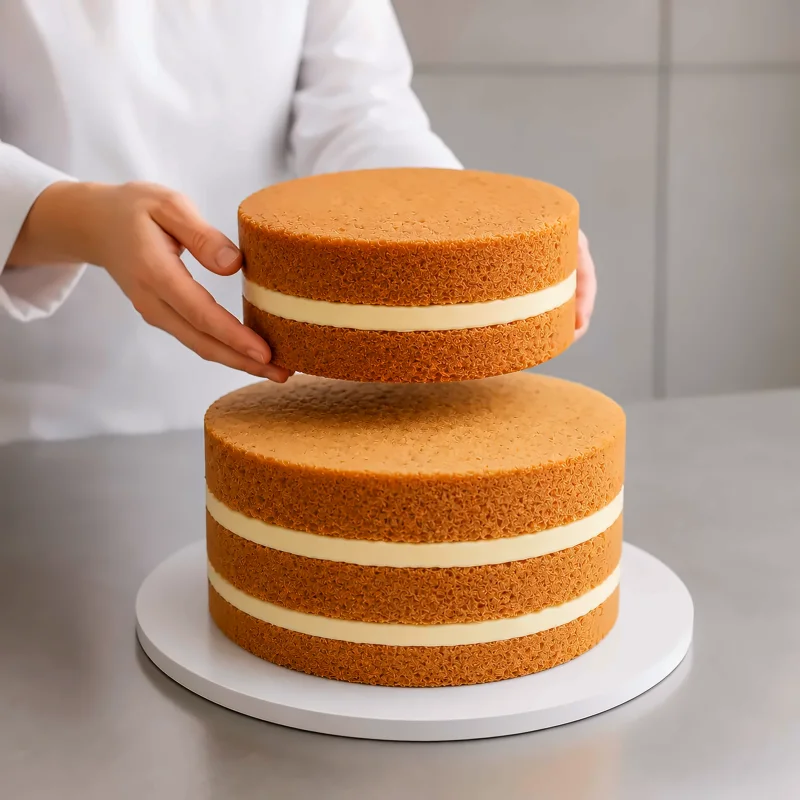
A tiered cake is not one oversized recipe
Each tier has its own diameter, and often its own height and number of filling layers. Calculate each tier separately. For round pans when you want the same batter depth, use:
scale factor = new diameter² ÷ original diameter².
If the new tier will also be a different height, multiply again by new height ÷ original height.
Worked example: 30 + 24 + 18 cm from a 20 cm recipe
For equal-height tiers based on a tested 20 cm recipe, the factors are 2.25 for 30 cm, 1.44 for 24 cm, and 0.81 for 18 cm. Together they equal 4.50 batches of the base recipe.
If that 20 cm recipe produces 900 g of raw batter, the target weights are about 2,025 g for the 30 cm pan, 1,296 g for 24 cm, and 729 g for 18 cm. Weighing the batter into each pan is far more repeatable than dividing one large bowl by eye.
Diameter does not scale linearly
A 30 cm pan is 50% wider than a 20 cm pan, but its circular base area is 2.25 times as large. Multiplying ingredients by only 1.5 would therefore make the larger tier much thinner.
This square-of-diameter rule is the key calculation whenever the shape is the same and the goal is to preserve batter depth.
Different tier heights require a height factor
Suppose the reference cake is 6 cm high but the new tier is intended to be 9 cm high. The height factor is 9 ÷ 6 = 1.5. A 30 cm tier based on the 20 cm reference becomes 2.25 × 1.5 = 3.375 times the base quantity.
For very tall tiers, multiple separately baked layers are often easier to control than one extremely deep pan of batter. Heat has a shorter path to the centre and doneness is easier to judge.
Weigh eggs and small high-impact ingredients
A scale factor often produces a fraction of an egg. Beat the eggs together and weigh the amount required instead of rounding by instinct. Treat baking powder, salt, gelatin and strong flavourings with the same care: calculate first, then round only as much as your scale and formula reasonably allow.
Filling scales by area and by number of filling layers
If the number and thickness of filling layers stay the same, the pan-area factor is a useful starting point. If a 20 cm cake uses 400 g of filling for two internal layers, similarly built tiers would use roughly 900 g at 30 cm, 576 g at 24 cm, and 324 g at 18 cm.
If one tier has more filling layers, include that change too. With mousse, fruit inserts or very soft creams, quantity and stability are separate questions; making more filling does not make it structurally stronger.
Calculate exterior frosting separately
Exterior frosting covers the top and the sides. Its requirement therefore does not scale exactly like an internal filling layer. A tall narrow tier can have substantial side area even when its top is small. Estimate filling and exterior coating as separate jobs, then add a sensible working allowance for smoothing.
A larger diameter does not automatically need a lower oven temperature
If recipe scaling keeps batter depth similar, start with the temperature of the tested base recipe. Do not multiply baking time by the recipe factor. Judge doneness from the actual cake, especially the centre. A much deeper batter layer may need more time or a different baking strategy, but that is a depth issue, not simply a diameter issue.
Frosting is not the structural support system
In a correctly stacked tiered cake, each tier normally sits on its own cake board and the load of upper tiers is transferred through an appropriate support system. The filling must hold the shape of its own tier, but it should not be treated as a substitute for boards and dowels/supports.
Recipe scaling and cake engineering are therefore separate tasks. One tells you how much cake and filling to make; the other determines how the weight is safely carried.
PEK recommends writing the scale factor and target raw batter weight beside every pan before mixing. When the pans are ready to fill, the digital scale—not a ladle or guesswork—becomes the final control.
Frequently asked questions
Answers to common questions
Do you calculate a tiered cake as one large cake?
No. Each tier has its own diameter and, when relevant, its own height. Calculate the factor for each tier separately and add the factors only at the end.
How much base recipe do I need for 30, 24 and 18 cm tiers if the original recipe is for 20 cm?
At equal batter depth, the factors are 2.25, 1.44 and 0.81. Together they equal 4.50 base recipes, but divide the batter between the pans according to the individual factors.
Do I scale the filling by the same factor as the cake batter?
For the same number of internal layers at a similar thickness, the area factor is a useful starting point. If the number of layers changes, adjust again. Calculate the exterior frosting separately because the side area also matters.
Does a larger pan automatically require a lower oven temperature?
No. If batter depth stays similar, start with the temperature used in the tested recipe. A substantially deeper batter layer may require a different baking time or baking approach.
Does the filling in the bottom tier need to support the upper tiers?
The filling must keep its own tier stable, but in a correctly built tiered cake the load of the upper tiers is transferred through cake boards and an appropriate support system.