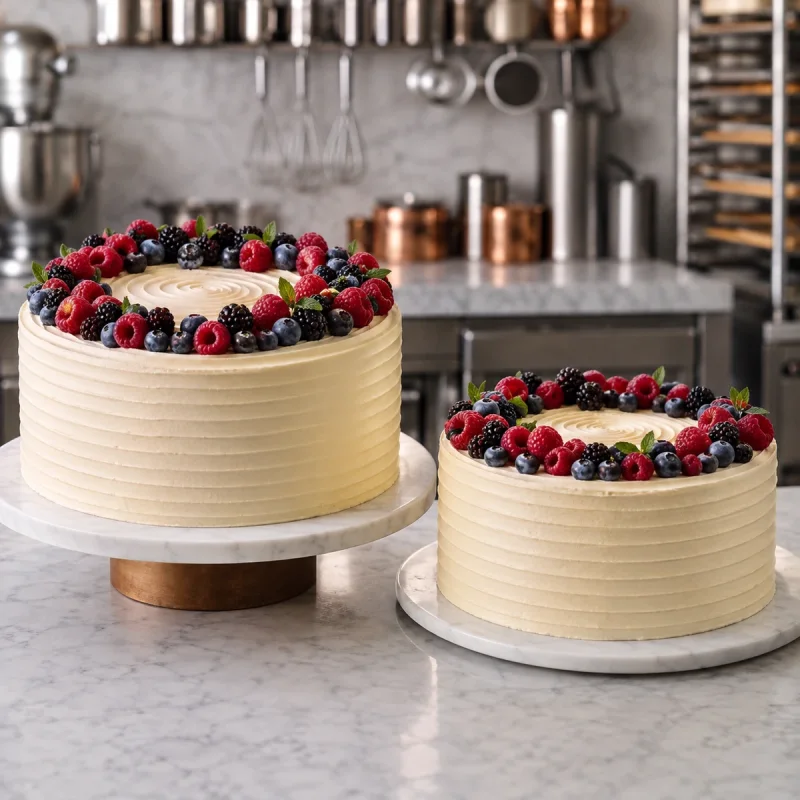
Diameter alone does not tell you how many servings you will get
Same width, different height, completely different yield
A 24 cm cake can serve very different numbers of people depending on its finished height and the volume you want in each serving. A low cake needs wider slices; a tall cake can be cut into narrower pieces with the same volume. The most common planning error is to use diameter without defining finished height and serving size.
For a one-off calculation that starts from a specific pan, cake height or guest count, use the cake pan converter.
This reference table uses two practical serving volumes:
- 125 cm³ for a standard celebration serving;
- 180 cm³ for a larger dessert serving.
At the same diameter, a cake that is 10 cm tall has twice the geometric volume of one that is 5 cm tall. Serving counts are rounded down after applying a 10% practical buffer.
Diameter is only the first input.
Measurements used by the chart
Use the pan before baking and the actual cake after assembly
The chart applies to properly round cakes with straight sides and an even finished height. Do not use it for strongly tapered, domed, slanted or irregularly trimmed cakes.
Before baking, measure the internal pan diameter through the centre, from one inner edge to the opposite inner edge. Do not use the outside diameter because it includes the thickness of the pan walls.
If the cake is already assembled, measure its actual diameter in two perpendicular directions through the centre. When the cake is visually round, use the average of the two measurements.
Example:
(23.8 cm + 24.2 cm) ÷ 2 = 24 cm
Small differences caused by coating or hand measurement do not automatically make the cake unsuitable for the chart.
If the finished cake is obviously oval, slanted or irregular, calculate its volume from its real geometry instead.
If the measured diameter is not listed, use the published formula. For a 23 cm cake, enter 23 cm. If you do not want to calculate manually, use the next smaller diameter in the chart for conservative planning. For 23 cm, use the 22 cm row rather than 24 cm.
Finished cake height means the evenly sliceable part of the completed cake: sponge, filling and even coating from the base to the flat top. The height of the empty pan is irrelevant. Individual fruit piles, figurines and tall chocolate decorations are not included unless every serving receives them.
For a deeper explanation of diameter, layers and filling, see how to choose cake height for pan diameter.
How the servings are calculated
A standard serving and a larger serving do not have the same volume
For a 10 cm tall cake, the central footprint of a standard serving is roughly 2.5 × 5 cm. A larger serving is roughly 3 × 6 cm. On lower cakes the footprint must be larger to preserve the same serving volume.
The chart already deducts a 10% practical buffer for trimming, uneven hand cutting and smaller edge pieces. This is not a claim that every cake loses exactly 10%; it is a planning margin.
The calculation is:
usable volume = π × (calculation diameter ÷ 2)² × finished cake height × 0.90
servings = usable volume ÷ serving volume
Results are rounded down.
Standard celebration serving chart
125 cm³ per serving
| Calculation diameter | Cake height 5 cm | Cake height 7.5 cm | Cake height 10 cm |
|---|---|---|---|
| 12 cm | 4 | 6 | 8 |
| 14 cm | 5 | 8 | 11 |
| 16 cm | 7 | 10 | 14 |
| 18 cm | 9 | 13 | 18 |
| 20 cm | 11 | 16 | 22 |
| 22 cm | 13 | 20 | 27 |
| 24 cm | 16 | 24 | 32 |
| 26 cm | 19 | 28 | 38 |
| 28 cm | 22 | 33 | 44 |
| 30 cm | 25 | 38 | 50 |
A 20 cm cake with a finished height of 10 cm gives 22 standard servings. At 24 cm the chart gives 32, at 26 cm 38 and at 28 cm 44.
If the same 24 cm cake is only 5 cm tall, the chart gives 16 standard servings rather than 32.
For a fast lookup limited to the most common diameters, use cake servings for 20, 24, 26 and 28 cm cakes. #206 remains the broader reference because it compares more diameters, three heights and two serving volumes.
Larger serving chart
180 cm³ per serving
| Calculation diameter | Cake height 5 cm | Cake height 7.5 cm | Cake height 10 cm |
|---|---|---|---|
| 12 cm | 2 | 4 | 5 |
| 14 cm | 3 | 5 | 7 |
| 16 cm | 5 | 7 | 10 |
| 18 cm | 6 | 9 | 12 |
| 20 cm | 7 | 11 | 15 |
| 22 cm | 9 | 14 | 19 |
| 24 cm | 11 | 16 | 22 |
| 26 cm | 13 | 19 | 26 |
| 28 cm | 15 | 23 | 30 |
| 30 cm | 17 | 26 | 35 |
A 24 cm cake at 10 cm finished height yields 32 standard servings or 22 larger servings under this model. Decide the serving size before choosing the pan, not only when you start cutting.
Choosing a cake size for a guest count
Define the serving first, then choose the pan
Do not automatically choose a 24 cm cake for 24 guests. At 7.5 cm finished height it gives 24 standard servings, but only 16 larger servings. At only 5 cm high it gives 16 standard servings.
Before choosing the pan, write down:
- guest count;
- standard or larger serving;
- planned finished cake height;
- the smallest diameter in the relevant table that reaches the required number of servings.
Choose the first value that meets or exceeds the guest count. For weddings or larger events, add your own event-specific reserve when you expect more guests than confirmed.
Cutting so the chart matches the plate
Tall cakes work better in strips; low cakes need wider pieces
Chill the cake before cutting so the filling firms up and the layers do not move under the knife. Wipe the knife after each cut.
For round cakes about 8–10 cm high, strip cutting is usually more practical than wide triangular wedges. Make parallel cuts to divide the cake into strips, then cut each strip crosswise.
For a 10 cm tall cake, central standard servings have an approximate footprint of 2.5 × 5 cm; larger servings about 3 × 6 cm. These are planning dimensions, not a rigid grid for every edge piece.
Edge pieces are shaped differently because of the curved perimeter. Count them as full servings only when they contain roughly the same amount of cake as the central pieces.
For cakes lower than about 8 cm, use wider wedge or rectangular pieces. The decisive quantity is serving volume, not shape.
The chart sets cake size, not recipe quantity
Scale sponge, filling and coating separately
Once you know the calculation diameter and finished cake height, you still need to calculate sponge batter, filling and coating separately. A serving chart tells you how large the finished cake should be; it does not tell you how much of every recipe component to make.
For ingredient planning, use the guide for how much cake batter you need for pan diameter and height. Record the internal pan diameter, planned baked-layer height, number of filling layers and final assembled height before weighing ingredients.
Frequently asked questions
Answers to common questions
Should I measure the inside or outside diameter of the pan?
Measure the internal diameter through the centre of the pan. The outside diameter includes wall thickness and is not appropriate for volume calculations.
What if the finished cake is smaller than the pan?
If it is still properly round, measure the actual finished diameter and use that measurement in the calculation.
Can I use the chart for an irregularly shaped cake?
No. The chart is based on the volume of a regular cylinder. An irregular cake needs to be calculated from its actual geometry.
How many servings does a 20 cm cake make?
At a finished height of 10 cm, the model gives 22 standard 125 cm³ servings or 15 larger 180 cm³ servings. At 7.5 cm high, it gives 16 standard or 11 larger servings.
Does a stable slice mean the serving is the correct size?
No. Serving size is defined by volume. Stability tells you whether the cake is cold enough and the filling firm enough.