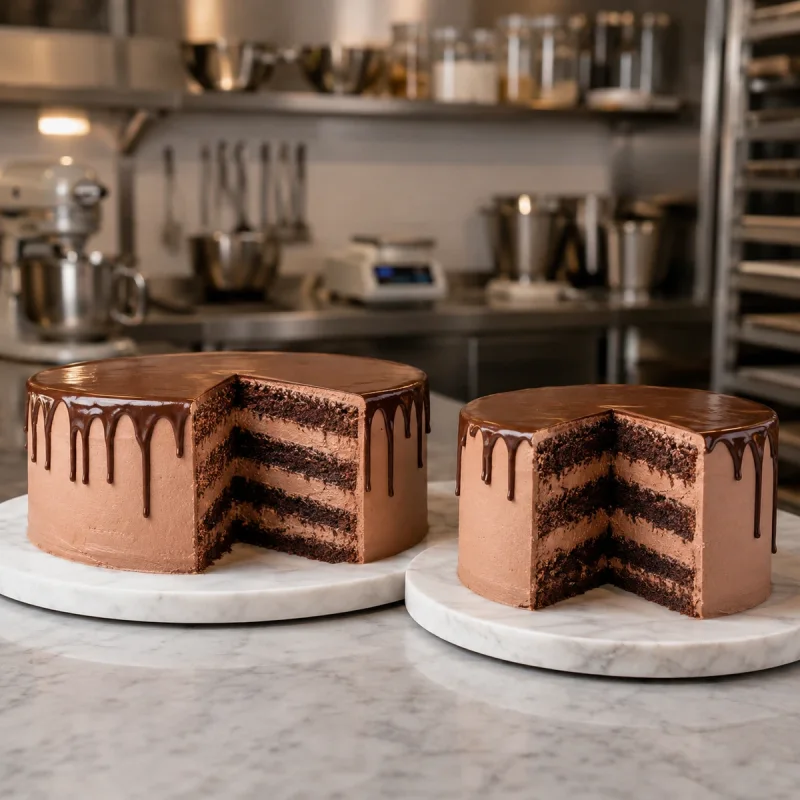
Quick answer for 20, 24, 26 and 28 cm round cakes
Diameter alone does not tell you how many servings a cake will make. You also need the edible cake height and the volume of each serving. The table below assumes a round cake with 10 cm of edible height, a smaller event serving of 125–150 ml, and a larger dessert serving of 180–220 ml.
| Cake diameter | Geometric edible volume at 10 cm high | Event servings 125–150 ml | Larger servings 180–220 ml |
|---|---|---|---|
| 20 cm | 3,140 ml | 20–25 | 14–17 |
| 24 cm | 4,524 ml | 30–36 | 20–25 |
| 26 cm | 5,309 ml | 35–42 | 24–29 |
| 28 cm | 6,158 ml | 41–49 | 27–34 |
The basic calculation is:
number of servings = edible cake volume ÷ serving volume
Always round down to whole servings. This is why generic cake-serving charts can disagree: if cake height and slice size are not defined, the number is only a rough guide.
Why a 28 cm cake is almost twice the quantity of a 20 cm cake
Cake quantity does not increase linearly with diameter. The area of a round pan is π × r², so at equal height:
28² ÷ 20² = 1.96
A 28 cm cake therefore has almost 96% more edible volume than a 20 cm cake at the same height. The same geometry matters when you scale a recipe. Moving from a 20 cm pan to a 24 cm pan requires about 44% more batter to maintain the same height—not 20%. See the guide to scaling a cake recipe for a different pan size.
How many guests each diameter covers with a 10% buffer
For an event, do not plan exactly one calculated serving per guest. Cuts vary and some pieces will be larger. We therefore include at least a 10% planning buffer:
maximum guest count = round down (cake volume ÷ serving volume ÷ 1.10)
| Diameter | Guests at 150 ml | Guests at 125 ml | Guests at 220 ml | Guests at 180 ml |
|---|---|---|---|---|
| 20 cm | up to 19 | up to 22 | up to 12 | up to 15 |
| 24 cm | up to 27 | up to 32 | up to 18 | up to 22 |
| 26 cm | up to 32 | up to 38 | up to 21 | up to 26 |
| 28 cm | up to 37 | up to 44 | up to 25 | up to 31 |
For 30 guests, a 26 cm cake is a practical starting point when servings are around 150 ml. A 28 cm cake can cover 40 guests only when each serving is no larger than about 139 ml. For larger slices or more guests, use a larger cake or plan a tiered cake.
Cake height changes the result directly
Every number above assumes 10 cm of edible cake height. If the cake is only 8 cm high, its volume at the same diameter is about 20% lower. A 24 cm cake at 8 cm high therefore makes roughly 24–28 small event servings, not 30–36.
Measure only the edible structure, from the bottom cake layer to the top edible layer. Tall toppers, non-edible decoration, internal voids or supports do not add servings. If you are changing both diameter and height, use the guide to choosing cake height for a given pan diameter.
How to cut a large round cake so the serving count holds up
A small round cake can be cut into radial wedges when you only need a few large servings. On a 26 or 28 cm cake, those wedges become very long and narrow. For many consistent servings, concentric-ring cutting is more practical.
Cut an outer ring about 5 cm wide, then divide that ring into shorter, more rectangular pieces. Continue ring by ring toward the centre. Keep pieces within each ring similar in width.
At 10 cm cake height, a 125–150 ml serving cut radially corresponds to roughly 2.5–3.0 cm at the outer edge of a 20 cm cake, 2.1–2.5 cm for 24 cm, 1.9–2.3 cm for 26 cm and 1.8–2.1 cm for 28 cm.
Wipe the knife after every cut. For soft fillings, warm a straight knife in 45–55 °C water, dry it completely and then cut.
When the real serving count will be lower
The geometric calculation assumes the entire calculated cake volume is edible. The actual yield is lower when the cake includes thick non-edible decoration, a hollow centre, structural supports, very uneven edges or soft layers that collapse while cutting.
Cake richness matters too. A dense chocolate cake with ganache is normally served in a smaller piece than a light fruit sponge. Before choosing a pan, define three things: guest count, target serving volume and actual edible cake height. Then choose a diameter that gives you at least a 10% buffer.
Technical terms
Terms worth understanding
- Geometric edible volume
- The calculated volume of the edible cylindrical portion of the cake, expressed in ml or cm³ and excluding non-edible decoration or supports.
- Event serving
- The planning serving used here: 125–150 ml of edible cake.
- Area factor
- The ratio between the surface areas of two pans, used to scale batter or ingredients when the diameter changes.
- Radial cut
- A wedge cut whose two sides run from the outer edge toward the centre of a round cake.
- Concentric-ring cutting
- Dividing a large round cake into rings, then cutting those rings into shorter pieces with similar volume.
Frequently asked questions
Answers to common questions
Will a 24 cm cake serve 30 guests?
It can at servings of about 125 ml: with a 10% buffer it covers up to 32 guests. At 150 ml per serving, plan for no more than 27 guests.
How do I adjust the servings if the cake is only 8 cm high?
Multiply the 10 cm-height serving figures by 0.80 because the edible volume is about 20% lower.
How much extra cake should I plan for a party?
Plan at least 10% extra capacity. Increase the buffer when guest count is uncertain or the cake will be cut by someone inexperienced.
What is the difference between a small event serving and a larger dessert serving?
This guide uses 125–150 ml for a small event serving and 180–220 ml when cake is the main dessert.