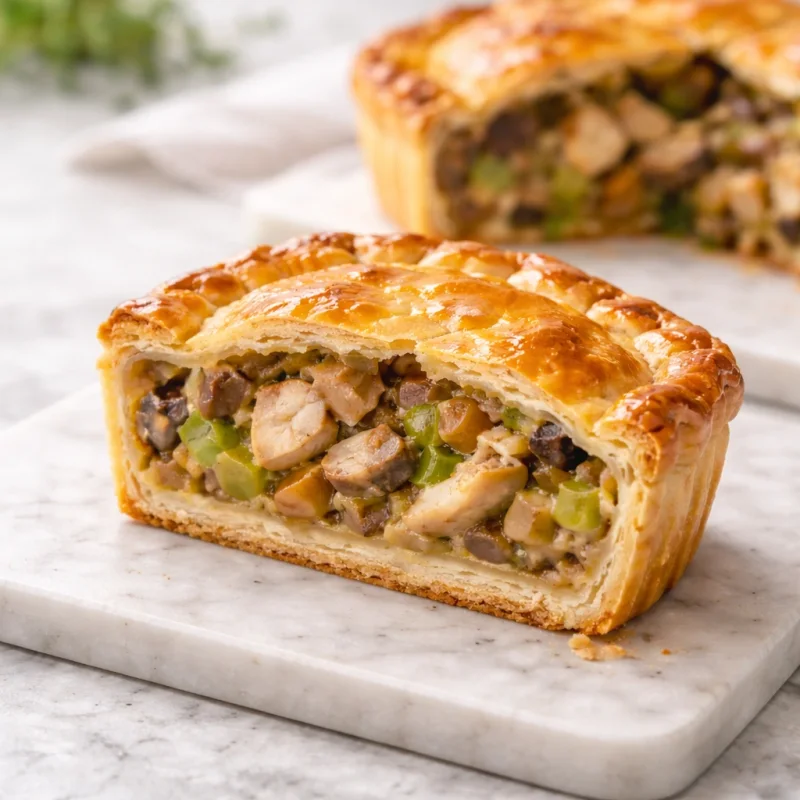
A soggy base is not caused only by a wet filling
A knife cuts through a nicely browned rim, but underneath the pastry has compressed into a pale, soft layer that clings to the tin. The problem develops when the dough does not receive enough direct heat for starch gelatinization and protein setting to stabilize the crust before water from the filling starts moving into it. In the wider system of shortcrust and strudel dough, the balance between water, gluten development, resting and baking temperature therefore matters.
There is no single trick that prevents a soggy bottom. You need a reasonably dry dough, a properly chilled lined tin, a thorough blind bake, strong heat from below and a filling without unnecessary free water. A well-baked base is golden, dry to the touch and firm enough that a cooled slice can be lifted without the bottom bending.
Use only enough liquid to bring the dough together
For a classic savory shortcrust, a useful starting ratio is 100 parts flour to 50–60 parts cold butter. Adjust the liquid to the flour’s absorption and to whether you use egg or another liquid. An egg is not pure water, so do not count its entire weight as added liquid.
Add liquid gradually. The dough is ready to shape when it holds together when pressed, while the surface is not sticky and there is no wet smear on the bottom of the bowl. If more liquid is needed, add it in 5 g increments, roughly one teaspoon at a time.
More water increases hydration and the potential for gluten development, especially if the dough is mixed hard or for too long. Excess water under a moist filling also means the crust needs longer to dry. Overworked dough becomes elastic, shrinks in the tin and bakes up tougher instead of tender and short.
The butter should be cold but not rock-hard. When flour and fat are rubbed into a crumbly mixture, small pieces of butter should remain coated with flour. In the oven the fat melts and some of its water turns to steam, helping create a short, fragile structure. If the butter smears into a greasy paste during mixing, chill the mixture before adding the liquid.
Resting and shaping help stop the sides shrinking
Flatten the mixed dough into a disc, wrap it well and chill for at least 30 minutes. In a warm kitchen or with a very soft dough, 60 minutes is safer. The rest allows moisture to distribute more evenly, the fat firms again and tension in the gluten network falls.
Roll the pastry to about 3–4 mm. A very thin shell absorbs moisture quickly and has too little mass to remain firm under a filling. A very thick shell needs longer to bake and may stay pale where it touches the tin. Uneven thickness gives you burnt thin spots while the thicker base is still damp.
When transferring the pastry to the tin, do not stretch it. Stretched dough contracts in the oven, the rim drops and filling can find a path between pastry and tin. For the detailed handling method, see how to roll out dough without sticking, tearing or shrinking.
Chill the lined tin for another 20–30 minutes. Move it straight from the refrigerator into a fully preheated oven. Cold fat takes longer to soften and melt, giving the sides of the pastry shell more time to set and hold their shape.
Blind baking must set the centre, not just colour the rim
With liquid egg, cream or vegetable fillings, a very short pre-bake is rarely enough. If the base is still white and soft after the weights are removed, it will remain damp under the filling even when the upper rim already looks browned.
Preheat a conventional oven to about 190 °C; for fan-assisted baking, start around 175–180 °C. The exact setting depends on the oven, the colour of the tin and its material. Place a heavy metal baking sheet or steel plate in the oven during preheating, then set the tart tin on it. This gives the lower crust a much stronger initial heat flow.
Cover the chilled pastry with baking paper and fill it with ceramic baking weights, dried beans or rice. The weights should reach the junction between the base and sides and support the walls. Empty, unsupported edges are more likely to slump during the first minutes of baking.
Bake with the weights for about 15–20 minutes, or until the rim is firm and the pastry under the paper no longer looks raw or greasy. Remove the paper and weights, then bake the base for another 5–10 minutes. It is ready when the floury pale appearance has gone, the surface is evenly dry and the centre has taken on a light golden colour.
Do not let the colour of the rim make the decision for the centre.
If the empty base bubbles after the weights are removed, gently pierce the bubble and return the shell to the oven. For a very liquid filling, do not dock the base heavily before baking because the filling can later seep through the holes.
For extra protection, brush the dry blind-baked base very thinly with lightly beaten egg white and return it to the oven for about 2 minutes. The egg white should form a thin continuous film, not puddles. This barrier can slow direct moisture transfer from the filling, but it cannot rescue an underbaked base.
Remove free water from the filling before it reaches the pastry
Vegetables release water as they cook even when they look fairly dry at the start. Mushrooms, courgettes, spinach, leeks and onions should therefore be cooked before they go into the tart. Continue until the liquid has evaporated or can be drained thoroughly. Thaw frozen vegetables, squeeze or drain them, and only then measure the amount for the filling.
Draining is not the same as cooling. A filling can be cold and still contain a great deal of free water. Properly prepared vegetables no longer create a fresh puddle underneath them after a few minutes in a sieve and do not release liquid when pressed gently.
Meat, fish and cheese can contribute moisture too. Drain cooked meat, leave very wet fresh cheeses in a sieve, and remove watery seed pulp from tomatoes or roast them first. Add salt with some care because it draws water from cut vegetables; if vegetables are salted in advance, draining afterwards must be part of the process.
A very juicy filling can be given a little extra insurance with a thin, even layer of finely grated hard cheese or fine breadcrumbs on the base. The layer absorbs some liquid, but it should never replace proper cooking and draining of the ingredients.
Spread the filling over the blind-baked shell only immediately before the final bake. Do not leave a filled tart standing on the worktop, because moisture starts moving into the crust before the tin even reaches the oven.
A metal tin and strong bottom heat make a visible difference
A thin metal tin transfers heat faster than thick ceramic or glass. For a crisp bottom, a dark metal tart tin with a removable base is especially useful because metal quickly conducts heat to the dough and the darker surface absorbs radiant heat efficiently. With a very dark tin, check the crust a little earlier because it browns faster.
Ceramic heats more slowly but retains heat for longer. If you use it, the oven must be fully preheated and the dish should sit in the lower third of the oven on a preheated baking sheet. A ceramic dish placed into a lukewarm oven without a hot tray underneath warms too slowly and often leaves the base pale.
Smaller tins have a different ratio of edge to base, so thin pastry shells dry and colour more quickly. For accurate shaping and blind baking of small shells, use the method for mini tart shells without cracks.
After the final bake, leave the tart in the tin for about 10–15 minutes, then move it to a rack if the filling is firm enough. Long cooling in the tin traps steam against the bottom crust. Cut only after the filling has stabilized; this also prevents hot liquid from the centre soaking back into the pastry as soon as you slice it.
Diagnostics
Common problems and solutions
The base is pale, soft and sticks to the tin after baking.
Cause: The shell was blind-baked only until the rim coloured while the centre remained underbaked.
Solution: After removing the weights, bake for another 5–10 minutes until the base is dry, firm and lightly golden.
The sides slide down during blind baking.
Cause: The pastry was stretched into the tin, was not chilled before baking, or the weights did not support the sides.
Solution: Ease the pastry into the tin without stretching, chill the lined tin for at least 20 minutes and fill the weights right up to the inner edge.
The rim is crisp but the base stays wet under a vegetable filling.
Cause: The vegetables released free water during baking that was not removed before filling.
Solution: Cook the vegetables first, drain them and continue cooking until no liquid remains in the pan.
The base is hard and chewy rather than short and tender.
Cause: Too much liquid was added or the dough was worked for too long after the water went in.
Solution: Add liquid in 5 g increments and stop mixing as soon as the dough holds together when pressed.
The blind-baked base was dry but softened before the filling was baked.
Cause: The filling sat in the pastry shell too long or still contained undrained liquid.
Solution: Prepare and drain the filling in advance, then add it to the shell only immediately before returning the tin to the oven.
Technical terms
Terms worth understanding
- Blind baking
- Pre-baking an empty pastry shell, usually weighted with ceramic baking beans, dried beans or rice.
- Free water
- Liquid that is not tightly bound within ingredients and can migrate from the filling into the pastry during baking.
- Starch gelatinization
- Structural setting in which starch swells in the presence of water and heat and helps form a firm crust.
- Thermal conductivity
- How quickly the material of a baking tin transfers heat to the dough; metal generally transfers heat faster than thick ceramic.
Frequently asked questions
Answers to common questions
Can I bake a savory tart without blind-baking the pastry?
Yes, when the filling is relatively dry and needs a long bake. With liquid egg, cream or very vegetable-heavy fillings, blind baking is much more reliable.
Can I prepare a blind-baked shell in advance?
Keep a fully cooled shell for up to 24 hours at room temperature in a dry, tightly closed container. Do not fill it in advance because the filling will transfer moisture into the crust while it waits.
Why does the bottom soften while cooling if it was crisp from the oven?
Steam from the hot filling moves toward the cooler crust as it cools. After the initial set, remove the tart from the tin and cool it on a rack when the filling is firm enough to allow it.