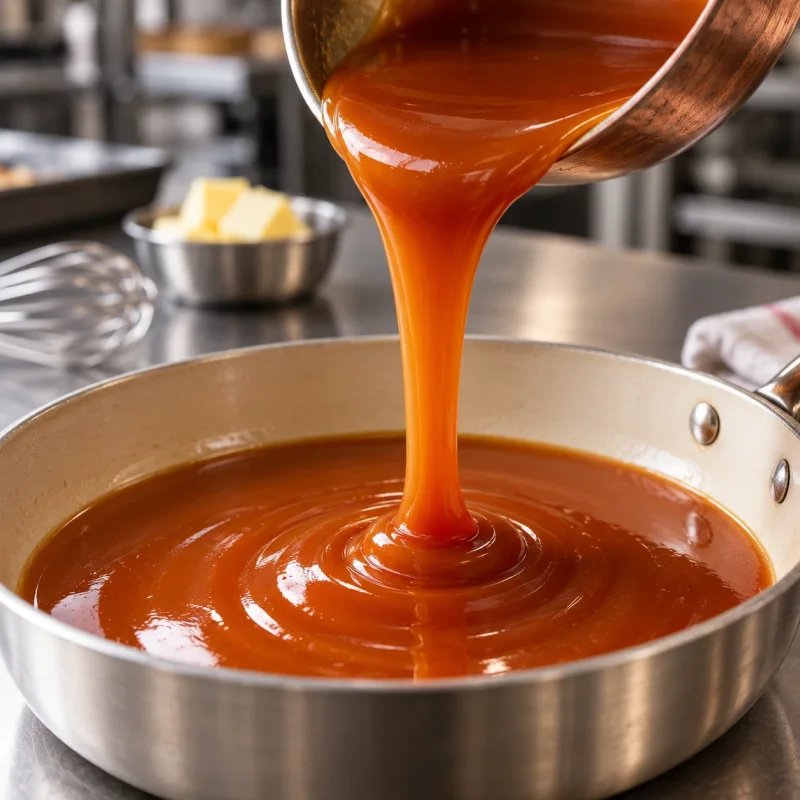
Caramel becomes much easier to control once you separate three processes that are often treated as one: melting and caramelizing sugar, crystallization of a sugar syrup, and the temperature stages used for candies and concentrated syrups. For basic caramel, there is no single magic temperature. The goal is evenly melted sugar, a clean amber color, and a toasted aroma without harsh smoke or burnt notes.
If you are making caramel for the first time, the wet method is usually more forgiving because the sugar first dissolves in water and heats more evenly. The dry method is faster, but it needs closer control because one area can darken before the rest has melted.
Basic caramel recipe without cream
For a practical batch, use 200 g granulated white sugar.
Wet method: add about 60 g water. The water is a process aid and mostly evaporates during cooking; a little more or less mainly changes how long it takes to reach caramelization, not the final sweetness.
- Put the sugar and water in a clean, light-colored saucepan and wet all the sugar.
- Heat moderately until the crystals dissolve and the syrup comes to a boil.
- Once it is boiling, do not stir with a spoon. If needed, gently swirl the pan and wash down crystals from the sides with a damp pastry brush or briefly cover the pan so steam cleans the rim.
- Cook until the syrup is a clear golden to amber color.
- Remove the pan slightly before the color looks perfect, because residual heat in the pan will continue to darken the sugar.
Dry method: use 200 g sugar with no water. Heat it in a wide pan in a thin layer. As it melts, you may gently move it with a heatproof spatula or add fresh sugar gradually into the melted portion. The aim is even melting, not vigorous stirring.
This is a recipe for caramelized sugar, not soft caramels or a finished caramel sauce. Once cream, butter, or another liquid is added, you are working with a different system in which water, fat, and further cooking determine the final texture.
Wet caramel: how to prevent crystallization
With wet caramel, the two key controls are fully dissolving the sugar before boiling and keeping the sides of the pan free of stray crystals. In a concentrated boiling syrup, an undissolved crystal can act as a seed that encourages sucrose to crystallize again.
The most useful preventive steps are simple:
- fully wet and dissolve the sugar before boiling;
- once boiling begins, do not scrape the sides with a spoon;
- wash crystals from the rim with a damp pastry brush or steam under a lid;
- use a clean pan and clean utensils;
- when appropriate, a small amount of glucose or invert syrup can interfere with sucrose forming large crystals.
For more detail on why invert sugars help control crystallization, see invert sugar in baking and pastry.
Acid can hydrolyze some sucrose into glucose and fructose and reduce the tendency to recrystallize, but do not add it without a reason. Too much acid changes syrup composition, hygroscopicity, and final texture.
Dry caramel: faster, but less forgiving
The rule that “caramel must never be stirred” does not apply universally to dry caramel. If part of the sugar is already dark amber while another part is still white, the heat is too high or the layer is too thick. Reduce the heat and gently move melted sugar toward the remaining crystals.
Small lumps during melting are not automatically a failure. If they are not burnt, they often dissolve once enough liquid sugar surrounds them. A wide pan over medium-low to medium heat gives more even results than a small pan holding a thick layer of sugar.
How to tell when caramel is ready
With pure sucrose, pronounced caramelization in pastry practice generally occurs once most water is gone and temperatures approach roughly 160°C / 320°F and above. But the number is not an on/off switch. Heating rate, batch size, pan construction, thermometer accuracy, and where you measure all affect what you see at the same reading.
Watch three signals together:
- Color: pale gold is mild, amber gives a fuller caramel profile, and very dark caramel quickly moves into harsh bitterness.
- Aroma: clean toasted caramel is the target; sharp smoke or a burnt smell means you have gone too far.
- Rate of darkening: the final stage moves quickly. If you focus only on an exact temperature, the caramel can pass its ideal point while you are reading the thermometer.
A thermometer is useful as a second check, but it does not replace color and aroma.
Why 118°C is not “soft caramel” in the same sense as 170°C
The soft-ball, firm-ball, soft-crack, and hard-crack stages mainly describe sugar concentration and how much water remains in a syrup. They are not sequential degrees of browning of pure sugar.
| Process | Approximate range | What the temperature actually indicates |
|---|---|---|
| Soft/firm ball candy syrups | about 112–121°C / 234–250°F | Enough water remains for a soft or chewy texture. |
| Hard crack | about 146–154°C / 295–309°F | The syrup is highly concentrated and becomes brittle when cooled. |
| Caramelized sugar | about 160°C / 320°F and above | Sugar browns more strongly and develops caramel aromas. |
A soft caramel candy cooked around the firm-ball range therefore does not mean that pure sugar “caramelizes at 118°C.” Candy formulas usually contain cream, glucose syrup, butter, or other ingredients, and color and flavor may develop through additional reactions.
Adding cream or butter safely
Hot caramel is far hotter than boiling water. Adding liquid can make it boil violently and rise very quickly. Use a tall enough saucepan, keep your face and hands away from the steam, and add liquid gradually.
Warm cream reduces the temperature shock and usually causes less hardening than cold cream. Even if the caramel temporarily turns into a hard lump, it is not necessarily ruined: return it to moderate-low heat and stir until the hardened sugar dissolves again.
Cream and butter turn caramelized sugar into a caramel sauce or caramel mixture. Do not judge the final thickness while it is hot, because caramel thickens significantly as it cools.
How to avoid bitter caramel
Most bitterness develops in the final moments. With a small batch, the gap between deeply aromatic caramel and a burnt result can be very short.
Four habits help:
- use a light-colored pan so you can see the true color change;
- reduce the heat near the end if the color is developing unevenly;
- stop one shade lighter than your final target;
- if necessary, move the pan to a cooler surface to reduce carryover heat from the base.
Very dark caramel can be intentionally slightly bitter, but the bitterness should be balanced and free from smoky or ashy flavors. A sharp burnt aroma means the process has gone too far.
The best sugar for learning caramel
Use white granulated sugar when learning. Its pale starting color makes it easy to see the transition from clear syrup to gold and amber. Brown, coconut, and other darker sugars contain additional compounds and already have color, so their behavior should not be treated as identical to pure sucrose.
Powdered sugar is also not the first choice because it often contains a small amount of anti-caking starch. For repeatable results, ordinary white granulated sugar is the cleanest reference.
Diagnose the problem before trying to fix it
A milky, cloudy, grainy wet syrup indicates crystallization. A hard lump after adding cream is often temporary hardening caused by temperature shock. A very dark, smoking, sharply bitter mass is overheated caramel. These three problems need three different responses.
If wet syrup crystallizes before it has browned strongly, it can often be redissolved with added water and cooked again. Hardened sugar after adding liquid often melts again with gentle heat. Burnt, smoking caramel cannot be repaired with water, butter, or cream — start again with fresh sugar.
Diagnostics
Common problems and solutions
Cloudy grainy syrup indicates crystallization.
Cause: crystallization
Solution: redissolving crystallized syrup
Prevention: washing crystals from pan sides
uneven melting
Cause: thermal inertia
Solution: dry caramel method
Prevention: monitoring amber color
hard lump after adding liquid
Cause: A hard lump after adding cream may redissolve with gentle heat.
Solution: A hard lump after adding cream may redissolve with gentle heat.
Prevention: monitoring amber color
Very dark smoking caramel is overheated.
Cause: burnt sugar
Solution: A sharp smoky or ashy smell indicates overheating.
Prevention: monitoring amber color
Syrup is clear before caramelization.
Cause: caramelization
Solution: Finished caramel is evenly golden to amber without white crystals.
Prevention: monitoring amber color
Technical terms
Terms worth understanding
- Caramelization
- Heat-driven reactions in sugars that create new flavor and color compounds without requiring proteins.
- Sucrose crystallization
- Dissolved sucrose molecules forming an ordered crystal structure again, making syrup grainy or cloudy.
- Hard crack
- A highly concentrated sugar-syrup stage that becomes brittle when cooled; it is not another name for dark caramel.
Frequently asked questions
Answers to common questions
Can I stir caramel while it cooks?
For reliable wet caramel, dissolve the sugar completely in water before boiling and do not stir the boiling syrup with a spoon. For dry caramel, gently move the sugar as needed for even melting. Stop at a clean amber color before the caramel smokes heavily.
Is caramel ruined if it hardens after adding cream?
A hard lump after adding cream may redissolve with gentle heat.
Does a thermometer prevent bitter caramel?
A sharp smoky or ashy smell indicates overheating.