Kneading dough: judge development, not minutes
Kneading is not the goal by itself. It helps build a gluten network that must be strong enough to retain gas and extensible enough to expand during fermentation and baking.
Mechanical work, hydration, rest and time all contribute. That is why the same kneading time does not suit every flour or fermentation schedule.
Signs of development
Underdeveloped dough is rough, tears quickly when stretched and struggles to hold shape.
As it develops, it becomes smoother, more cohesive and elastic, and it stretches farther before tearing.
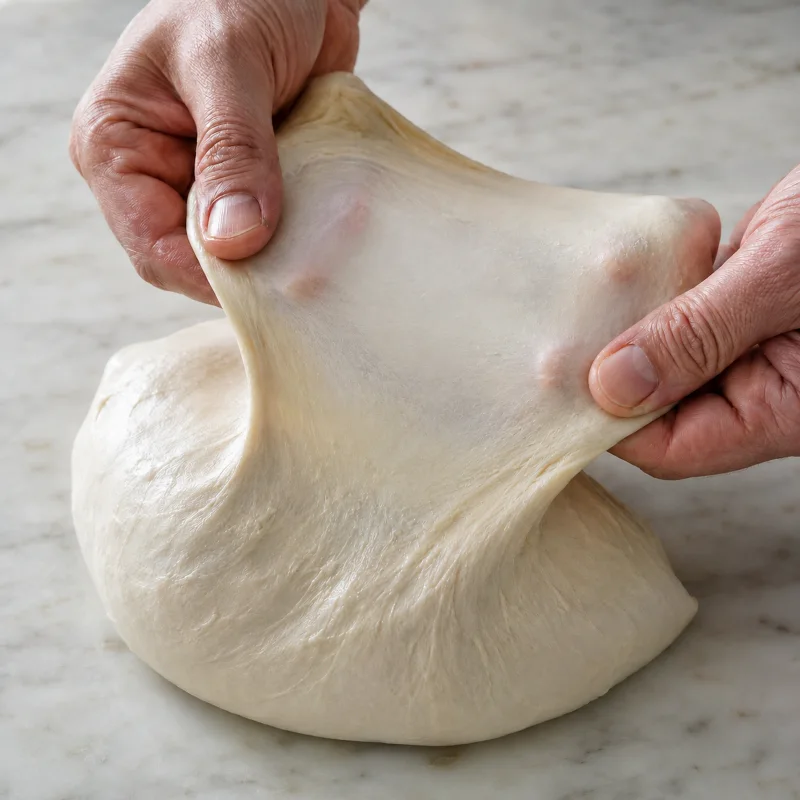
The windowpane test
Let a small piece of dough relax briefly, then stretch it gently. If it tears immediately, development is limited. If it stretches into a thinner membrane, the network is stronger.
A perfect transparent window is not required for every bread. Long-fermented dough continues gaining strength through time and folds.
Folds instead of endless kneading
Folds during bulk fermentation can build strength gradually, especially in softer doughs. There is no universal number of sets.
Stop adding folds when the dough already holds height well and gives substantially more resistance to stretching.
Hydration is not a magic range
A fixed 65–75% hydration is not a universal requirement for open crumb. Different flours absorb water differently, and fermentation, shaping and dough strength matter just as much.
Dough temperature
Warmer dough ferments faster, and intensive machine mixing adds heat. 28 °C is not a universal gluten-failure threshold.
Use temperature as process information, not as a single absolute alarm.
Reliable sequence
Mix → assess texture → rest if useful → develop through kneading or folds → recheck extensibility → stop unnecessary mechanical work once the dough has enough structure for the next stage.
Diagnostics
Common problems and solutions
Dough tears very quickly.
Cause: Gluten is still underdeveloped or needs more rest.
Solution: Rest briefly, then continue gently with kneading or folds.
Dough snaps back strongly.
Cause: The network is very tense.
Solution: Give it a short rest before shaping again.
Dough becomes warm and smeary.
Cause: Intensive mixing and fermentation are changing the texture.
Solution: Stop mixing and assess temperature and process.
Frequently asked questions
Answers to common questions
How do I know when dough is kneaded enough?
Look for a smoother, more cohesive dough that holds shape better and stretches farther before tearing. Do not judge by minutes alone.
Does every dough need to pass a perfect windowpane test?
No. Long-fermented doughs continue gaining strength through rest and folds, so full windowpane immediately after mixing is not always necessary.
How many folds should I do?
There is no universal number. Fold while the dough is gaining useful strength; once it holds shape well and resists further stretching, more folds are not automatically better.
Does higher hydration always mean a more open crumb?
No. Extra water helps only if the flour, gluten network and fermentation can retain gas. Too much water for the flour can create weak, spreading dough.
Is 28 °C a hard limit where gluten structure breaks down?
No. Warmer dough ferments faster and may feel softer, but the appropriate temperature depends on the recipe and fermentation plan.