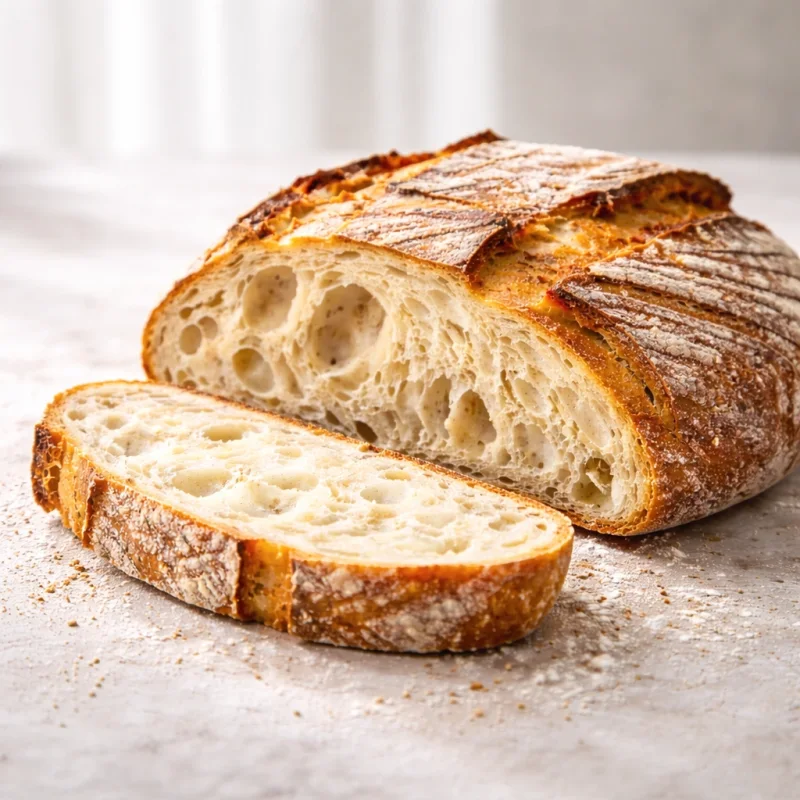
Bread flavor comes from fermentation and baking
Flavor develops in two main stages. During fermentation, yeast and, in sourdough, lactic acid bacteria produce acids, alcohols, esters, and other metabolites. During baking, the crust develops additional toasted and caramel-like notes.
Longer fermentation can deepen flavor only while the dough still has enough strength to retain gas. More time is therefore not automatically better. A ripe preferment can add complexity; an overripe preferment can reduce volume and make flavor less balanced.
What changes during fermentation
Yeast consumes fermentable sugars and produces carbon dioxide together with ethanol, higher alcohols, aldehydes, esters, and other volatile compounds. In sourdough, lactic acid bacteria add lactic and acetic acids and broaden the flavor profile.
Flour enzymes also release sugars and smaller compounds. Some shape crumb flavor directly, while others become aroma precursors during baking.
Preferments move part of fermentation earlier
A preferment uses part of the formula's flour and water before the final mix. Poolish, biga, pâte fermentée, and levain are different versions of this idea.
Use maturity, not the clock alone. A good preferment is active, bubbly, and aromatic. One that is still sluggish brings little benefit; one that has collapsed far beyond peak can weaken volume and flavor.
Slow fermentation does not require sourdough
Commercial yeast can also build complex flavor. Less yeast and more time allow fermentation by-products to accumulate more gradually. Sourdough adds bacterial fermentation and therefore a different acid profile, not an automatic quality ranking.
Cold fermentation gives more time, not unlimited time
Refrigeration slows fermentation strongly but does not stop it instantly. An overnight cold phase can widen the timing window and produce a more nuanced loaf when the formula is designed for it.
Useful duration depends on yeast or starter quantity, dough temperature, actual refrigerator temperature, prefermented flour, and flour strength. Watch growth, bubbles, aroma, tension, and shape retention rather than counting hours blindly.
Flavor and structure must stay in balance
Organic acids can support dough structure within a useful range, but very long fermentation plus enzyme activity eventually reduces gluten strength. If the dough spreads badly, tears easily, and cannot hold gas after shaping, more time is unlikely to help.
The crust adds another layer of aroma
Fermentation is especially important for crumb aroma; baking strongly shapes crust aroma. A well-developed crust contributes toasted, nutty, and caramel-like notes. Steam early in the bake supports expansion and crust development; see steam in bread baking.
Run a controlled test
Make two batches with the same formula and change only the fermentation schedule. Compare dough aroma before baking, volume, tension, fully cooled crumb flavor, crust, and next-day structure.
Ripe: clean grain-fermentation aroma, visible bubbles, increased volume, and useful remaining tension.
Underfermented: little gas, tight dough, and aroma dominated by raw flour.
Overfermented: weak tension, difficult shaping, spreading, and often overly sharp acidic or alcoholic notes.
Diagnostics
Common problems and solutions
Bread rises well but tastes bland.
Cause: Fermentation was sufficient for volume but too short for stronger flavor development.
Solution: Slow the next test with less yeast, a ripe preferment, or an appropriate cooler phase.
Dough loses tension after a long fermentation.
Cause: The process passed optimal maturity; acidity and enzyme activity reduced mechanical strength.
Solution: Shorten time, reduce inoculation, or introduce the cooler phase earlier.
Bread has a harsh alcoholic-acidic aroma and poor volume.
Cause: The preferment or main dough was probably used past peak activity.
Solution: Track bubbles, surface, aroma, and tension and use the preferment at maturity.
Technical terms
Terms worth understanding
- preferment
- A portion of the formula's flour and water fermented in advance before the final dough is mixed.
- poolish
- A liquid yeasted preferment containing equal weights of flour and water.
- fermentation maturity
- The point where fermentation is sufficiently developed before the dough becomes overripe.
Frequently asked questions
Answers to common questions
Is longer fermentation always better for bread flavor?
No. More time can create more aroma compounds, but only while the dough retains enough structural strength. Overfermentation can reduce volume and produce an unbalanced flavor.
Can I develop complex flavor without sourdough?
Yes. A yeasted preferment or a smaller dose of baker's yeast with a longer fermentation can develop deeper flavor. Sourdough adds bacterial fermentation and therefore a different acid and aroma profile.
How do I know when poolish is ripe?
It should be clearly active, bubbly, and aromatic. Near peak maturity the surface is often slightly domed. A badly collapsed, harsh-smelling preferment may be overripe.
Does cold fermentation always improve flavor?
It can provide more time for flavor development, but the result depends on refrigerator temperature, yeast or starter amount, dough temperature, and duration. Cold slows fermentation; it does not stop it immediately.
Why does long-fermented dough sometimes become weak?
Acidity and enzyme activity change the gluten network over time. If fermentation continues too far, the dough can lose mechanical strength and gas-retaining ability.
Is crust aroma produced by fermentation?
Fermentation contributes precursors and crumb aroma, but many roasted and caramel-like crust notes are generated mainly during baking.
How should I compare short and long fermentation?
Make two batches with the same formula and change only the fermentation schedule. Compare pre-bake aroma, volume, fully cooled crumb flavor, crust, and next-day structure.