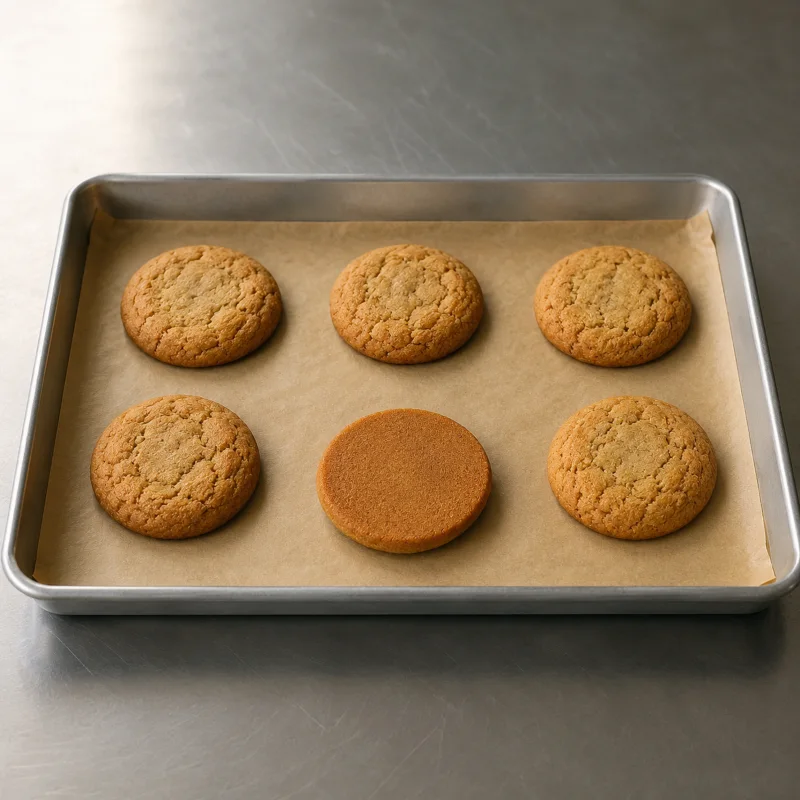
Parchment paper is not just an anti-stick barrier
Parchment paper is useful when you want cleaner release, easier lifting from a pan and less direct contact between batter and hot metal. It does not correct the wrong oven temperature, an unsuitable pan or an underbaked centre. Among baking tools for home baking, it is simple, but it still has to match the pan, the temperature and the type of bake.
The most useful rule is practical: trim the sheet to fit, check the rated temperature on the package and keep loose edges away from heating elements. An empty sheet is light enough to move in strong convection airflow.
For a quick decision:
| Situation | What to do |
|---|---|
| You do not know which side goes up | Check the package; with parchment coated on both sides, orientation is often irrelevant. |
| The paper curls | Reverse-roll it briefly or hold it with a few tiny dots of fat under the sheet. |
| You are baking hot | Stay within the temperature stated by the manufacturer. |
| Convection lifts the sheet | Trim it properly and weigh it down with batter, dough or food. |
| You want to reuse it | Reuse only if the product allows it and the sheet is still clean, flexible and undamaged. |
Parchment does not make different pans thermally identical. A dark metal pan can still brown edges and bottoms faster than a light aluminium pan, and an oversized pan still spreads batter into a thinner layer.
Which side of parchment paper goes up
Many modern parchment papers have a silicone non-stick treatment on both sides. With those products, a slightly shinier or duller surface does not by itself identify a “correct” side.
Check the manufacturer’s instructions first. Some current products include a special anti-slip side, while others are simply non-stick on both faces. That is exactly why one universal rule is unreliable.
Wax paper is not the same material as parchment paper and should not be treated as a general oven substitute unless the manufacturer explicitly allows that use.
Rolled parchment often wants to curl back. Reverse-roll the cut piece for a few seconds. With fluid batters, tiny dots of butter or another fat between the pan and the parchment can act as an anchor; that does not mean the food-facing surface needs greasing.
How to line a sheet pan and a round cake pan
For cookies and small bakes, cut the sheet close to the inside dimensions of the tray. Large loose flaps can move, approach a heating element or disturb airflow. Keep the paper as flat as practical because pronounced folds can print into soft batters.
For rectangular cakes or loaves, a longer strip can cover the base and two opposite sides, leaving short handles for lifting the cooled bake. Do not leave the paper so tall that it can reach the element.
For a round pan, trace the base and cut a circle just inside the line. If you also need a lined side, a separate straight strip is usually neater than forcing one sheet into deep pleats.
Some airy cakes need batter to grip the side of the pan as they rise, so do not automatically grease or line every wall. Follow the method of the specific recipe.
When choosing between baking pans and cake tins, remember that parchment reduces sticking but does not erase the thermal differences between aluminium, steel, dark coatings, glass and ceramic.
Does parchment paper change spread, colour and baking time?
The liner changes the contact between food and the hot pan. The difference is often easiest to see in thin cookies, where spread and bottom colour respond quickly to surface conditions.
A parchment-lined tray can produce a slightly lighter bottom than bare metal. That alone does not mean the cookie or cake is underbaked. Judge the edge, centre and texture as well as colour.
A silicone mat and parchment paper are not automatically interchangeable. They can change cookie spread and browning differently, so when you switch surfaces, watch the first batch before changing flour or bake time.
For a more complete explanation of fan setting, temperature and rack position, see how to use the oven correctly for baking.
Temperature limit and safe oven use
There is no single universal maximum temperature for every parchment paper. Products on different markets are rated differently. Use the temperature printed on the specific package.
Keep the sheet away from direct contact with heating elements, open flame and very hot oven walls. Do not use a loose sheet under a broiler or grill when it can reach the upper element.
With convection, trim and weigh down the sheet with food, dough or a pan. Avoid preheating with a loose empty sheet when airflow can lift it.
The same caution applies to baking stones, steels and very hot pizza setups. First check whether the paper is rated for that temperature.
If the paper becomes very dark, brittle, crumbly or smells overheated, discard it and check both temperature and pan position.
When parchment paper is not the best choice
For pizza, flatbread and other foods where you want maximum direct heat and a very crisp base, contact with a properly heated metal surface, stone or steel can be better.
Parchment is also not a universal substitute for greasing a highly detailed mould, nor is it ideal when batter must grip the pan wall as part of the rising mechanism.
Syrups, melted fats and fruit juices can run underneath the sheet, so the pan still needs normal cleaning and maintenance after use.
Can parchment paper be reused?
Reuse is not a universal property of every parchment product. Some manufacturers allow repeated dry bakes; others recommend a fresh sheet. Follow the package.
When reuse is allowed, keep the sheet only while it remains flat, clean, flexible and free of badly scorched edges. A sheet used for a dry batch of cookies may remain in better condition than one used under a very greasy or sugary mixture.
Discard the sheet if it is torn, brittle, heavily browned, saturated with grease, coated with burnt sugar or so deformed that it cannot sit safely in the pan.
Before another bake, make three quick checks: rated temperature, condition of the sheet and distance from the heating element. That is more reliable than any fixed rule saying parchment is always good for exactly one, two or three uses.
Diagnostics
Common problems and solutions
The parchment lifts, folds or moves toward the heating element.
Cause: The sheet is oversized, was preheated empty or was moved by convection airflow.
Solution: Trim it to the inside of the pan and weigh it down with dough, batter or food before strong airflow starts. Do not preheat a loose empty sheet.
Deep wrinkles and an uneven edge appear on the bottom of a cake.
Cause: The parchment was crumpled or did not lie flat under a fluid batter.
Solution: Cut a smooth piece to the correct shape. In a round pan, use a separate base circle and, if needed, a separate side strip.
Cookies have a softer or paler bottom than expected.
Cause: Parchment reduced direct contact with hot metal, and the cookies may also have stayed on the hot pan too long after baking.
Solution: Check actual oven temperature and move cookies to a rack once they are stable enough. Do not extend bake time only because the underside looks lighter.
The edges of the parchment darken quickly and smell overheated.
Cause: The oven exceeds the paper's rated temperature or the sheet is too close to an element, flame or hot wall.
Solution: Move the pan to a safer rack position, reduce the temperature to the product's allowed range and use a fresh sheet.
Parchment sticks to a very moist or underbaked bottom.
Cause: The structure has not set fully, the product contains a lot of moisture or it was unmoulded too soon.
Solution: Finish baking and allow the structure to firm. Peel parchment away slowly at a low angle rather than pulling straight upward.
Technical terms
Terms worth understanding
- Silicone coating
- A thin heat-resistant surface layer that reduces sticking of dough, batter and fat to the paper.
- Direct heat transfer
- Heat moving from hot metal into the food at the contact surface; parchment slightly changes that contact.
- Temperature rating
- The highest temperature at which the manufacturer permits use of that specific parchment paper.
Frequently asked questions
Answers to common questions
Which side of parchment paper goes up?
For many papers coated with silicone on both sides, either side can face the food. If the manufacturer marks a specific side, follow the package; appearance alone is not reliable for every brand.
What temperature is parchment paper safe to?
Only to the temperature stated by the manufacturer of that specific product. Limits vary, so there is no universal number.
Do I need to grease parchment paper?
The food-facing side of quality non-stick parchment normally does not need greasing. A few small dots of fat underneath can be used only to hold the sheet in place.
Can parchment paper go directly on an oven rack?
Do not use it as a loose unsupported sheet on an open wire rack. Use it on a tray, in a pan or on another stable surface according to the paper and oven instructions.
Can parchment paper be reused?
Only if the manufacturer permits reuse and the sheet is still clean, flexible and free of badly scorched edges, tears, heavy grease or burnt sugar.
Can aluminum foil replace parchment paper?
Not as an equal substitute. Foil transfers heat differently and usually does not offer the same non-stick surface, so use it only when it suits the recipe and cooking method.