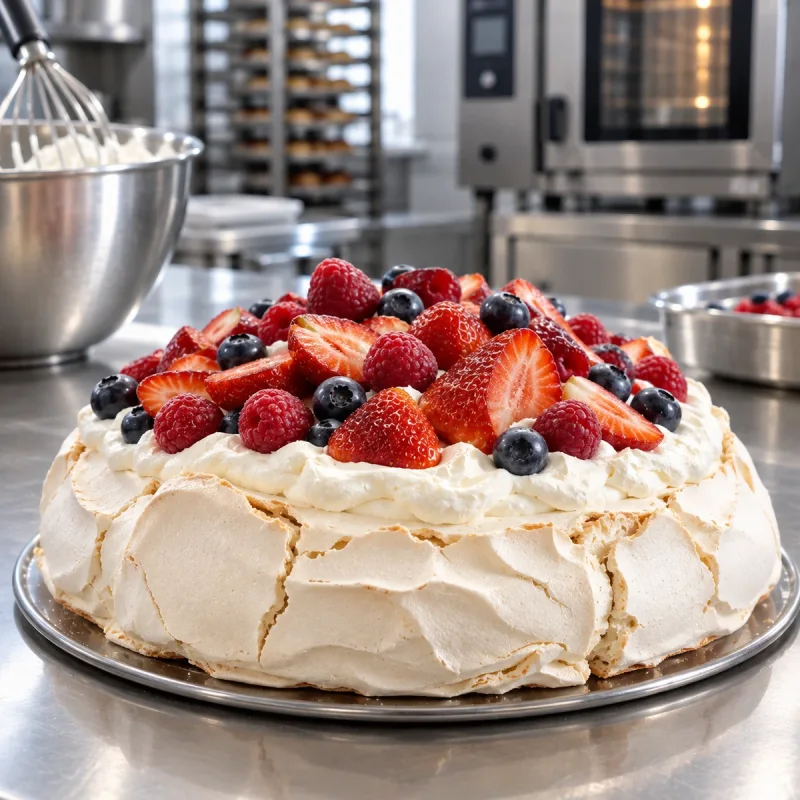
Pavlova cracking, browning or weeping syrup? Check sugar, drying and humidity
Pavlova looks simple: egg whites, sugar, slow baking or drying, then cooling. In practice, many failures appear only at the end. The surface cracks, sticky syrup leaks from the base, the pale meringue turns brown, or a tall shell suddenly sinks as it cools.
Those problems are not solved reliably by “whip longer” or “bake another ten minutes.”
Pavlova stays stable only when the foam, dissolved sugar, gentle heat and controlled moisture loss are in balance. Egg-white proteins form a network around air bubbles, sugar stabilizes that network and holds water, and heat must dry the outer shell without browning or setting the surface too quickly.
A good pavlova is therefore not the same as a completely dry meringue. The outside should be dry and lightly crisp, while the center may stay softer and almost marshmallow-like.
First separate normal cracking from real collapse
Small cracks are not automatically a failure. Meringue expands as it heats and contracts as it cools. The outer shell is rigid while the inside remains softer, so some cracking at the edge or top is common.
The problem is different when the center caves in deeply, the whole shell collapses toward the base, syrup leaks from cracks, or the inside remains very wet and unstable after cooling.
Do not correct appearance alone. Work out whether the failure started in the meringue before baking or during moisture loss while baking and cooling.
If the basic egg-white foam is already unstable, start with the PEK guide Egg whites won’t stiffen: causes and how to whip them correctly.
1. Add sugar only after the foam has begun to form
Do not load liquid egg whites with the full amount of sugar at the start. First build a fine, even foam. Then add sugar gradually in smaller additions while continuing to whip.
Sugar has two important roles. It slows foam development, but it also stabilizes an already forming protein network and helps manage water. If it is added too fast or all at once, the foam can build more slowly and the sugar can be harder to dissolve evenly.
The finished meringue should look smooth, dense and glossy.
2. Gritty sugar is a useful diagnostic sign
Rub a small amount of meringue between two fingers. Obvious coarse grains mean some sugar has not dissolved.
Not every formula needs to feel perfectly smooth under the fingers, but a clearly sandy texture raises the risk of uneven meringue and later sugar syrup weeping out.
Use sufficiently fine sugar and add it gradually. If the meringue is already very stiff, dry and flaky, do not keep beating for a long time just to chase remaining crystals. That can push the foam beyond a useful, elastic stage.
3. The stiffest possible meringue is not the best meringue
Pavlova needs firm foam, not dry, grainy foam. When you lift the whisk, the peak should stand while the surface remains smooth and glossy.
If the mixture starts breaking into dry flakes and loses its shine, it has probably been whipped too far. Over-whipped foam is harder to shape and requires more mechanical work, which can damage the fine bubble structure further.
Aim for strength with elasticity, not record stiffness.
4. Acid can improve tolerance, but it cannot repair bad foam
A small amount of cream of tartar, lemon juice or another acid can make egg-white foam more tolerant during whipping. That does not mean more acid automatically makes a better pavlova.
Acid cannot fix grease in the bowl, a trace of yolk, undissolved sugar or badly over-whipped whites. It supports a correct process; it does not replace one.
5. Starch changes the center but does not fix every crack
Many pavlova formulas include a small amount of starch. Its job is not to create volume. Volume comes from air in the foam and the expansion of gases and water vapor.
Starch can bind some water and contribute to the characteristic softer center. If the meringue itself is poorly whipped or the sugar has not dissolved well, extra starch will not remove the root cause.
6. Shape without pressing out unnecessary air
Transfer the meringue to the baking sheet and shape it with gentle movements. The surface does not need to be geometrically perfect; soft ridges and a natural shape are completely appropriate.
If you keep smoothing, pressing and redistributing the mixture, you lose some of the air that was built during whipping.
For a large pavlova, make the center slightly lower to hold cream and fruit later, but avoid compressing the walls into a dense mass.
Why pavlova turns brown
If you want a pale, nearly white shell, strong browning is primarily a sign that the surface is getting too hot.
At higher heat the meringue colors faster, and the outer layer can set before moisture from the center has had enough time to move outward gradually.
Pavlova is therefore not treated like sponge cake, where fast lift and a golden crust may be desirable. The goal is closer to slow drying at moderate heat.
If the surface browns quickly, check the actual oven temperature rather than trusting the dial alone.
Why pavlova weeps syrup
Sticky droplets or a puddle of sugar syrup are not the same as a normally soft center.
Check three things first.
Was the sugar sufficiently dissolved? Coarse crystals increase the risk of uneven distribution of sugar and water.
Was the center sufficiently stabilized and dried? Very wet meringue can release liquid as it cools.
Was the pavlova exposed to high humidity? Sugar is hygroscopic, so even baked meringue can pull water back from humid air.
Simply baking longer is therefore not always the right answer. First identify whether the liquid comes from poorly prepared meringue or from an already baked shell that has reabsorbed moisture.
Why the surface becomes sticky
A thin sticky layer is very often a humidity problem. Dry meringue left in a humid kitchen or stored unprotected can soften again because sugar attracts water from the air.
That matters especially with pavlova because whipped cream and fruit add even more moisture. If you want a crisper shell, assemble the dessert as close to serving time as practical.
Cracks after baking: check the cooling rate
A very rapid temperature drop increases mechanical stress between the dry outer shell and the softer interior. Gradual cooling in the switched-off oven is therefore often useful.
It is not a magic rule that prevents every crack. Small cracks can be normal. Gradual cooling mainly reduces thermal shock and gives internal moisture more time to redistribute.
A large hollow under the top crust
Pavlova is naturally light and partly hollow, so a cavity by itself is not a failure.
If you get a very thin high shell, a large empty space underneath and a dense wet layer at the bottom, look first at heating speed. Excessive initial heat can expand and set the outside rapidly while the inner mass is still unevenly stabilized.
Do not change every ingredient in the next batch. First check the real oven temperature and how quickly the surface begins to color.
The center collapses deeply
A slightly lower center is often desirable in a pavlova that will hold cream and fruit. A deep collapse of the whole structure means the supporting network lost too much strength.
Possible causes include foam that was not stable enough before shaping, too much mechanical handling, too much free moisture at the end of baking, or a very fast temperature change.
A cut section is the best clue. A wet, heavy, gummy center means something different from a light center with a few normal cracks.
Pavlova is dry all the way through
That is not necessarily a technical failure; you may simply have made a different style of meringue.
Classic pavlova usually aims for a contrast between a dry crisp exterior and a softer center. If the entire piece is hard and dry, moisture loss was high relative to its size and thickness.
Next time check size, thickness, temperature and time. Do not automatically conclude that more sugar is required.
When to add cream and fruit
Pavlova should be completely cool before filling.
Cream and fruit bring water into the system. If you assemble too early, the crisp shell starts to soften. Drain very juicy fruit if necessary and add the cream close to serving if preserving the contrast between shell and center matters to you.
The most useful troubleshooting order
Meringue is grainy or dull before baking: start with whipping and sugar addition.
The mixture looks good but browns quickly: check oven temperature.
Syrup appears after baking: check sugar dissolution, internal moisture and cooling conditions.
The surface turns sticky after cooling: check ambient humidity and storage.
The pavlova collapses badly: cut it and judge whether the center is too wet or structurally weak.
There are a few cracks but the interior is light and the texture is right: you probably do not have a serious problem.
The biggest mistake with pavlova is often trying to eliminate every crack. A more useful target is stable foam, sufficiently dissolved sugar, gentle heat and controlled moisture. When those four elements are right, a little natural irregularity is not a defect; it is part of how a real meringue structure behaves.