Room temperature is not one number for every ingredient
In baking, “room temperature” does not mean every ingredient must have exactly the same temperature. It means the ingredient should be in the physical state required by the method. In a classic butter cake, butter, eggs, and liquid dairy should be close enough in temperature that the butter stays plastic and the emulsion remains stable. Shortcrust and laminated doughs may deliberately require colder fat.
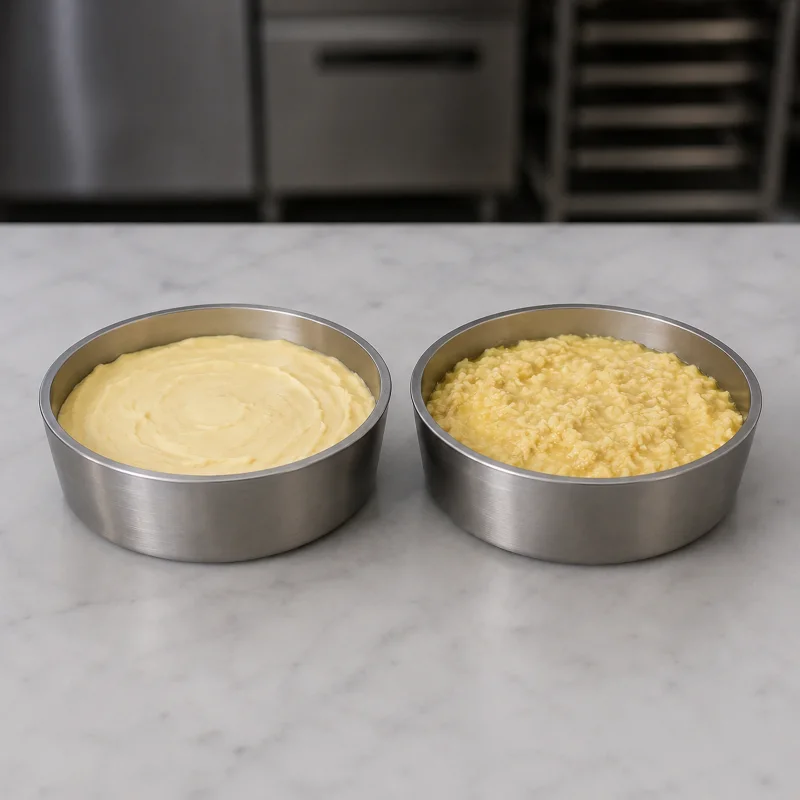
A common failure happens when butter is around 19°C / 66°F and an egg goes in straight from the refrigerator. The cold egg chills the butter locally, part of the fat firms up, and the water phase becomes harder to disperse. The batter turns grainy or looks curdled. At the opposite extreme, butter that is very soft, greasy, and shiny cannot hold as much stable air during creaming.
For many butter cakes, butter around 18–21°C / 65–70°F is a useful starting range. Eggs and liquid dairy work well near normal room temperature, about 20–21°C / 68–70°F. Matching the physical state matters more than forcing every ingredient to the identical number.
Why temperature changes creaming and emulsification
During creaming, sugar crystals create tiny air pockets in plastic butter. Butter that is too cold cannot stretch effectively around those cells; butter that is too warm or partly melted cannot support them.
Eggs add water, proteins, and yolk emulsifiers. Add them in several smaller portions and let each addition disappear into the batter before adding more. A smooth, aerated, evenly creamy batter is a good sign. Graininess, firm pale butter flecks, or free liquid indicate an unstable mixture.
How to recognise properly softened butter
Butter for creaming should be soft but not greasy or partly melted. A finger should leave a clear indentation while the butter still offers slight resistance. About 18–21°C / 65–70°F is a useful practical range for standard butter.
If the butter cracks or stays in hard pieces under the beater, it is too cold. If the surface looks shiny, gives way with almost no resistance, or shows liquid fat at the edges, it is too warm. Melted butter is not a substitute for softened butter in a formula designed around creaming.
Eggs and dairy: when to warm them
When a cake begins by creaming butter and sugar and then gradually adding eggs, room-temperature eggs generally support a more stable mixture. A practical target is around 20–21°C / 68–70°F.
Cold eggs in their shells can be placed in warm tap water for about 10 minutes. The goal is not to make them hot, only to remove the refrigerator chill. Warm milk, cream, yogurt, or sour cream only as much as the recipe requires.
In simple one-bowl cakes that do not depend on creaming or a delicate emulsion, egg temperature is often less critical.
Yeast dough: target the dough, not a fixed liquid temperature
A single prescribed milk or water temperature is not the best way to control yeast dough. Adjust the liquid temperature so that the fully mixed dough reaches the desired final dough temperature.
For many wheat-based yeast doughs, about 24–26°C / 75–78°F after mixing is a useful target. Room temperature, flour temperature, preferment, liquid, and friction from mixing all affect the result.
In soft yeast crescent rolls, the final dough temperature matters more than whether the starting liquid happened to be 25°C or 30°C.
When ingredients should not be at room temperature
Shortcrust, puff pastry, and laminated yeast dough follow a different rule. The fat often needs to stay cooler, or at least have similar firmness to the dough, so layers remain distinct.
Foam cakes also have their own process temperatures. In classic genoise, eggs and sugar may intentionally be warmed to about 43°C / 110°F before whipping to a stable ribbon. That is a process temperature, not room temperature.
The useful rule is simple: choose temperature according to the method.
Temper ingredients without overheating them
Cut butter into smaller pieces and judge its texture or centre temperature. A fixed counter time is unreliable because room conditions and piece size vary.
Use warm tap water for eggs for about 10 minutes. Warm milk or cream in short intervals and stir between them. When temperature matters, use a clean probe thermometer.
A microwave is the least forgiving way to soften butter. Use low power and very short bursts. Shiny or liquid edges mean it has already gone too far for classic creaming.
Ingredient temperature changes the bake as well
A colder batter enters the oven with a larger temperature lag. The outer zone can begin setting while the centre still needs more time.
Do not automatically add baking time. Check several doneness signs together: the centre springs back lightly, a wooden skewer does not carry raw batter, and the edges may begin to pull slightly from the pan.
Internal temperature can be an additional tool, but it is not universal. Classic butter cakes often finish roughly around 96–99°C / 205–210°F, depending on the formula, so use temperature with the other signs rather than as the only rule.
What to do if the butter batter has already curdled
If the batter contains firm butter flecks and separated liquid, it is often too cold. Warm the outside of the bowl gently while mixing slowly, only until the emulsion comes back together.
If the batter is shiny, greasy, loose, and has lost volume, it is probably too warm. A brief cool-down can return the butter to a plastic state. Do not add flour simply to hide a curdled appearance; doing so can start gluten development too early.
Frequently asked questions
Answers to common questions
How long do eggs take to reach room temperature?
Do not rely on counter time alone. For a quick method, place cold eggs in their shells in warm tap water for about 10 minutes; for butter cake, roughly 20–21°C / 68–70°F is a useful practical target.
Can I soften butter in the microwave?
Only with caution, low power, and very short bursts. Stop before the edges become shiny or liquid because that butter will hold less stable air during creaming.
Does room temperature always mean 20°C / 68°F?
No. Creaming butter often works well around 18–21°C / 65–70°F, while eggs in butter cake may be around 20–21°C / 68–70°F. Laminated dough and genoise intentionally use different temperatures.
Can I use cold eggs if I add them slowly?
Slow addition helps, but very cold eggs can still firm softened butter locally. When the formula depends on a stable butter emulsion, temper the eggs first.