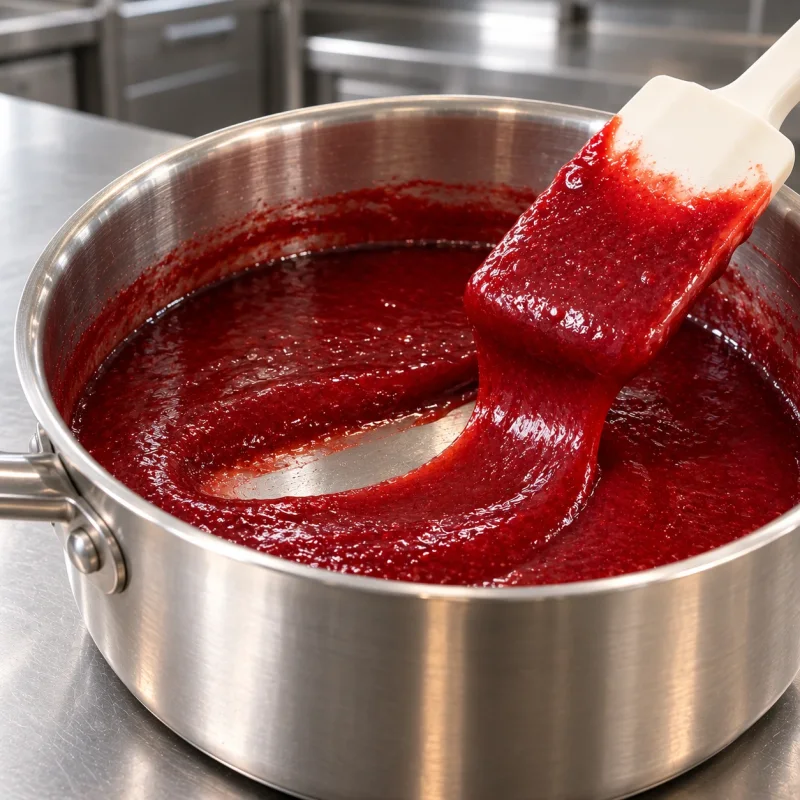
Tapioca should thicken the liquid, not turn it into glue
A fruit filling can still look fairly fluid while it cooks and then thicken dramatically within seconds. This is exactly where bakers often make a mistake: they add more starch because the hot mixture still seems too loose. After cooling, the result becomes rubbery and stringy and clings to the knife.
When you are replacing flours and binders in gluten-free baking, the same principle applies: tapioca works best when the amount matches the dessert, the available water and the texture you want. In fillings, glazes and creams, tapioca primarily binds water, raises viscosity and creates a smooth, slightly elastic structure.
A correctly thickened mixture should still move while hot. A spatula trail should remain visible for a few seconds and then soften slowly at the edges. If the mixture already forms firm, rubbery ridges in the pan, there is too much starch.
Choose the right form of tapioca thickener
For smooth creams, fruit sauces and cooked fillings, use finely milled tapioca starch. Some packages call it tapioca flour, but do not confuse it with whole-root cassava flour, which also contains fibre and other root components. Tapioca pearls are not a direct substitute for starch; they are intended for desserts in which the swollen granules are part of the texture.
For the differences between products and possible substitutes, see what tapioca starch is and how to replace it.
Quick-cooking or instant tapioca consists of pretreated small granules. It is especially useful in fruit pies and rustic fillings where a fine granular texture is acceptable. Let it stand in the fruit for about 15–30 minutes before baking so the granules can hydrate. Added immediately before baking, it may leave visible translucent specks.
Pregelatinised tapioca starches can thicken in cold liquid. Modified starches may be instant or cook-up products and may be designed for freezing, acidity or intensive processing. Their performance varies, so follow the manufacturer’s dosage and process for that specific product.
How much tapioca starch to use
Treat the quantities below as starting ranges for fine, regular tapioca starch in a specific type of mixture, not as universal formulas. Sugar, acidity, fruit juice, the proportion of fruit pieces, cooking time and cooling all change the final result.
Per 1,000 g of each type of mixture, start with:
- 8–12 g for a strained fruit sauce or glaze that should remain pourable;
- 15–25 g for a cooked fruit filling that should be thick but spreadable;
- 25–40 g for a baked fruit filling that must hold a clean slice after complete cooling;
- 8–15 g as a supporting thickener in dairy or plant-based cream.
Do not transfer these ranges directly from one system to another. The amount of free water and the heating method are different.
With very juicy or frozen fruit, start toward the upper end only if all released liquid remains in the filling. Start lower if part of the liquid is reduced first. Frozen fruit often releases more water as it heats, so base the decision on the actual free liquid rather than fruit weight alone.
In dairy creams, tapioca is not always ideal as the sole thickener. A larger dose can become stringy or slimy, particularly in protein-rich liquids. For a more stable pastry cream, use a smaller amount of tapioca together with cornstarch or rice starch. Tapioca contributes smoothness and flexibility while the second starch limits excessive elasticity.
Disperse the starch in cold liquid first
Do not pour dry tapioca starch directly into hot fruit juice or milk. The outside of the particles hydrates and gels immediately while the centre of the lump stays dry, and later whisking may not remove those lumps.
Make a cold slurry with one part starch and two to three parts cold liquid. For 20 g starch, use roughly 40–60 g of water, juice or another cold liquid from the recipe. Stir the slurry again immediately before adding it because starch settles quickly.
In high-sugar fillings, you can first mix the starch thoroughly with the sugar and then add the liquid. Dry mixing separates the fine particles and reduces lumping. At the same time, sugar ties up part of the water and can raise the temperature at which starch develops its full thickening effect.
Pour the cold slurry into a warm, not yet boiling base while stirring constantly. Heat evenly and scrape the sides and bottom of the pan. The mixture usually changes from slightly cloudy to thicker and more translucent.
Heat must reach the centre of the mixture
Laboratory measurements place gelatinisation of a simple 5% aqueous tapioca-starch dispersion over a broad range of roughly 63–84 °C. That is a model system, not a target temperature for every dessert. Real fillings also contain sugar, acids, fats and other solids, so the first sign of thickening does not mean all starch is fully cooked.
For a cooked sauce or cream that can tolerate a brief boil, bring the mixture to a gentle boil after it thickens and cook for about 30–60 seconds while stirring. It should be uniformly smooth, without milky-white starch traces or a raw, floury mouthfeel.
Long, violent boiling is not an improvement. Extended heating in an acidic fruit filling can weaken the swollen starch structure, and aggressive stirring can damage the granules further. Once viscosity is even, stop cooking.
In a baked fruit pie, the filling should visibly bubble closer to the centre, not only around the hot edge of the pan. Edge bubbles alone do not prove that the centre has heated sufficiently.
Account for acid, sugar and fat
Fruit acids do not prevent you from using tapioca, but low pH combined with high heat and long cooking can reduce final viscosity. If the recipe allows, add lemon juice or concentrated acid near the end of cooking. In baked fillings where everything is combined before baking, avoid unnecessary long pre-cooking.
A large amount of sugar reduces the water available to starch. A very sweet filling can therefore thicken later than a less sweet one even with the same starch dose. Do not add more starch merely because the mixture has not thickened at a lower temperature.
Fat and chocolate also increase apparent body without additional starch. In chocolate cream, remember that cocoa butter firms as it cools. A warm cream that seems slightly soft may become fully stable once chilled.
Hot thickness is not final thickness.
Judge the texture only after cooling
Spread a small spoonful of hot filling on a chilled plate and wait two to three minutes. This quick test gives a better idea of how a larger batch will behave after cooling. A correctly thickened fruit mixture remains spreadable, does not weep around the edges and does not pull into long sticky strings.
Cool pies and filled pastries completely before cutting. The starch structure stabilises during cooling and the fruit juices settle among the pieces. Cutting too early can make a correct formula look under-thickened.
For the next batch, record the filling weight, starch amount and final result. If it was too soft, increase the starch by about 2–3 g per 1,000 g of mixture. If it was rubbery, reduce it by the same small step. With tapioca, small changes matter.
Diagnostics
Common problems and solutions
Translucent or white lumps remain in the cream or fruit filling.
Cause: Dry starch was added directly to hot liquid, so the outside gelled while the centre of the lump stayed dry.
Solution: Mix the starch first with two to three parts cold liquid, then pour the slurry into the warm base while stirring continuously.
The cooled filling is rubbery and pulls into strings on the knife.
Cause: Too much tapioca starch was used, or it was used as the only thickener in a dairy cream.
Solution: Next time reduce the amount by 2–3 g per 1,000 g of mixture. In dairy creams, replace part of the tapioca with cornstarch or rice starch.
The fruit pie is runny when cut even though the filling bubbled at the edge.
Cause: The centre did not become hot enough for even starch gelatinisation, or the pie was sliced while still warm.
Solution: Bake until the filling visibly bubbles closer to the centre as well, then cool the pie completely before slicing.
The filling thickens during prolonged cooking and then becomes thinner again.
Cause: Long heating of an acidic mixture and vigorous stirring weakened the structure of the swollen starch granules.
Solution: For a cooked mixture that can be boiled, cook only another 30–60 seconds after even thickening. When the recipe allows it, add strongly acidic ingredients near the end.
Visible gelatinous specks remain in a filling made with instant tapioca.
Cause: The granules did not have enough time to hydrate before baking.
Solution: Mix instant tapioca evenly with the fruit and let the filling stand for 15–30 minutes before baking.
Technical terms
Terms worth understanding
- Starch gelatinisation
- The process in which starch granules absorb water and swell when heated, increasing the viscosity of the mixture.
- Slurry
- A cold mixture of starch and liquid that allows the starch to be added evenly without lumps.
- Viscosity
- A measure of a liquid’s resistance to flow; higher viscosity means a thicker, more slowly flowing mixture.
- Modified tapioca starch
- Functionally treated starch designed for properties such as freeze-thaw stability, heating, cold thickening or other demanding processes.
Frequently asked questions
Answers to common questions
Can I replace cornstarch with the same amount of tapioca starch?
Not always. Tapioca produces a clearer, more elastic texture, so use a ratio tested for the specific recipe and adjust the amount after judging the cooled result.
Can tapioca starch thicken a no-cook cream?
Regular tapioca starch needs water and heat. For cold preparation, use only a product explicitly labelled pregelatinised or suitable for cold thickening.
Is tapioca starch suitable for freezing fruit fillings?
It depends on the specific starch and the filling formula. For repeated freezing and thawing, use a tapioca starch specifically declared stable for freeze-thaw use.
Why is a tapioca filling much thicker after cooling than while cooking?
The starch structure stabilises during cooling, so the filling firms further. Do not decide the final starch amount from the appearance of the hot mixture alone.