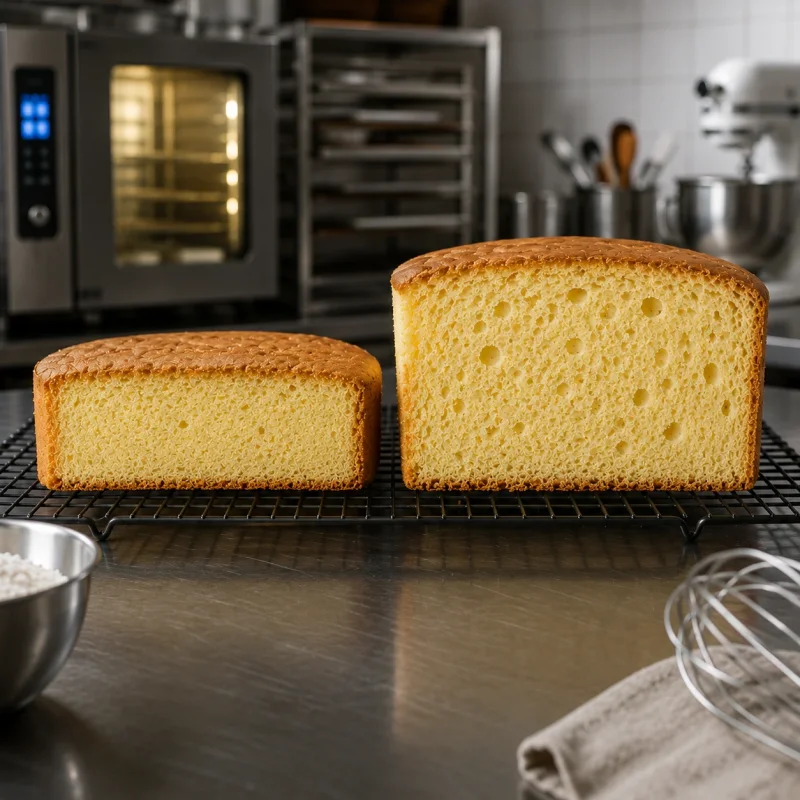
Why sponge cake stays low
In an egg-foam sponge, a flat or dense result usually means that too little stable air was built into the batter, or that much of that air was lost before the structure could set. The most useful clue is therefore not only the final height of the cake, but when the batter lost volume: during whipping, while folding in flour, after adding fat, or only during baking.
If the batter was already thin and low before it entered the oven, start with the foam and folding technique. If the sponge rose well and then collapsed, treat that as a different problem; see why sponge cake sinks after baking.
For the broader relationship between foams, creams and cake structure, see dessert structure, stability and texture.
First checkpoint: the foam before the flour
With whole eggs and sugar, a practical endpoint is ribbon stage. The mixture is much paler and thicker, and batter falling from the whisk forms a broad ribbon that remains visible on the surface for a few seconds before blending back in. A fixed whipping time is less reliable because batch size, egg temperature, bowl shape and mixer power all change the clock.
If the recipe uses separately whipped whites, the target depends on that formula. The foam should be even and flexible enough to fold into the rest of the batter. Dry, grainy or clumpy whites are harder to combine without losing air. For the detailed technique, see how to whip eggs and sugar to ribbon stage.
Egg proteins help surround and stabilize air bubbles during whipping. During baking, heat gradually sets that protein network. The oven can expand gases already present, but it cannot replace air that has already been lost from the batter.
Second checkpoint: what happens after flour is added
A well-developed foam can lose a large share of its volume in only a few forceful strokes. Dry ingredients add weight, so fold only until the flour is evenly incorporated and no dry pockets remain. The goal is not extra mixing; it is to preserve as much of the existing aeration as possible.
Compare two moments:
- before flour, the mixture is pale, thick and leaves a visible trail;
- after flour, it should still look clearly aerated rather than suddenly turning thin and runny.
If the batter collapses at this step, folding technique is a more likely cause than oven temperature.
The amount of flour also matters. Too much flour for the formula can make the batter heavy and the baked sponge low and dry. That is a separate fault from weak foam; see too much flour in sponge cake.
Third checkpoint: how fat is incorporated
In genoise and related foam cakes, melted butter or another fat can sink through the foam and displace air. Many methods therefore mix the fat with a small portion of batter first, then gently fold that lighter mixture back into the main bowl.
This is not a universal rule for every sponge. Follow the method of the specific recipe. The diagnostic clue is useful, however: if the batter is still airy after the flour but becomes noticeably lower and heavier immediately after the fat goes in, investigate that step.
Sugar can stabilize foam, but the method decides when it is added
With whipped egg whites, sugar generally slows initial foaming but helps stabilize the foam as whipping and heating continue. That is why many separate-egg methods add sugar gradually after the whites have already become foamy.
Whole-egg sponges often use a different method: eggs and sugar are whipped together to ribbon stage. There is no safe universal rule that sugar must always be added later.
The same caution applies to egg temperature. Tempered eggs often whip faster and may reach a larger volume, but the tested method of the actual recipe takes priority over a generic rule.
The oven sets structure; it does not create missing aeration
By the time the batter reaches the oven, most of the required air should already be trapped in the mixture. Heat expands gases and steam, egg proteins set, and starch helps form a stable crumb.
There is therefore no single baking temperature or fixed “never open the oven for X minutes” rule for every sponge. Formula, pan size, batter depth and oven mode all matter.
Use three more reliable checks:
- preheat the oven to the temperature specified by the tested recipe;
- do not leave a finished foam batter standing unnecessarily;
- do not judge doneness by surface colour alone — the centre must be set and springy.
If the cake rises first and then sinks, do not diagnose it as the same fault as a cake that never rose. In that case, centre doneness, moisture balance and structural stability during baking also need to be checked.
Diagnose by the symptom
The batter is thin immediately after whipping the eggs. Check whether the foam reached the required stage. With whole eggs, look for a thick pale ribbon; with whites, use the peak stage required by the recipe.
The foam has volume but looks dry, dull or grainy. The whites may be overwhipped. A dry foam is harder to distribute evenly and can lose more air when combined.
The batter looks good until the flour is added. A rapid loss of volume points to folding that was too aggressive or too prolonged.
The batter survives the flour but drops after butter or oil is added. Review the fat-incorporation method and follow the technique specified by the recipe.
The sponge is low and also very dry. Check flour quantity and baking time in addition to the foam. A low cake is not always only a whipping problem.
The cake rises in the oven and then sinks. That is a different symptom. Check whether the centre was fully set and compare with the dedicated collapse guide.
PEKI control system: four places to catch the fault
Instead of guessing after the cake is baked, inspect the batter four times.
1. After whipping. The mixture has the colour, viscosity and foam structure expected for the chosen method.
2. After dry ingredients. It is still visibly aerated and has not suddenly become thin and fluid.
3. Before baking. The batter goes into the prepared pan without a long delay or unnecessary vigorous smoothing.
4. At the end of baking. The centre is set and resilient, not simply browned on top.
This turns troubleshooting into a sequence instead of guesswork. If everything looks right after whipping but volume disappears after flour, do not change the oven temperature next time — change the folding. If the batter reaches the pan airy but the structure does not survive baking, then investigate the baking stage.
For a low sponge, the most useful question is therefore: at which step did the volume disappear? Once you can answer that, the correction is far more precise than adding extra baking powder or randomly changing the oven temperature.
Frequently asked questions
Answers to common questions
Why doesn’t my sponge rise even though I used baking powder?
If the formula relies mainly on egg foam, baking powder cannot replace air that was never incorporated or was lost during folding. Check foam development and the change in volume after flour first.
How do I know when whole eggs are whipped enough for sponge cake?
The mixture should be much paler and thicker. Lift the whisk: it should fall in a broad ribbon that stays visible on the surface for a few seconds before slowly blending back in.
Is a flat sponge always caused by underwhipped eggs?
No. Air can also be lost through rough flour folding, poor fat incorporation, an overly heavy formula or during baking. Track the step where the batter actually changed.
What does it mean if the sponge rises and then sinks?
That is not the same symptom as a sponge that never rises. Check centre doneness, formula balance and the baking process as well as the original foam.