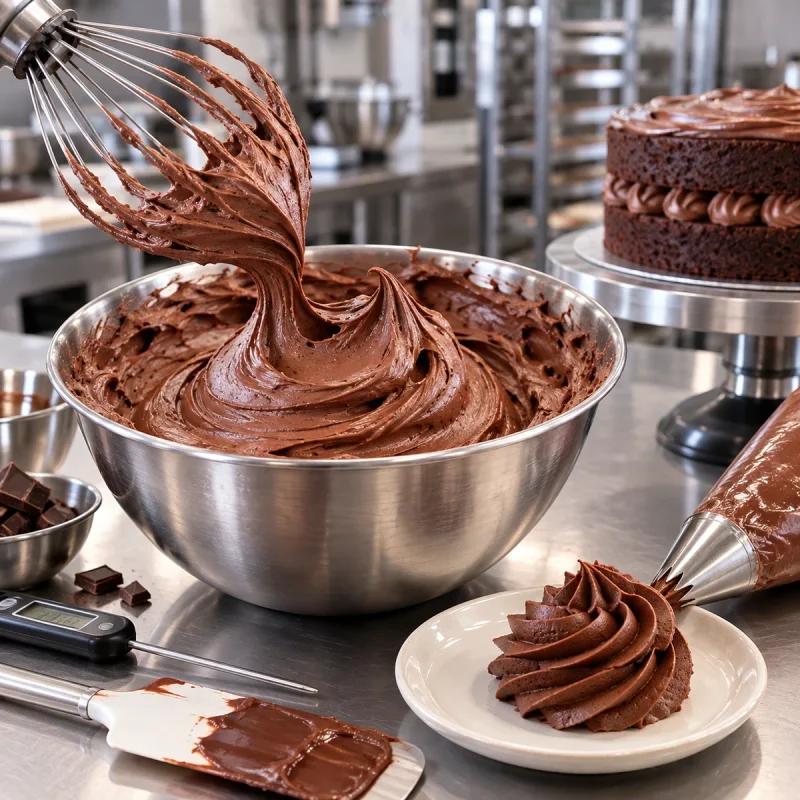
Whipped ganache should not be treated as ordinary warm ganache that simply needs more beating. First you build a smooth, stable emulsion, then add the cold cream, chill the base completely, and only then whip it until it becomes light and pipeable.
For the underlying emulsion, start with the guide to smooth, stable chocolate ganache.
Two methods that are often confused
A standard ganache can be cooled and whipped; the result is relatively dense and rich. A professional ganache montée uses a smaller hot liquid phase to emulsify the chocolate, then a larger cold cream portion is blended in. After several hours of refrigeration — often overnight — the base is whipped. This second method gives a lighter, airier cream.
A practical starting point for dark couverture
For dark couverture around 64–74%, a useful starting point is 100 g chocolate, about 120 g cream for the hot phase, 240–250 g very cold cream, and 10–12 g honey, glucose or invert syrup. This is not a universal formula. Milk and white chocolate need different balances.
Build the emulsion before chilling
Add the hot cream to the chocolate in two or three additions, stirring from the center outward. A good emulsion becomes glossy and elastic with no greasy rim. Keep an immersion blender below the surface to avoid pulling in air.
Once the emulsion is fully homogeneous, blend in the cold cream. Cover directly on the surface and refrigerate for at least about 3 hours; overnight is more reliable. The center must be cold too, not just the edges of the bowl.
Whip to texture, not to a fixed number of minutes
Start at low to medium speed. Whisk trails appear first, then volume increases and the color lightens slightly. Stop while the surface is still smooth and faintly glossy, with a soft peak that bends rather than breaking.
Pipe one test rosette onto a cold plate. If the ridges stay defined for several minutes without feeling hard, dry or grainy, the ganache is ready.
If it will not whip
The base may be too warm, insufficiently chilled, made with low-fat cream, or too soft for the specific chocolate. Chill it fully before changing anything else. If a thoroughly cold base is still fluid, the formula is the likely issue; endless whipping will not fix it.
If it turns grainy or greasy
A suddenly dry or grainy surface usually means you have gone too far. Stop immediately. A greasy rim or free fat points to an emulsion problem rather than a lack of whipping.
Dark, milk and white chocolate are not interchangeable
Different amounts of cocoa butter, sugar and milk solids change firmness. Professional formulas therefore use different chocolate amounts for dark, milk and white versions, and some white-chocolate formulas use an additional stabilizer.
Three checks before filling a cake
Whisk test: the peak is smooth and bends slightly. Rosette test: the ridges remain clear. Spatula test: the cream spreads cleanly but does not flow like a sauce. When all three are right, the ganache is usually ready for the cake.
Whipped ganache is most reliable when you think of it as a chilled emulsion that is aerated only at the end.
Diagnostics
Common problems and solutions
Ganache stays fluid
Cause: The base is too warm or the formula is too soft.
Solution: Chill completely; if still fluid when cold, correct the formula rather than whipping longer.
Ganache becomes grainy
Cause: Overwhipping.
Solution: Stop immediately and do not try to fix it with higher speed.
Frequently asked questions
Answers to common questions
How long should ganache chill before whipping?
At least several hours; professional formulas commonly specify about 3 hours minimum and often overnight.
Can I use the same ratio for white chocolate?
No. White and milk chocolate need their own balance.
Why does the piped rosette slump?
The cream may be too warm, underwhipped or structurally too soft for that application.
Is whipped ganache the same as mousse?
No. It can feel mousse-like, but its structure and formulation are different.