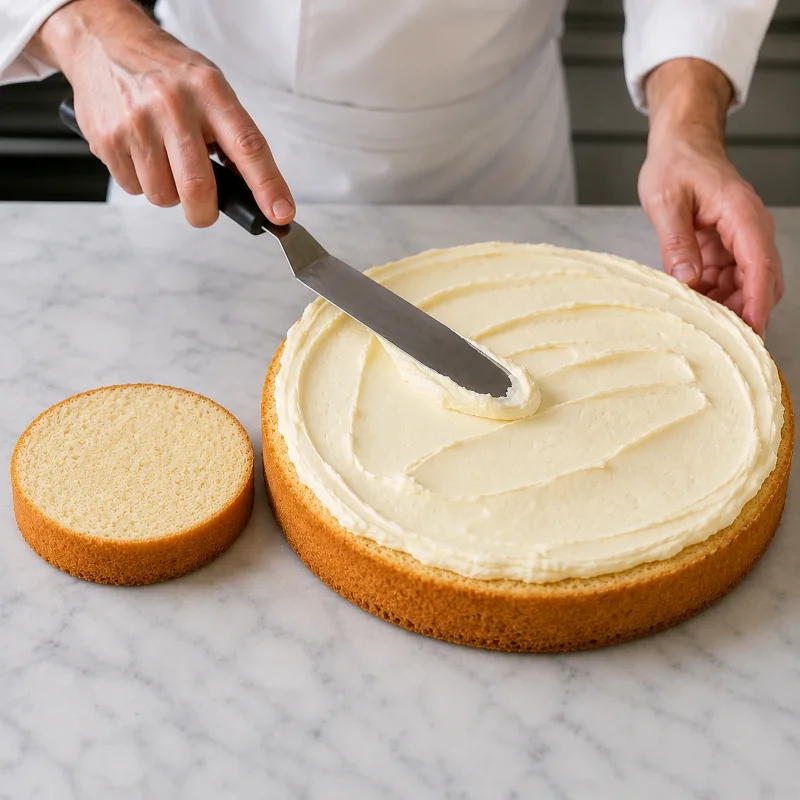
Scale filling by cake area and number of layers
For one equally thick layer of the same filling, use the ratio of cake areas. For round cakes, new diameter² ÷ old diameter² is the practical shortcut. Moving from 18 cm to 24 cm gives a factor of about 1.78. If one 18 cm layer used 600 g of the same filling, about 1,070 g is a sensible geometric starting point for one comparable 24 cm layer.
For the underlying pan calculation, see how much cake batter to use by diameter and depth.
Filling-layer count is a second multiplier
The area factor describes one comparable layer. If the new cake has more filling layers, include the ratio of layer counts as well. Three cake layers usually create two filling layers; four cake layers create three.
For a move from 20 cm to 26 cm, the area factor is about 1.69. If the cake changes from two filling layers to three, multiply the total by another 3 ÷ 2.
Calculate exterior frosting separately
Inner filling covers a flat cake surface. Exterior frosting also covers the sides, so usage changes with cake circumference and final height. A taller cake at the same diameter needs more side frosting even when its filling area has not changed.
Plan filling, crumb coat, final coat and piping as separate jobs rather than applying one universal multiplier to everything.
There is no universal filling thickness
Whipped-cream filling, mascarpone cream, ganache, buttercream and fruit filling have different densities and structural limits. The same mass does not always occupy the same volume. Instead of relying on a universal millimetre target or fixed extra percentage, weigh the amount used for one successful layer and record the cake diameter and layer count.
Stability matters more than extra quantity
Scale all components of a fruit filling together, including its setting system. Do the same with ganache or whipped-cream formulas. A filling that is too soft does not become structurally safer simply because you made more of it.
If a cake layer is too short in a larger pan, fix the batter and baking problem first rather than compensating with a thicker filling; see why cake gets flatter in a larger pan.
Calculate tiered cakes one tier at a time
Treat every tier as its own cake with its own diameter, height and filling-layer count, then add the totals. See also how to calculate amounts for a tiered cake.
The most dependable system is to record actual usage after each build. That turns general geometry into a tested reference for the fillings you actually use.
Diagnostics
Common problems and solutions
Problem
Problem
Technical terms
Terms worth understanding
- Area factor
- For an equally thick inner layer, use the pan-area factor rather than the linear change in diameter.
- Filling layer
- If the number of filling layers changes, multiply by the ratio of filling-layer counts as well.
- Exterior frosting
- Exterior frosting is a different calculation because side coverage grows with circumference and cake height.
- Personal reference
- The most repeatable method is to weigh the filling used for one successful layer and keep that as your own reference.
Frequently asked questions
Answers to common questions
How do I calculate filling for a larger round cake?
For one equally thick layer of the same filling, multiply the amount by new diameter² ÷ old diameter².
How much more filling do I need from 18 cm to 24 cm?
For one equally thick layer of the same filling, the factor is about 1.78.
What if the new cake has more filling layers?
Multiply the area factor by the ratio of new filling-layer count to the old count.
Do I scale exterior frosting by the same factor?
Not exactly. Exterior frosting also covers the sides, so finished cake height and the desired finish matter.
Should I always make 10% extra frosting?
Not as a universal rule. Recording your actual usage and adjusting any reserve to the decoration style is more reliable.