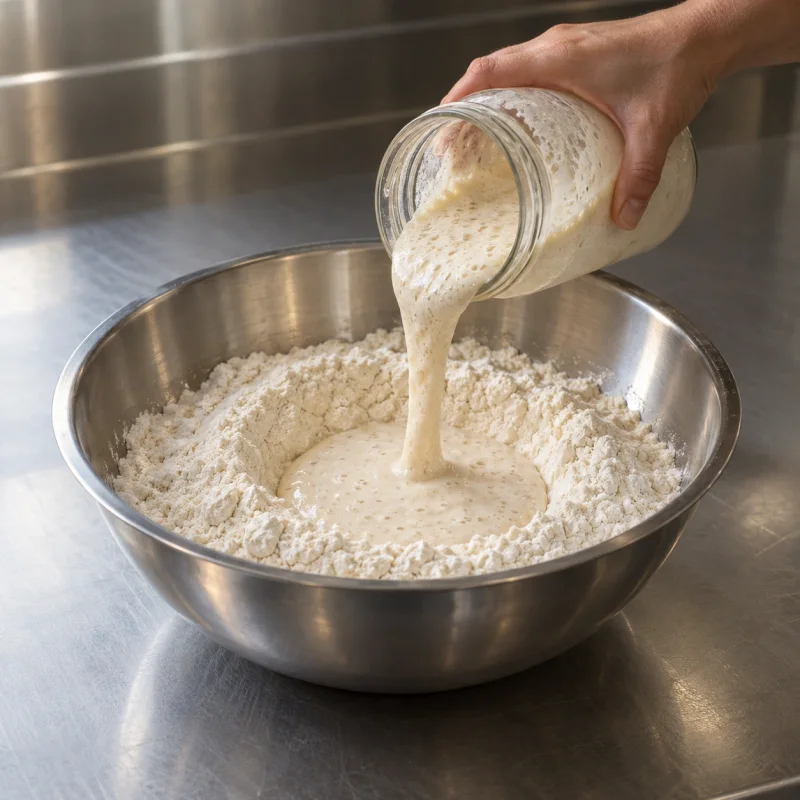
What the percentage in your recipe means
“20% starter” does not tell you whether the author means the whole starter weight or just the flour inside it. The reference flour weight can differ too. Establish both before comparing two recipes.
Start with total flour
Prefermented flour (%) = flour in the preferment / total flour in the whole formula × 100. Include the flour already in the preferment, not just what you add in the final mix.
With 900g final-mix flour and 200g levain at 100% hydration, the levain contains 100g flour and 100g water. Total flour is 1,000g, so prefermented flour is 10%. Levain weight is 20% of that total flour: a different measurement.
Separate flour and water using hydration
For a preferment made only of flour and water:
Flour = preferment weight / (1 + hydration/100). Water is the remainder. Hydration expresses water weight relative to flour; 100% means equal weights, not a mixture made entirely of water.
| Hydration | Preferment weight | Flour | Water | Share of 1,000g total flour |
|---|---|---|---|---|
| 50% | 200g | 133.3g | 66.7g | 13.33% |
| 100% | 200g | 100g | 100g | 10% |
| 125% | 200g | 88.9g | 111.1g | 8.89% |
Prefermented flour calculator
Figures are rounded for display. These are calculation examples, not recommended hydrations or universal bread proportions. If the preferment contains salt, fat or other additions, use its actual composition. Include the flour and water in seed starter, but do not add them again if already included in the stated weight and hydration.
Subtract water as well as flour
Choose a total formula of 1,000g flour and 700g water, using 200g levain at 100% hydration. It supplies 100g of each, leaving 900g flour and 600g water for the final mix. Overall hydration stays 70%, with 10% prefermented flour.
Adding the levain on top of all 1,000g flour and 700g water gives 1,100g flour and 800g water: about 72.73% hydration and 9.09% prefermented flour. That is a different formula. This example is not a complete tested bread recipe.
To compare an increased prefermented flour proportion, keep total flour and water unchanged. Arithmetic alone does not make poolish and levain interchangeable: culture, acidity and maturity can differ.
What a higher proportion changes
More prefermented flour brings more active fermenting material, microorganisms and products of earlier fermentation into the final dough. Under comparable conditions, this can speed up final fermentation. The rate also depends on dough and room temperature, preferment maturity and hydration, flour, salt, final dough hydration, commercial yeast or sourdough culture, and the time and temperature of the earlier fermentation.
A rule such as “4–6 hours at 22–24 °C” is therefore not universal. A poolish with very little yeast may be designed to mature for 12–16 hours, while another preferment may be ready much sooner. With sourdough, the range depends even more on the culture and formula.
More preferment does not guarantee an open crumb
An open crumb needs enough gas and a structure strong enough to retain it. More preferment can improve aroma and change dough behaviour, but a large hole beside dense, gummy crumb can indicate underfermentation rather than success.
Gluten development, suitable hydration, properly managed dough fermentation, shaping and putting the dough in the oven at the right stage also matter.
How to tell when a preferment is ready
The signs depend on the type of preferment. Ripe poolish is aerated, bubbly and near its peak rise; substantial collapse means it has passed the optimum for many formulas. With levain, assess rise, aroma and texture against the fermentation schedule the recipe was designed for.
Do not apply one visual test to every preferment. A stiff biga behaves differently from a liquid poolish, just as a levain at 50% hydration looks different from one at 100% hydration.
Assess a slightly overripe preferment against its formula and actual condition. For repeatable results, remake one that has badly collapsed or degraded. Chilling slows further fermentation but does not restore lost structure. Do not assume its subsequent activity or fermentation time will be the same, or that it will necessarily ferment faster.
Compare the process as well as the slice
Record the prefermented flour percentage, preferment hydration and maturity, final dough temperature and time. For the first comparison, keep flour, total water, salt and method as similar as possible. Otherwise, extra water or warmer dough may be mistaken for a preferment effect.
The dough also has to retain the gas it produces. Large gaps beside dense crumb or dough spreading are not conclusive diagnoses. Check gluten development, maturity and baking; the guide to dense, sour or cracked sourdough bread helps distinguish related faults.
What about digestibility?
Fermentation can alter dough composition, but prefermented flour percentage alone cannot reliably predict whether a particular bread will be easier for an individual to digest. The whole formula, time, culture, temperature, grain type and individual all matter. Use the percentage to plan your dough, not as a measure of digestibility.
Diagnostics
Common problems and solutions
Large holes with dense, gummy crumb between them
Cause: The dough may be underfermented.
Solution: Also check culture activity, temperature, dough development and baking. If several signs support underfermentation, allow more time next bake under comparable conditions and record the response.
Dough spreads heavily during shaping and barely rises in the oven
Cause: Possible overfermentation or inadequate gluten structure.
Solution: Distinguish excessive fermentation from high hydration, weak flour or insufficient development. If maturity confirms overfermentation, shape the next batch earlier; more preferment is not an automatic fix.
Frequently asked questions
Answers to common questions
Do I count the flour and water in the seed starter?
Yes. Combining 20g of starter at 100% hydration with 90g flour and 90g water gives 200g levain containing 100g flour and 100g water, including the seed. Using the whole levain includes all of it. If total weight and hydration already account for the seed, do not add it again.
How do I calculate levain weight from a target prefermented flour percentage?
Levain flour = total flour × target percentage/100. For levain made only of flour and water, weight = that flour × (1 + hydration/100). With 1000g total flour, 10% prefermented flour and 100% hydration, you need 200g levain. This is arithmetic, not a recommended proportion.
What if the preferment contains salt?
Salt is neither flour nor water. For a preferment containing only flour, water and salt, with hydration H and salt S in baker’s percentages: flour = weight / (1 + H/100 + S/100). A 202g preferment at 100% hydration and 2% salt contains 100g flour, 100g water and 2g salt. Subtract that 2g from the recipe’s total salt.
What if I do not know the levain hydration?
Weight alone cannot tell you. Find the composition of the latest feed and the seed starter, then total their flour and water separately. Fluidity is not a reliable substitute. Without composition or known hydration, the split is only an estimate.
When should I round the quantities?
Keep extra decimal places during calculation and round the final weights to your scale’s resolution. The table’s 133.3g and 66.7g are display values. Check the flour and water totals again after rounding; a tenth of a percentage point does not establish a different maturity.
Can I shorten fermentation in direct proportion to a higher percentage?
No. Moving from 10% to 20% prefermented flour does not imply half the time. Temperature, culture activity and maturity, flour, hydration, salt and added yeast can change the process. Assess the dough rather than making a linear conversion of hours.