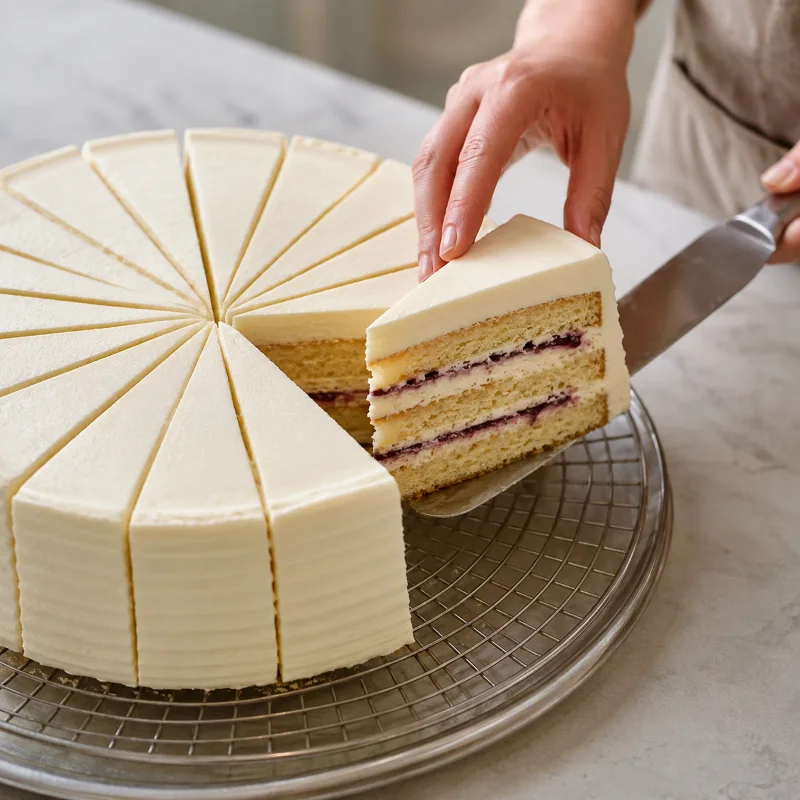
Start with servings, not the pan diameter
First choose the number of servings and how you will cut them. Then scale the batter by the ratio of pan areas if the batter depth stays the same. Calculate filling separately from area and number of filling layers. For round pans, the factor is (new diameter ÷ original diameter)²: changing from 20 to 26 cm gives 1.69. If the depth also changes, compare volumes.
Start with a cake you already know. Its actual serving yield, pan dimensions, layer height and filling usage give you a measurable reference for the next cake.
Define what one serving means
A dense chocolate cake, a light fruit cake and a tall wedding cake need different cutting plans. Wilton illustrates this with roughly 4-inch-high cakes: wedding pieces about 1 × 2 inches and party pieces about 1.5 × 2 inches. These are reference cuts, not a required PEK portion size. Use centimetres or inches consistently; 4 inches is about 10 cm.
Average serving weight = finished cake weight ÷ actual servings. If your decorated 20 cm cake weighs 1800 g and reliably gives 15 slices, your reference is 120 g per serving. Use that measured yield instead of assigning the same gram allowance to every cake.
Scale sponge batter by area at equal depth
For equal layer height, batter quantity follows pan area, not diameter directly.
Round pans, equal depth: factor = (new diameter ÷ original diameter)²
26² ÷ 20² = 676 ÷ 400 = 1.69
300 g flour in the 20 cm recipe becomes approximately 507 g for a 26 cm pan at equal depth.
The π/4 term cancels when comparing round pans. The 20-to-26 cm factor is 1.69, not 1.30. Apply it to ingredients that scale proportionally, checking the recipe's constraints. For other shapes, compare actual base areas rather than diameter or side length alone.
Weigh beaten eggs when the factor produces a fraction of an egg; do not round to whole eggs at the outset.
Convert a round cake pan to a square pan
Include volume when the depth changes
Area ratios apply at approximately equal batter depth. A depth change requires volume scaling.
Changed depth: volume factor = area factor × depth factor
For a 20-to-26 cm change and 20% more batter depth, the starting volume factor is 1.69 × 1.20 = 2.028, approximately 2.03. This gives the total quantity; it does not mean all the batter should go into one deep layer.
Several shallower layers may make heating the centre easier to control. For a major size increase, do not change pan, depth, oven settings and recipe all at once without a trial. Keep as many proven conditions as possible.
Plan 30 or 40 servings without a magic pan size
If the reference cake gives 12 servings and you need 30, the yield factor is 30 ÷ 12 = 2.5. For one round cake at the same height, a 20 cm diameter would become 20 × √2.5 ≈ 31.6 cm. Do not multiply the diameter itself by 2.5.
That larger cake changes handling, chilling, transport and cutting. Two cakes or several tiers may be easier to manage. Calculate each tier separately and plan its support; geometry alone does not establish structural safety.
Calculate quantities for a tiered cake
Calculate filling separately
A 20 cm cake with two filling layers of 250 g uses 500 g in total. Keeping the same number and thickness of layers in a 26 cm cake gives a starting estimate of 500 × 1.69 = 845 g.
Adding another filled join requires another adjustment. Sponge, filling and outer frosting do not necessarily share one factor. Soft fruit fillings and airy creams also depend on temperature and assembly, not just quantity.
Scale cake filling and frosting quantities
Do not scale baking time or temperature by a fixed percentage
A larger pan does not automatically mean lowering the oven by 10 °C or adding 20 minutes. Keep the reference temperature unless the recipe or pan maker specifies otherwise, preserve comparable batter depth and check the centre and edges. A very deep batch may need dividing between pans or a method proven for that cake.
Baking time does not increase linearly with ingredient quantities; check batter depth and the centre for doneness.
Do not apply a universal temperature correction; start with the proven recipe settings unless the specific pan or recipe requires otherwise.
Write down the plan before weighing ingredients
If you cannot write down the following eight details, you have extra ingredients rather than a complete scaling plan. Use the same units for the reference and target pan.
- Target servings and cutting plan.
- Actual serving yield of the reference cake.
- Original pan shape, dimensions and batter depth.
- New pan or combination of pans.
- Area or volume factor.
- Batter quantity for each pan.
- Number of filled joins and filling quantity per layer.
- Baking method and the doneness signs known from the original recipe.
Signs that the scaling plan needs attention
- The larger pan produces a much shallower cake than the reference recipe.
- The centre remains underbaked while the edges are already overbaked.
- Very thick filling layers provide most of the cake height.
- The serving calculation works by weight but not by the actual cutting plan.
The formula to keep handy
Square or rectangular pans, equal depth: factor = new area ÷ original area
Round pans, equal depth: factor = (new diameter ÷ original diameter)²
New quantity = original quantity × (new pan area ÷ original pan area). For round pans at equal depth: new quantity = original quantity × (new diameter ÷ original diameter)². Include the depth factor when depth changes.
Serving yield, pan area and filling quantity are separate calculations. One multiplier for everything can upset the proportions.
Frequently asked questions
Answers to common questions
How much cake should I allow per person?
There is no weight that suits every cake. Use the cutting plan or the actual serving yield of a proven cake. To work in grams, weigh the finished cake and divide by the number of portions you actually cut.
Can I triple a recipe for 10 servings to make 30?
Tripling gives three times the total yield, but does not specify a suitable pan. To keep the same height, compare pan areas or volumes. For a large increase, several pans or tiers may be more practical.
How do I scale a 20 cm cake recipe to a 26 cm pan?
At approximately equal batter depth, use (26 ÷ 20)² = 1.69. Multiply proportional ingredients by that factor. If the batter depth also changes, include the depth ratio or compare volumes.
Should I lower the oven temperature for a larger pan?
Not automatically. Baking depends on the recipe, pan material, batter depth and oven. Start with comparable depth and proven settings; use a tested approach for very large or deep cakes.