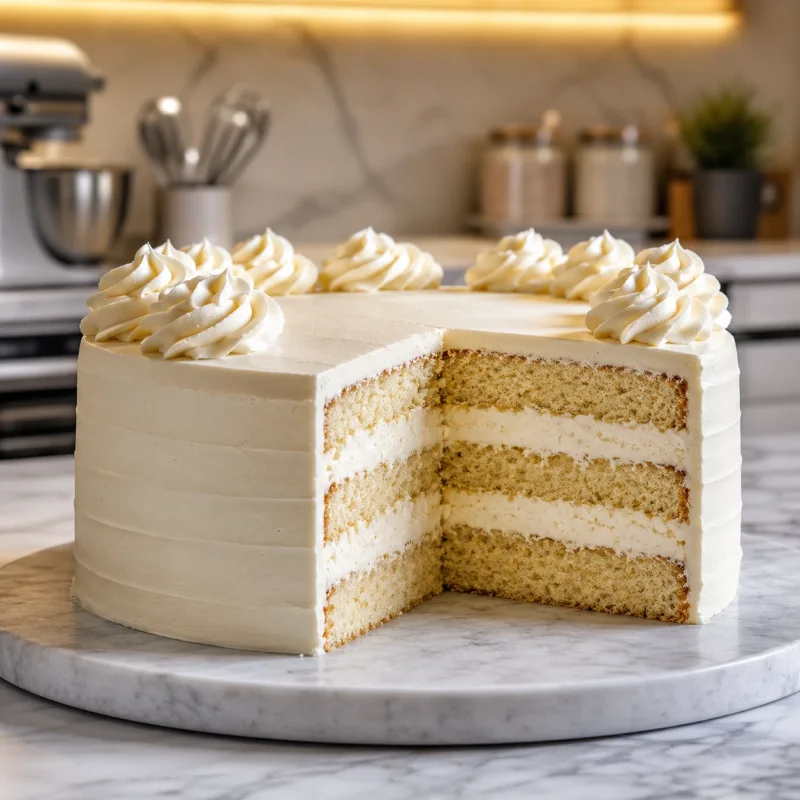
Cake filling without gelatin can be firm enough for a clean slice, but only if you choose a structure that matches the job. Whipped-cream filling, mascarpone cream, ganache, buttercream and a cooked starch cream do not become stable in the same way. Do not automatically fix a soft filling with more sugar, more whipping or extra mascarpone. First decide what the filling actually has to support in the cake.
In a layered cake, success is easy to recognise: the filling stays in an even layer between the cake layers, it does not squeeze out when sliced, the edge of the slice stays straight, and the filling is still pleasant to eat rather than rubbery or unnecessarily heavy.
First decide what the filling has to withstand
“Firm” is too vague. A thin coating does not have the same job as a thick filling between three cake layers, tall piping or a cake that has to travel.
| Use | Better gelatin-free structure | Why it works | Main limitation |
|---|---|---|---|
| Light filling and softer slice | whipped cream or mascarpone-whipped cream | chilled fat structure holds air and mascarpone adds body | sensitive to warmth and overwhipping |
| Firmer chocolate filling or coating | ganache | a stable emulsion and later crystallisation of cocoa butter increase load-bearing capacity | a poor ratio or broken emulsion can make it too soft or greasy |
| Piping, borders and greater mechanical support | buttercream | the fat phase holds its shape well in the right temperature range | too warm becomes soft; too cold becomes stiff and hard to spread |
| Cooked cream or filling that is not foam-based | starch-thickened base | starch thickens the water phase during heating and creates body | the final formula still has to suit the intended use after cooling |
If your main goal is stable whipped cream, use the dedicated guide on how to stabilise whipped cream. This article is deliberately broader: it helps you choose the right type of filling, not only whip cream correctly.
Four fillings can feel equally firm for completely different reasons
Whipped cream: stability is limited by the fat network
As cream is whipped, a structure forms around air bubbles and depends on the state of the milk fat. Cold cream with enough fat reaches useful firmness more easily than warm or lower-fat cream.
Important: more whipping is not the same as more stability. As cream approaches the overwhipped stage, it loses smoothness, becomes grainy and starts moving toward separation of fat and liquid.
If the cream is already finely grainy, do not use it as a structural cake layer simply because it feels “hard”. Check how to rescue overwhipped cream before it turns to butter.
Mascarpone cream: mascarpone adds body but does not correct every fault
Mascarpone is useful when you want a richer dairy filling with more body, but it is not a universal stabiliser. If the base is already too warm, overwhipped or has an unsuitable balance of liquid and solid components, extra mascarpone does not guarantee a good result.
A correctly made mascarpone cream should stay smooth and spreadable. When you draw a spatula through it, the track should remain visible and the edge should not break into small curds.
If the problem is mainly lumps or how the ingredients are combined, use the specific guide to mascarpone frosting without lumps.
Ganache: firmness depends on formulation and emulsion state
Ganache is not simply “chocolate cream”. It is an emulsion in which the chocolate-to-liquid ratio sets the starting thickness, while the way the phases are combined determines whether the mixture stays smooth and free of released oil. Ganache firms further as it cools, so do not judge its final load-bearing capacity immediately after mixing.
For a cake filling, ganache should be firm enough to remain between layers but still plastic enough to spread under a spatula without breaking.
For ratios and troubleshooting, use the guide to smooth, stable chocolate ganache.
Buttercream: firmness depends strongly on temperature
Buttercream is generally better suited to piping and mechanically demanding layers than a very light whipped-cream foam, but “firm” can still be misleading. Buttercream that is too cold may be stiff and difficult to spread; when too warm, it loses defined edges and becomes glossy and soft.
American buttercream and meringue buttercreams do not have the same structure, so do not repair them with one universal rule. For faults, use the guide to fixing split or too-soft buttercream.
Sugar alone is not the answer to a soft filling
A common shortcut is: “If the cream is soft, add more icing sugar.”
That rule is too weak.
Sugar can change viscosity and the amount of freely available water in some formulas, but it does not automatically repair an overwhipped cream structure, an incorrect ganache ratio or overheated buttercream. Adding sugar may simply make the filling too sweet while the real cause remains.
The same applies to chilling. A refrigerator can temporarily firm a fat-based cream, but it cannot turn a poor formulation into a good one. If the filling softens quickly again at serving temperature, the type of cream or the formulation needs correction rather than simply more chilling.
Do three simple tests before filling the cake
1. Spatula test
Draw a spatula through the cream.
A suitable layer filling leaves a clear track that does not close immediately. The surface should remain smooth and uniform. If you see watery streaks, a greasy film or crumbly grains at the edge, it is not ready for cake assembly.
2. Mound test
Place a spoonful of cream on a cold plate or a piece of baking paper.
The mound should keep some height and an edge for a while. If it quickly spreads into a wide puddle, it will be even less stable under the weight of the next cake layer.
3. Load test
Spread a small amount of cream between two cake offcuts and press lightly.
If the filling immediately moves toward the edge, squeezes out in a thick ring or the layers start to slide, it is too soft for that layer thickness and cake weight. This is more useful than judging the cream only in the bowl.
If the filling is too soft, identify the symptom first
| Symptom | More likely problem | First correct decision |
|---|---|---|
| smooth but spreads quickly | structure is too soft for the job or too warm | check the type of filling, temperature and formulation |
| finely grainy and firm | whipped cream is often overwhipped | do not keep whipping; check whether it can still be rescued |
| greasy streaks or released oil | ganache or another emulsion may have separated | correct temperature and emulsion before anything else |
| holds after chilling, then softens quickly | strongly temperature-sensitive or not load-bearing enough | choose a more stable system for the actual serving conditions |
| squeezes out between cake layers | load is greater than the cream can support | reduce the thickness of the soft layer or choose a stronger filling |
| sliced layers lean or slide | the problem is not only the cream; moist filling, uneven cake and assembly can contribute | check the whole cake construction |
For the wider assembly problem, see stable layer cake: stop sliding, bulging and messy slices.
What not to do when the filling will not hold
Do not add mascarpone only because a filling is soft. First check temperature, whipping and the actual formulation.
Do not whip cream “a little more” if it is already firm and is beginning to lose smoothness. Harder is not automatically more stable.
Do not use icing sugar as a universal stabiliser. It can change texture but cannot correct every instability mechanism.
Do not rely on the refrigerator as a permanent fix. The filling has to work at the temperature at which the cake will be cut and served.
Do not use agar as a direct one-for-one replacement for gelatin in every cream. Agar forms a different gel structure and requires a different process. If you actually need a gelling agent without gelatin, use the separate guide to using agar agar instead of gelatin.
When a different filling is a better choice than “stabilising” the current one
For a tall cake, a thick layer, a long journey or a warmer environment, a light whipped-cream filling may simply be the wrong structural choice. It makes little sense to search for a trick that gives a very light foam the load-bearing capacity of ganache or buttercream.
A better approach is:
- define the weight and thickness of the layer;
- define how long the cake has to remain assembled;
- account for temperature during assembly, transport and serving;
- choose a filling whose structure suits those conditions;
- only then adjust the formulation.
If none of the desired fillings without a gelling agent can provide a safe, repeatable structure, a proven gelled formulation may be a better decision than forcing the label “without gelatin”.
Diagnostics
Common problems and solutions
The filling is smooth but spreads quickly.
Cause: The structure is too soft for the job or its temperature is unsuitable.
Solution: Check the filling type and temperature, then run a small load test between two cake offcuts; adjust the formula or choose a more load-bearing filling.
Whipped cream is finely grainy and very firm.
Cause: It may be overwhipped and the foam-fat structure may be starting to break down.
Solution: Do not keep whipping. Check for graininess or separation and use the dedicated overwhipped-cream troubleshooting process.
The filling squeezes toward the edge between cake layers.
Cause: The load exceeds the filling’s support capacity or the layer is too thick for that structure.
Solution: Repeat the load test at the intended layer thickness; reduce the soft layer or choose a stronger filling system.
Frequently asked questions
Answers to common questions
Which gelatin-free cake filling is the firmest?
There is no single universally firmest filling. Ganache and buttercream can provide more mechanical support than very light whipped cream, but they have different flavour, texture and temperature sensitivity. Choose according to the cake’s job.
Does mascarpone always stabilize whipped cream?
No. Mascarpone can add body, but it does not repair overwhipped cream, excessive warmth or a formulation that is too soft for the cake load.
Can I fix a soft filling only by chilling it?
Sometimes, if excess temperature is the main problem. If the formula is structurally too soft or already damaged, chilling only hides the problem temporarily.
Does icing sugar stabilize cake filling?
It can change the texture of a specific formula, but it is not a universal stabilizer and does not repair overwhipped cream, split ganache or overheated buttercream.
When should I choose another filling instead of insisting on no gelatin?
When the cake must carry more weight, travel longer or face conditions in which a light cream loses structure. A stronger filling system or a proven formulation is then the better choice.